

Ang Bayan Special Report (2022-2025) Intensified us military intervention, worsened subservience of the Marcos regime
Download: PDF (Colored) | PDF (Black & White)
Introduction
In early 2024, the imperialist US described its military relations with the Philippines as being “in hyperdrive.” US military bases proliferated, the presence of American troops multiplied, and new political, economic, and military agreements formed between the US and the Philippines. All of these complied with Donald Trump’s “deterrence strategy” and the Joseph Biden regime’s Indo-Pacific Strategic Plan. This continues the “pivot to Asia” strategy which the Barack Obama regime declared since 2009. This strategy aimed to block China’s expanding power in Asia and to impose US hegemony or its imperialist domination in the region.
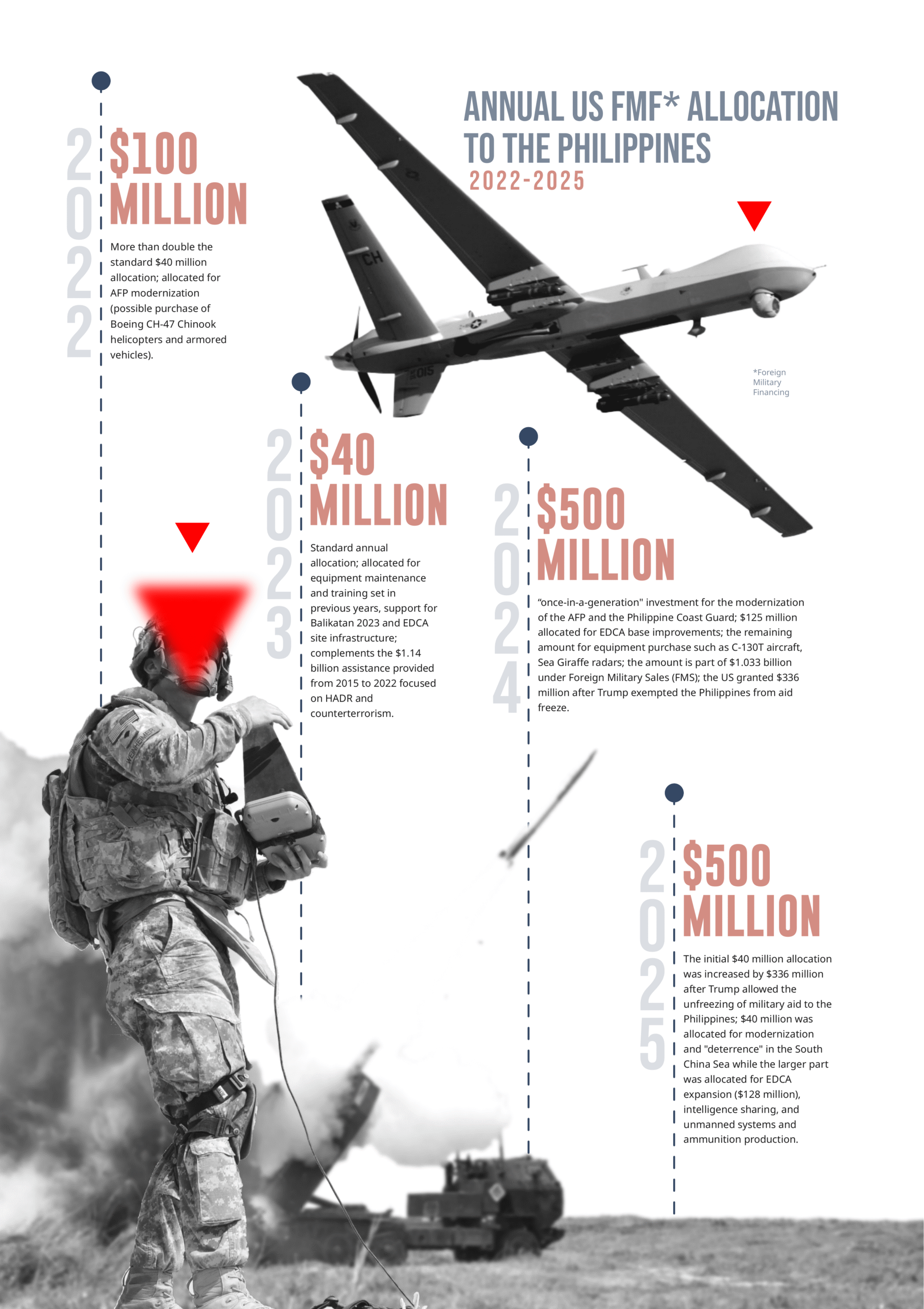
“Hyperdrive” also describes how Marcos and the Armed Forces of the Philippines (AFP) are scrambling to follow US dictates and perform the puppet role assigned by the mentioned strategic plan. The US rewards Marcos’ servility with political and military support. Between 2022 and 2024, Marcos received $1.14 billion (₱64.98 billion) under the US Foreign Military Financing program, in addition to $332.3 million (₱18.94 billion) in other military aid. This military aid was the largest in all of Asia. Since Marcos took office, top US government and military officials visited the Philippines at least 14 times, starting with then–US vice president Kamala Harris in 2022. Secretaries and officials from the departments of state, defense, and commerce of the Biden regime visited in succession. When Donald Trump returned to power in the US in 2025, the Philippines became the first country in Asia visited by his defense secretary Pete Hegseth.
The White House summoned Marcos five times to sign agreements and “roadmaps” for military relations between the two countries. In 2023, Marcos signed the Bilateral Defense Guidelines which expanded the scope and objectives of the Mutual Defense Treaty and laid the ground for further lopsided military agreements. These agreements opened military bases for US troops and for storing materiél and fuel for US military war vehicles.
Comprehensive Archipelagic Defense Concept
In 2024, the AFP declared that it would carry out a “strategic shift” in the Philippine security plan. It called this the “Comprehensive Archipelagic Defense Concept” or CADC. The AFP said the CADC aims to “guarantee Filipino corporations, and foreign entities authorized by the Philippines, the peaceful conduct of exploration and exploitation of all natural resources within the exclusive economic zone and other areas under Philippine jurisdiction.”
CADC has nothing to do with defending the Philippines’ economic interests. It is a mere copy of the the US military document “Archipelagic Defense Strategy,” which contains operation concepts in the “Western Pacific Theater of Operations.” This emphasized the so-called “First Island Chain” of countries nearest China, which includes the Philippines.
The AFP’s CADC implements the US concept of “anti-access/area denial” to deprive the “enemy” (China) of operational area and to deprive it of the capacity to launch “aggression” in the region. Under this plan, the US lays out a network of overt and covert bases and facilities to establish a system of radars, troop stations, missile launch pads, and storage for weapons, including nuclear arms, various equipment, fuel, and many other goods for war.
To ensure the smooth flow of US command, the AFP will establish the “Strategic Defense Command” this year. This command transforms the AFP’s current Education, Training, and Doctrine Command, which has long served as proponent of US military doctrine.
AFP “Modernization”
The AFP modernization is being implemented under the framework of the Archipelagic Defense strategy. The AFP supposedly aims to effectively fight China. To this end, the US promised the AFP $2 trillion to buy US-made weapons, vehicles, and other materiél. The AFP signed many of these contracts during the Duterte regime.
Using the Security Sector Assistance Roadmap, the US dictated the types and quantities of arms it will hand over to the Philippines in the next 5 to 10 years. Most are outdated equipment, such as US F-16 jet fighters, large ships, and radars from Japan, and other “big ticket” or major weapons included in the AFP’s ReHorizoned 3 program.
Despite its promises, the US has no intention to strengthen the AFP as an independent national defense military force. The US actually aims to keep the AFP and other Asian allies dependent and weak. The US only sells limited and weak weapons to the AFP. It does not allow the AFP to handle powerful weapons like HIMARS, NMESIS, and Typhon Missile Systems, which it prepositioned in and around the Philippines. The AFP merely houses and secures these weapons.
Military base construction
The US wants the Philippines to believe that building its military bases and facilities serves AFP’s “modernization.” In line with this, the US obliges the Philippines to shoulder the costs of constructing or repairing military and civilian infrastructures in camps and locations the US chooses under EDCA.
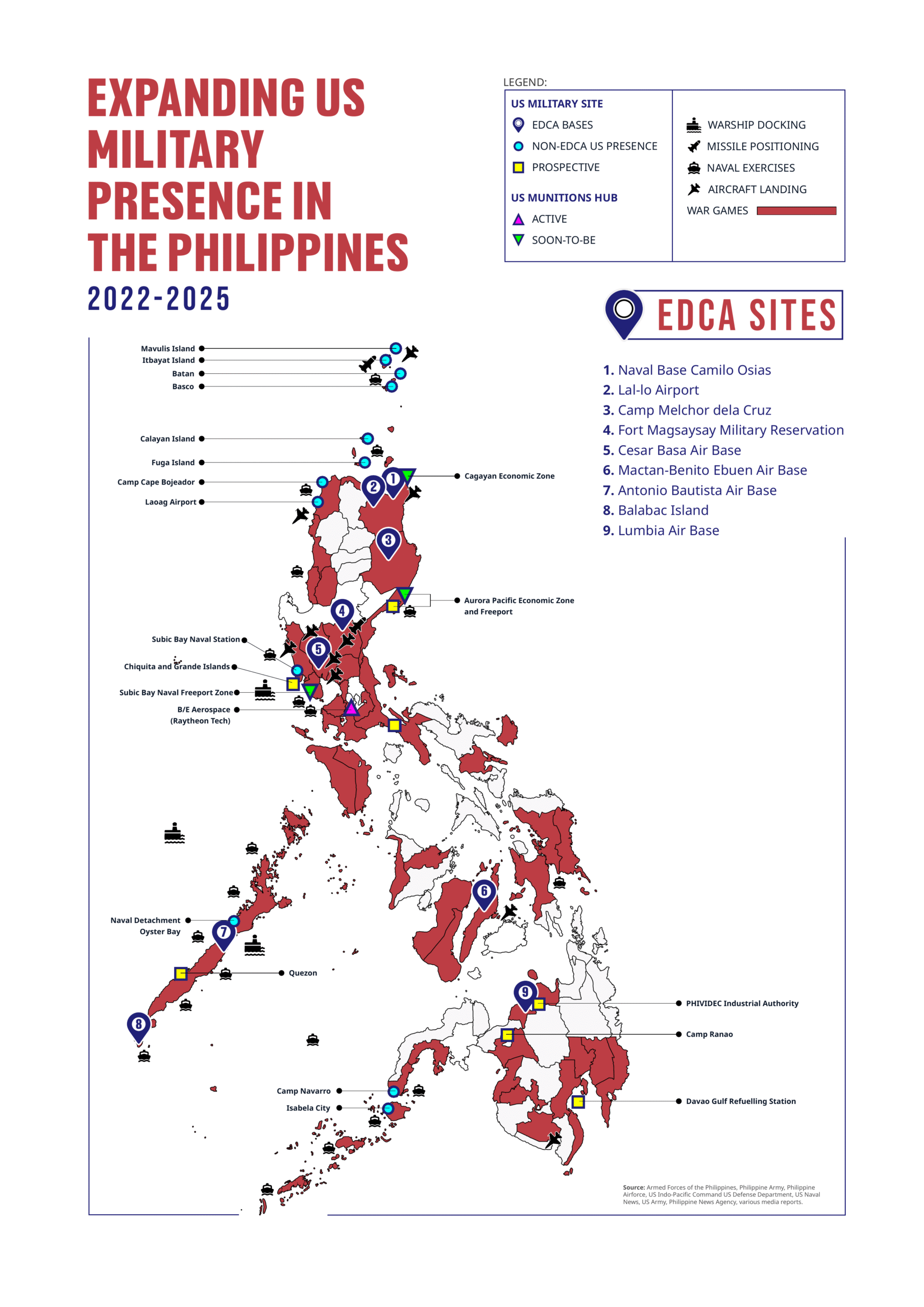
In February 2023, Marcos formally increased the previous five “agreed locations” for US military bases by four. The AFP chief followed this up by stating that the US intends to open another 10 to 15 locations for its troops and materiél. The US aims to complete repairing these locations by 2026.
Besides the nine official EDCA sites in Cagayan (Lal-lo, Sta. Ana), Isabela, Pampanga, Nueva Ecija, Palawan (Puerto Princesa, Balabac Island), Cebu, and Cagayan de Oro, the US reportedly uses at least eight more other locations. These are in the form of camps, storage facilities, repair stations, ports, and forward operating bases in Batanes (Mavulis), Aurora (Casiguran), Ilocos Norte (Burgos), and Zambales (Subic and Subic Bay). The US expanded its presence in Cagayan (Calayan and Fuga islands) and Palawan (Ulugan Bay and the Quezon coast). All these extend beyond the designated EDCA sites. In 2026, the US plans to build a refueling depot or fuel storage in Davao Gulf, spanning Davao City’s coastline to Malalag Bay.
The US also announced its plan to construct an ammunition factory in Subic Bay Freeport and a drone factory in Aurora Pacific Economic Zone and Freeport. The US identified other military companies that it plans to bring into the country under the Joint Vision Statement on US-Philippine Defense Industrial Cooperation, signed by Marcos in March 2025.
Large and integrated war games
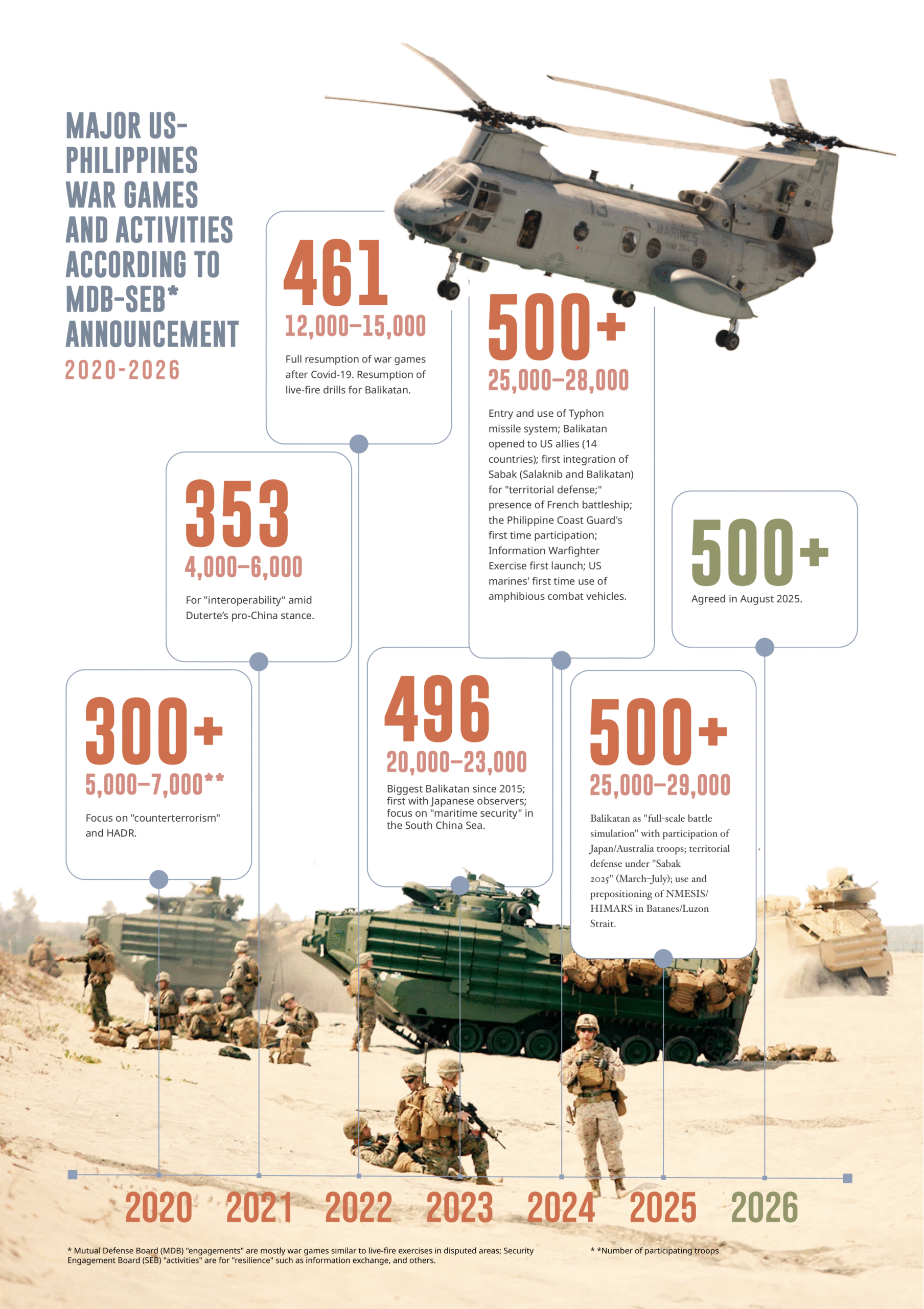
The US continues to hold overlapping and successive war games and military activities in the Philippines and countries around China. This increases their need for additional bases and military facilities in the Philippines to station US troops and store US equipment. The Mutual Defense Board-Security Engagement Board’s planned US military “engagements” rose from 300 in 2020 to over 500 annually from 2024 to 2026. Around 70% to 80% of these are joint exercises, patrols, and other activities, while 10% to 20% are large-scale war games involving thousands of troops.
In the three largest war games—Balikatan, Salaknib, and Kamandag—participating troops rose from 5,000 to 7,000 in 2020 to 12,000 to 15,000 in 2022 and 25,000 to 29,000 in 2025. The scale and scope of these war games, such as the combined Salaknib and Balikatan (SaBak), extended and expanded from March to June 2025.
Under Marcos, the US further enlarged and raised the level of its war games. It prepositioned advanced equipment like HIMARS missile systems in 2024 and Typhon and NMESIS in 2024 to 2025. The US also expanded the participation of its allied countries in the Asia-Pacific (Japan and Australia) and NATO (France, Canada, UK, Germany).
Control of the seas
In September 2022, the US announced forming Task Force 76/3, a unit from its naval forces in the Indo-Pacific Command permanently stationed in the South China Sea. This task force aims to tighten US control over naval facilities, bases, and forces in South, East, and Southeast Asian countries under the guise of “integration” and “interoperability.”
This is a new mechanism of the Pentagon’s Pacific Deterrence Initiative started by the Biden regime, with an allocated budget of $5.1 billion. This program aims to establish facilities in countries along the “first island chain” to get close and surround China permanently with land-based long-range missiles.
Balikatan 2025 formally began operating the Littoral Rotational Force (LRF)-Luzon, a unit under the US 3rd Expeditionary Marine Force and part of Task Force 76/3. LRF-Luzon focuses operations on the Bashi Channel, a strait between Taiwan’s southern Lesser Orchid Island and the Philippines’ northernmost Mavulis Island in Batanes. The US calls this strait its submarine operations “choke point” and considers it crucial for US naval ships to enter the South China Sea. Important telecommunications cables extending to all of South Asia lie beneath this sea. The US now appropriates Mavulis as a “training ground” for its special military forces.
The US formed Task Force-Ayungin in 2024 to provoke maritime skirmishes between China and the Philippines in the West Philippine Sea. At the behest of the US, the AFP expanded military facilities at Ulugan (Oyster) Bay to serve as a port and repair station for large US vessels. This site also serves as a launching pad for the continuous sailing of US naval vessels in the South China Sea to provoke armed confrontations with China. TF-Ayungin’s US troops are based in the AFP Western Command in Puerto Princesa, Palawan.
Overlapping agreements and military cooperation
US intervention in the country accelerated ever since Marcos took power. Even before Marcos took his oath, the US Indo-Pacific Command and AFP signed the Maritime Security Framework in May 2022. Only a few months into his term, then-US vice president Kamala Harris visited to push for opening more US military bases and facilities under EDCA.
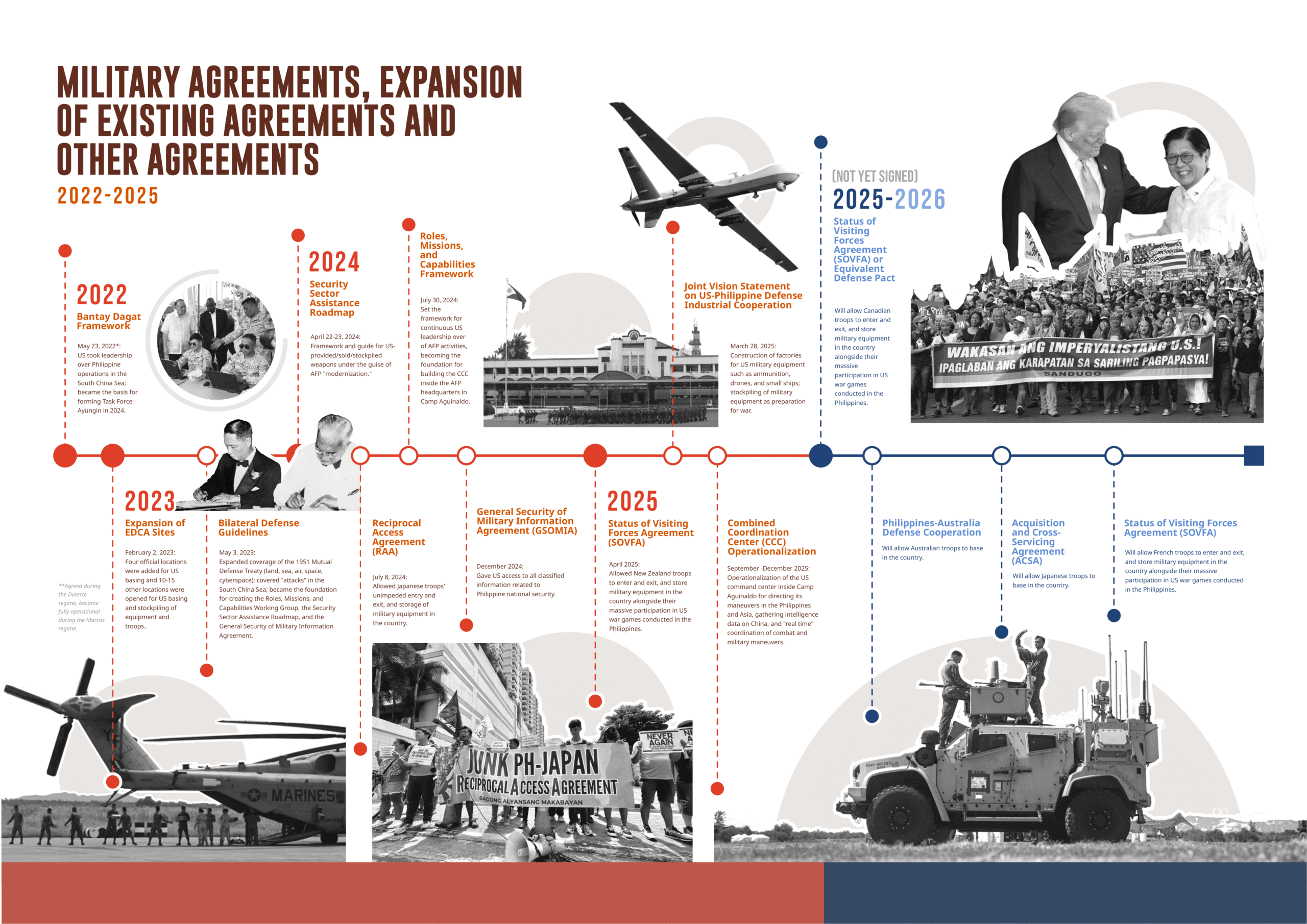
The following year, Marcos traveled to the US to sign the Bilateral Defense Guidelines, one of the most comprehensive defense agreements between the US and the Philippines. This ratified and amended the 1951 Mutual Defense Treaty without Senate consent. It covered various forms of warfare, including cybersecurity, as well as alleged “attacks” in the South China Sea in designated US “gray-zone areas.” This became the foundation for forming the Roles, Missions, and Capabilities Working Group and other agreements like the Security Sector Assistance Roadmap, General Security of Military Information Agreement, and Joint Vision Statement on US-Philippine Defense Industrial Cooperation.
Compelled by the US, Marcos in 2025 progressively opened the Philippines to foreign troops. He ratified the Reciprocal Access Agreement with Japan, allowing Japanese troops unchecked entry and exit. He signed a Status of Visiting Forces Agreement with New Zealand granting their troops extraterritorial rights. He plans to sign similar agreements with Canada and France. These also include agreements for Japanese and Australian troop and equipment basing through agreements like EDCA.
Luzon Economic Corridor
Unlike countries promoting economic sovereignty, the Marcos puppet government is rushing to subject the Philippines not only to military programs, but even to economic, and political ones. It aligns with the regime’s “wide open door” policy to foreign plunderers of the local economy, in exchange for minor investments and a small market shares for the American market.
In 2022, the US established an office for the US Trade and Development Agency (USTDA) in Metro Manila to strengthen its control of policies and economic projects in the Asia-Pacific. This agency will facilitate American companies’ control of newly opened sectors like public utilities, telecommunications, infrastructure and energy projects, and mining and commercial plantation expansions. Also signed that year was the 123 Agreement, opening the door for nuclear power plants in the country.
Marcos just recently co-signed with the USTDA an agreement for preliminary research and studies on the Subic-Clark-Manila-Batangas (SCMB) Railway project. The SCMB Railway and connected bridges and roads will link large US military “EDCA sites” or bases in Luzon, easing the transfer of weapons, personnel, and military vehicles between them. The project is part of the Luzon Economic Corridor (LEC), a trilateral program between the US, Philippines, and Japan aimed at accelerating the dumping of imperialist capital, personnel, and equipment through infrastructure projects in renewable energy, ports, airports, bridges, and roads.
Devastation and ruin to the people
Whenever the US military launches war games in the Philippines, tens of thousands of fisherfolk face sailing bans, depriving them of livelihood. In 2024 and 2025, the US and AFP imposed a no sail policy in Zambales, Ilocos Norte, and Palawan provinces to make way for live-fire exercises using missile launchers such as HIMARS along the coastline. Fisherfolk and farmers in Aurora were also barred from sailing and working during US warships docking exercises there. In Aparri, Cagayan, fisherfolk faced sailing bans in May 2025 to give way to US military exercises called Counter Landing Live Fire. This disrupted 15,000 registered fisherfolk in the area.
Multilateral maritime cooperative activities carried out by the US with Japan, Canada, and Australia devastate and endanger municipal waters serving as fishing ground for small fisherfolk. These war games included nautical missile firings and ship sinking, which damage fishing grounds and marine ecosystems.
All-night drone and aircraft flights, as well as war games with artillery firing near homes bring deafening noise and anxiety to civilian communities.
Anti-imperialist opposition and resistance
People are aware that US expansion of military presence and accelarating intervention in the Philippines serves its strategic goal of pushing back rival imperialist China’s influence and maintaining hegemony in Asia.
Affected residents in Ilocos, Zambales, and Cagayan expose and oppose the harm caused by American troopss in their areas. Their calls clearly reject US and allied military presence and activity.
Protests confront visits by high US officials, openings of Balikatan war games, and even Marcos’ US trips. National democratic groups express their opposition to military intervention before the US embassy, Malacañang, and AFP headquarters. They condemn the US’s wanton trampling on Philippine sovereignty and dragging the country into imperialist wars that for certain will extensively devastate the Filipino people and nation. Filipinos also join Japan and South Korea peoples launching their own national anti-imperialist movements.
In the US itself, migrant Filipinos actively oppose war games—not only in the Philippines but across Asia-Pacific—that endanger many people in various countries and territories. They demand the US government to stop funding and providing military aid to the fascist AFP.