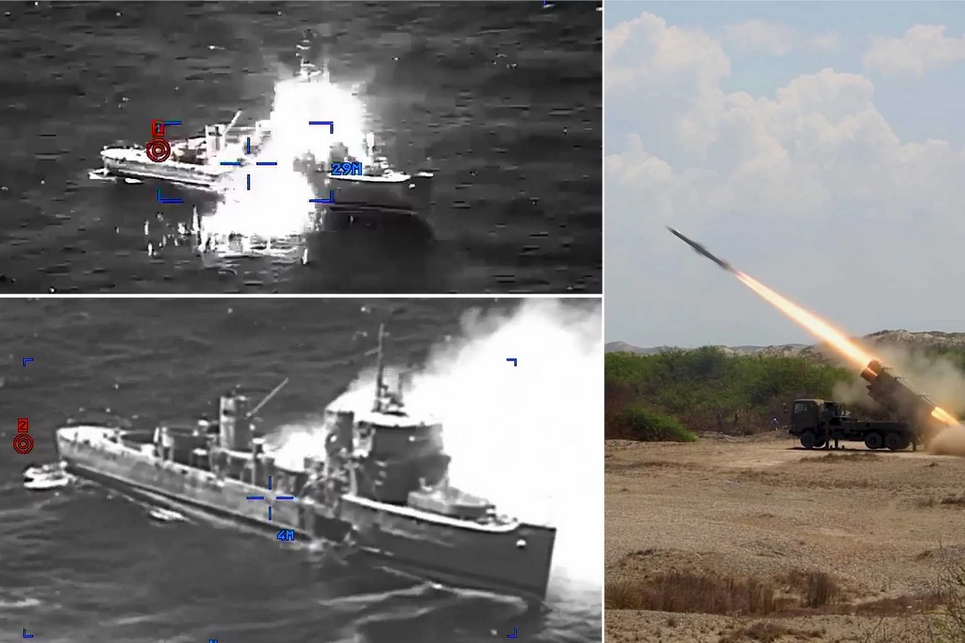
Japan and US launch missiles, use Philippines as a war playground
Bagong Alyansang Makabayan (New Patriotic Alliance) condemned Japan and the US for firing deadly missiles under the guise of “training” on May 5 and 6, turning the Philippines into a “firing range.
“Allowing live-fire missile exercises on our land and seas violates national sovereignty,” Bayan stated. “This endangers civilians, especially communities near facilities and sites used in Balikatan.”
The group called the missile explosions a “grave escalation”.
“It further normalizes the use of Philippine territory as a testing ground and showcase arena for foreign military capabilities,” the group said. “It also deepens our entanglement in intensifying geopolitical and military rivalries, where the Filipino people stand to lose the most in lives, livelihoods, and national security.”
Return of the brutal invader
For the first time since Japanese troops were driven out of the Philippines in 1945, they again set foot in the country to conduct offensive operations. Japanese troops launched two Type 88 surface-to-ship missiles on May 6. Japan considers this the first time it launched “offensive missiles” in another country since World War II. The missiles fired from the sand dunes of Culili Point (Paoay Sand Dunes) in northwestern Luzon struck and blew up the old Philippine Navy ship BRP Quezon, 75 kilometers from the coast.
The launch is part of Balikatan 2026 war games joined by a total of 17,000 troops from seven countries, including around 1,400 Japan Self-Defense Forces (SDF) personnel, Japan’s largest troop deployment abroad since 1945. The traitor Marcos regime allowed the presence of Japanese forces under the Reciprocal Access Agreement (RAA) framework ratified in 2025.
Japan sent troops and military equipment to the Philippines under its war-mongering prime minister Sanae Takaichi. Under her leadership, Japan’s ruling class is rapidly dismantling post-World War II limits on Japan’s military power. Takaichi’s government measures include lifting bans on exporting lethal weapons and removing the 1% GDP cap on defense spending.
Resistance to Japanese militarism
Takaichi’s push to “normalize” militarist Japan draws fierce condemnation and resistance.
Her government faces massive protests inside Japan over changes her cabinet made on rules on exporting offensive weapons. These changes violate peace provisions enshrined in their constitution. Many also view its troops’ participation in an offensive war game like Balikatan as provocation, disrupting order in the Asia-Pacific.
In the Philippines, Filipinos have long condemned the traitor Marcos regime and puppet AFP for allowing Japanese troops into the country, despite their brutal occupation in the last century.
“We call on the Marcos government revoke any consent it has granted that enables foreign forces to conduct live-fire missile launches and similar offensive drills in the country,” Bayan said.
Filipino and Japanese people alike know that Japan’s militarization and its actions aligning with the US framework of imperialist war in Asia are wagers that will drag the Philippines into the clash of big powers. While Japan claims its measures defend a “rules-based order,” Japan clearly uses the Philippines as a “launchpad to show off its weapons” to sell off old equipment. This includes the outdated Abukuma-class destroyer it plans to “sell” to the Philippines.