
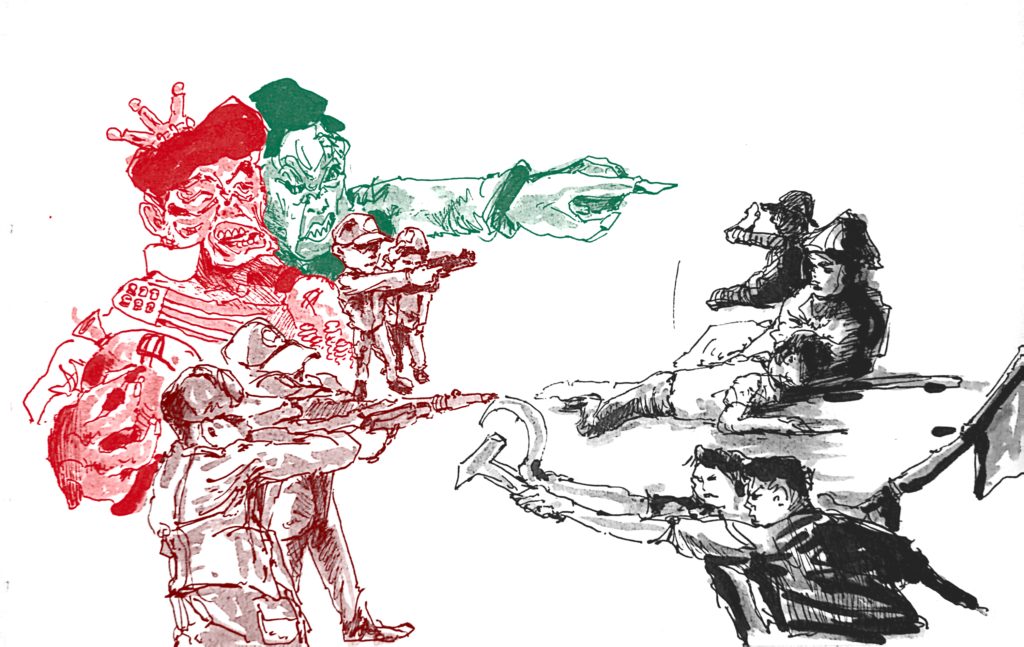
Ang Bayan Human Rights Report (December 1, 2024-December 1, 2025) US-Marcos regime perpetuates fascist repression against the people
Introduction
The Marcos regime continues to inflict relentless suffering and repression against the Filipino people over the past year. While busy plundering public funds, it also intensified suppressing mass struggles and terrorizing the people.
When people’s anti-corruption protests erupted beginning in September, the Marcos regime unleashed a campaign of repression to harass the protesters in an attempt to quell their resistance. It systematically used state fascist machinery to enforce repressive policies and actions.
Bloodshed and human rights violations continue to rise in the name of counterinsurgency. The regime is in a frenzy in its campaign to destroy the Filipino people’s patriotic and democratic aspirations and struggles and to end their revolutionary resistance. It serves the interests of foreign monopoly capitalists, big comprador bourgeoisie, landlords, and bureaucrat capitalists.
To illustrate the severity and extent of this cruelty and to echo the people’s clamor for justice, Ang Bayan (AB) releases this report on Marcos’s armed agents’ rampant human rights abuses and violations over the past year (December 2024 to December 1 of this year). The fascist elements of the Armed Forces of the Philippines (AFP), Philippine National Police (PNP), paramilitaries, and other armed agents of the reactionary state perpetrate these abuses.
This report is based on information reported, compiled, and analyzed by AB.
Intensified repression make sending reports difficult, thus many cases in rural areas remain undocumented. AB used international standards in estimating the number of victims of evacuation and militarization, as well as the number of victimized children.
This current report does not include the many human rights violations against the Moro people that often remain publicly inaccessible. It also excludes extrajudicial killings under the bogus drug war that the Marcos regime perpetuates. Over the past year, The Dahas Project reported no fewer than 264 victims of this fake war.
Policy of repression
The Marcos regime mainly implements this year the policy of the National Action Plan for Unity, Peace, and Development (NAP-UPD) 2025-2028. This became the framework for intensified political repression against the Filipino people. The regime began preparing this new-but-old policy as early as the previous year.
The Office of the President issued Memorandum Circular No. 83, series of 2025 which officially approved the NAP-UPD. The memorandum directed all government agencies to implement the plan as part of the “whole-of-nation” and “whole-of-society” approach to “resolving the problems bred by the revolutionary movement.” The NAP-UPD is based on the National Security Policy 2023-2028 and the Philippine Development Plan 2023-2028.
It is called a “strategic blueprint” to eradicate the Communist Party of the Philippines, the New People’s Army, and the National Democratic Front by 2028. The Duterte regime created The National Task Force-Elcac seven years ago to primarily implement this new policy.
Following this policy, the AFP and PNP aggressively carry out an all-out dirty war against the Filipino people in both urban and rural areas. The state continues its intense fascist terrorism, subservience to US imperialism, and suppression of patriotic and democratic forces.
In enforcing the NAP-UPD, Marcos continues to use the five-year-old Anti-Terrorism Law and the Terrorism Financing Prevention and Suppression Act to persecute and silence critics, dissenters, and ordinary citizens. The regime targets what it labels “legal fronts of the CPP-NPA-NDFP” supposedly to “stop recruitment, cut off financial support, and thwart propaganda.” This rampant repression tramples on the sectors’ right to organize.
Despite repeated claims of the US, AFP and Marcos about the “shift” of the country’s armed forces from “internal defense” to “external defense” purportedly because the NPA is allegedly “weakened” or “defeated,” most AFP troops remain in the countryside and guerrilla fronts. The regime makes the repeated lie that no active guerrilla fronts exists, yet thousands of soldiers, police, and paramilitary forces continue to be mobilized in counterinsurgency campaigns.
Rural communities remain militarized and occupied focused military operations (FMO), often in the form of martial-law-style control of villages under the Retooled Community Support Program (RCSP). These operations mainly use military violence and repression targeting unarmed civilian peasants. These are accompanied by aerial bombings, strafing, and shelling of farms and mountains, endangering civilians and destroying the environment.
Fascist military terrorism grows more intense where large mining operations, plantations, ecotourism projects, and other exploitative ventures on the environment and communities also follow. The military operations serve to ensure that the areas are “safe” for war games the US conducts with its allied countries such as Japan, Australia, and Canada, along with the US puppet AFP.
The NTF-Elcac relentlessly enforces “balik-loob” (realignment with the state), “localized peace talks,” and schemes that use fake amnesty programs in the countryside. These complement campaigns of intimidation, forced “surrender” of civilians, and plunder of public funds. The Marcos regime funded in April the formation of a “former rebel” organization that it weaponizes against the Filipino people. These traitors now operate across the country to deceive communities. They infiltrate universities and schools to spread terror and fascist mindset.
As in the past three years of his rule, the Marcos regime continues to flagrantly violate the rules of war by willfully killing wounded fighters, extrajudicially killing civilians in fake encounters, and afflicting entire communities alongside AFP combat operations.
Human rights violations
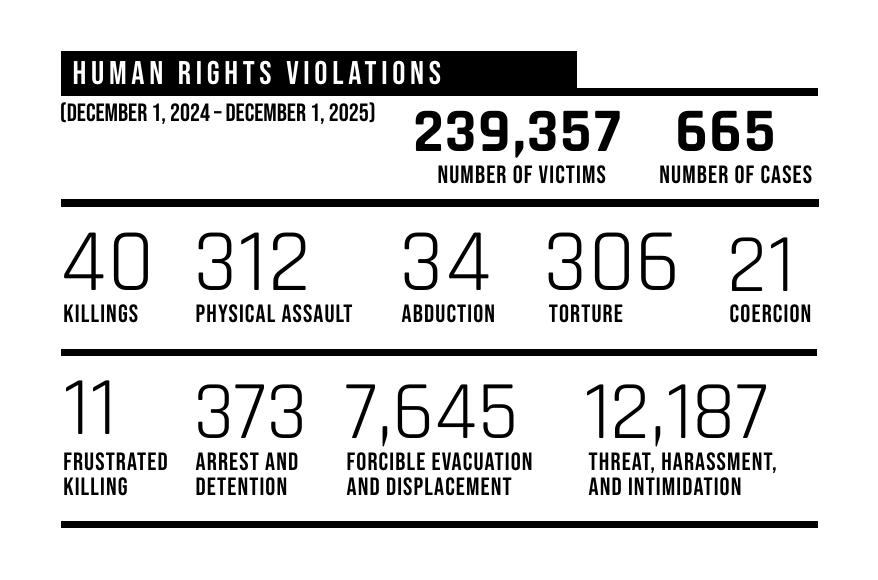
Ang Bayan’s records indicate that there are 239,357 victims of human rights violations by the US-Marcos regime from December 1, 2024 to December 1 of this year. AB recorded 665 cases of violations nationwide.
An average of no fewer than three people fall victim to political killings each month. Two people fall victim to abduction and 25 to torture every month. Over the past year, 11 people fell victim to frustrated killing of state forces.
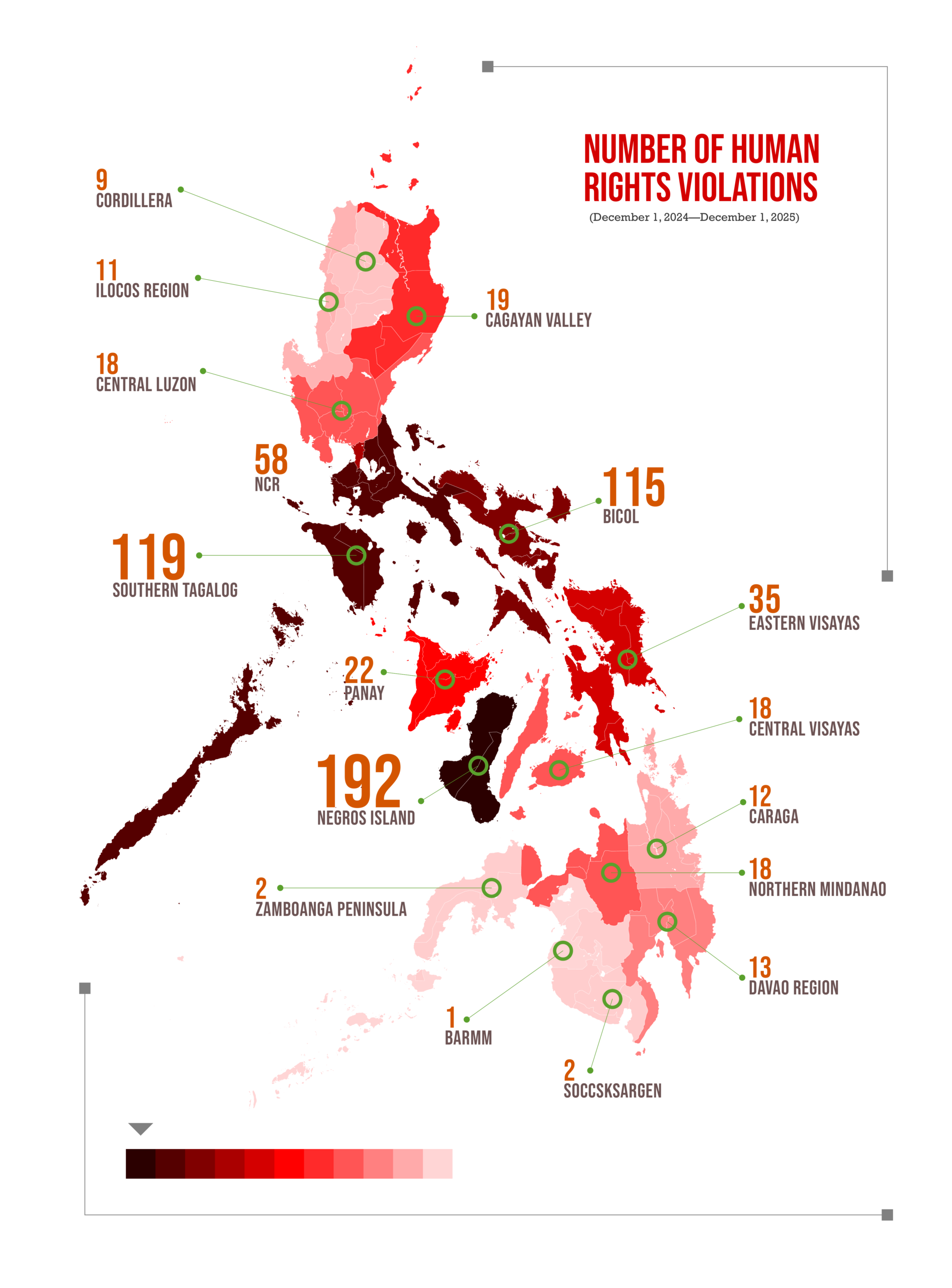
As in previous reports, most of the victims came from the ranks of peasants (211,447) and urban poor (25,988). The victims included children (94,597). The highest number of human rights violations occurred in Negros Island (192), followed by Southern Tagalog (119) and Bicol (115). By province, Negros Occidental ranked first (132), followed by Masbate (94) and Negros Oriental (60).
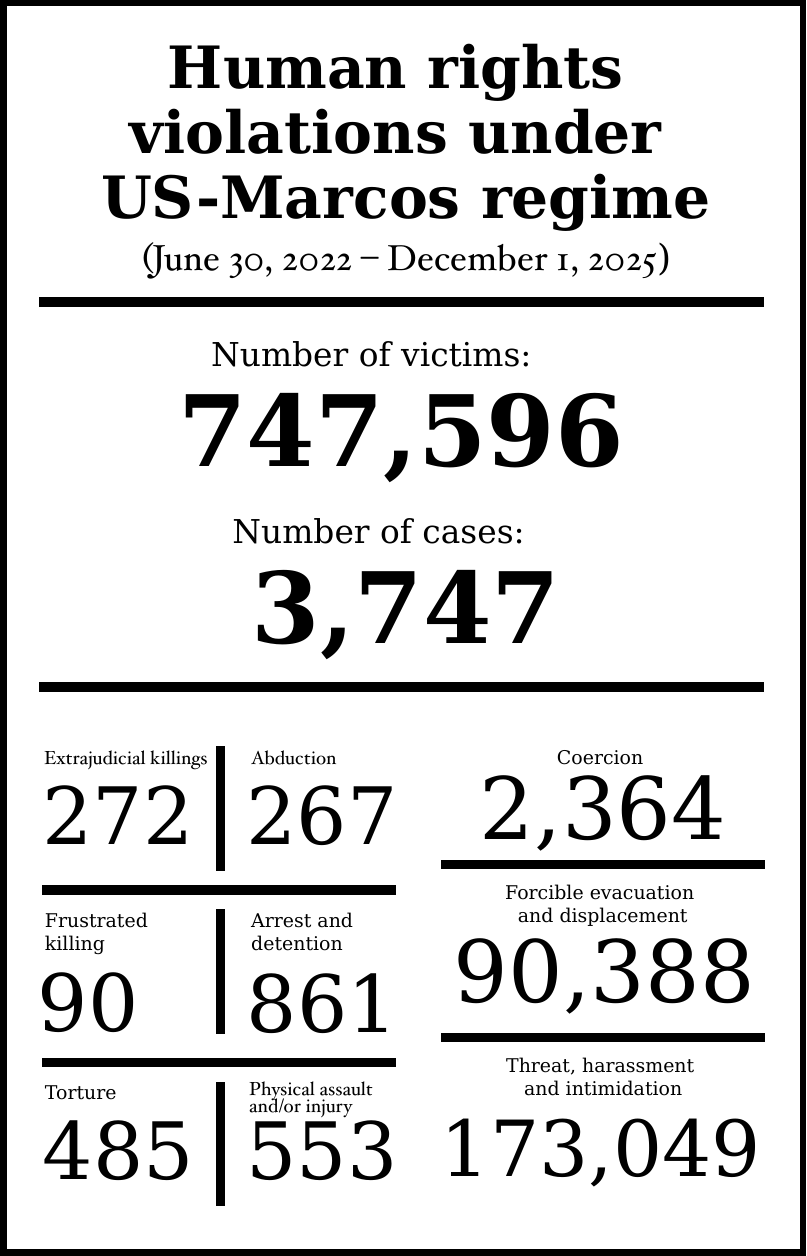
During the Marcos regime’s more than three years in power, AB recorded a total of 3,748 cases involving no fewer than 747,598 victims. Based on this number, an average of 581 people suffer human rights violations every day under the past three years of the Marcos regime.
Killings, frustrated killings, and torture
No fewer than 40 people were victims of political killings nationwide this year. Most of the cases were perpetrated at the height of FMO and RCSP operations conducted by soldiers and police in peasant and indigenous communities. Killings were recorded in Manila, Occidental and Oriental Mindoro, Masbate, Northern and Eastern Samar, Samar, Leyte, Capiz, Iloilo, Negros Occidental and Oriental, Misamis Oriental, Agusan del Sur, Surigao del Sur, Davao Oriental, and Sarangani.
As before, the AFP claimed that many of the victims died in “encounters.” To make it appear that they were killed in battle, the remains were dressed up by soldiers, planted with firearms, ammunition, and other military items, covered with mud and positioned in random locations. The AFP publicly issued fabricated reports despite strong refutations from the victims’ families, neighbors, and even local village officials.
The victims include 13 hors de combat (wounded or ill combatants incapable of fighting), as well as non-combatants or retired revolutionaries. Butchers of the AFP arrested and deliberately killed them instead of declaring them prisoners of war or charging them in court. The bodies also showed marks of torture.
Massacres. Four cases of massacre were carried out during the period covered by the report: an entire family was killed in one incident, another involved three peasants, and two involved the massacre of hors de combat.
In Agusan del Sur, 26th IB soldiers mercilessly massacred the Gomansil family along the Dayuman River, Barangay San Vicente (Balagnan), Esperanza on December 15, 2024. The butchers killed the couple Toto and Toni Gomansil and their daughter Celine. They accused the family of having links with the NPA and the revolutionary movement in the province.
Prior to the crime, the Gomansil family even asked soldiers stationed at a nearby detachment for permission to work on their farm. Despite the notification, the soldiers followed and tied up Toto and Toni. They were subjected to intense interrogation and repeatedly asked about the presence of the NPA in their community, which the couple denied. Soldiers also demanded information about Celine’s husband, whom they accused of being an NPA fighter.
The soldiers then stabbed the couple to death. Celine tried to flee after witnessing her parents’ murder, but the soldiers swiftly shot her. They even desecrated and mutilated her body.
In Northern Samar, 8th ID soldiers shot and killed three peasants in Barangay Nagoocan, Catubig on June 8. The military falsely claimed that the three were among five people killed in a clash between troopers and the NPA. The victims were identified as Noel Lebico Sr, Arnel Aquino, and Nonoy Norcio.
Lebico was a resident of Barangay Roxas in Catubig, Aquino was from Barangay Osmeña in Palapag, and Norcio lived in Barangay Luneta, Gamay. Their villages and towns have been under de facto martial law since 2020. The victims had already been experiencing harassment and military abuses before the incident.
The three had refused to join the 8th ID’s forced surrender program.
Killing of minors. Over the past year, minors also suffered the military’s brutality. Three cases of child killings were recorded in this period. These heinous crimes by state forces occurred in Masbate, Eastern Samar, and Negros Occidental.
In Masbate, AFP soldiers stationed in Barangay Paguihaman, Uson, Masbate shot and killed two teenage boys on their way home from a Christmas party in the early morning of December 27, 2024. The victims were 18-year-old Redjan Montealegre of Barangay Mongahay and 14-year-old JP Osabel of Barangay Mabini. Both were shot in the head.
In Eastern Samar, the 63rd IB killed 16-year-old Jayson Grafil Padullo in indiscriminate gunfire on June 15 in Sitio Bagong Barrio, Barangay Pinanag-an, Borongan City. The military claimed Padullo was a Red fighter. His neighbors in Barangay Benowangan strongly denied this, saying he was a civilian who had just enrolled in Grade 7 and was about to start classes that June.
In Negros Occidental, 62nd IB soldiers’ indiscriminate fire killed the Gelacio family’s 6-year-old boy in Sitio Inangaw, Barangay Quintin Remo, Moises Padilla on October 28. The soldiers went berserk and sprayed bullets in the middle of the community after encountering an NPA unit.
Killing of indigenous people. Over the past year, two cases of extrajudicial killings of indigenous people were recorded.
In Surigao del Sur, personnel from the 3rd Special Forces Battalion (SFB)’s 9th Special Forces Company killed 25-year-old Lumad-Manobo Eliotero Ugking on June 6 at Kilometer 9, Barangay Diatagon, Lianga.
His family stated that Ugking had come from Sitio Neptune after hauling falcatta wood. He was walking home around 4 a.m. on June 6 near Kilometer 9, where the 3rd SFB troops were encamped. That morning, residents heard gunfire. When they checked, they found Ugking’s naked body propped against a rock near the gate of the military camp. The soldiers themselves reported that the victim had died.
Upon examination, the family discovered signs of torture. His body bore numerous wounds, burns on his back likely caused by boiling water, bullet wounds on his leg and left thigh, head injuries, and neck wounds indicating strangulation. Residents were certain that soldiers committed the crime. However, the troops forced a CAFGU element to admit guilt. The soldiers turned over the CAFGU member they implicated in the killing.
In Oriental Mindoro, fascists killed Hanunuo Mangyan Hulyo Aytag on March 14. Soldiers captured him during operations and held him in the camp for several days before killing him. They claimed that an encounter occured between the NPA and the 4th IB in Sitio Cabuyao, Barangay Panaytayan, Mansalay to cover up the murder.
Willful killing of hors de combat. The AFP and the Marcos regime blatantly violated the rules of war. Willful killings of hors de combat were recorded in the provinces of Oriental Mindoro, Negros Oriental and Occidental, Iloilo, and Leyte.
In Iloilo, the military and police willfuly killed Roberto Moises Cabales (Ka William) and Mateo Suarez (Ka Badong) on the night of October 5 in Barangay Coto, Lambunao. State forces claimed that the two resisted arrest while being served a warrant.
Soldiers and police aboard more than 10 vehicles reportedly conducted the operation. The joint forces of the 301st IBde under Nhel Richard Patricio and the Philippine National Police (PNP)-Iloilo under Bayani Razalan perpetrated the crime. Neighbors said they heard only three gunshots from Suarez’s house. Armed state forces then loaded the victims into an ambulance and brought them to the hospital, but both were declared dead on arrival.
Another prominent case was the willful killing of Nonoy Ponteras (Ka Jojo) and Marisa Pobresa (Ka Kim) in Negros Occidental. Operatives of the Crime Investigation and Detection Group of the Philippine National Police (PNP) and the AFP arrested the two from a house in Bacolod City on March 7 at around 8 p.m. They were forcibly loaded into a van and brought to an unknown location, where they were eventually killed.
Marcos’ butchers took their bodies to Sitio Paraiso, Barangay Caduhaan, Cadiz City. The next day, local military spokesmen spread the false report that the two were killed in an encounter past 1:00 a.m. between the 79th IB and the NPA.
Ponteras was a leading NDF-Negros official, while Pobresa was an NDF regional office administrator. Their work involved consulting with workers, peasants, farm workers, urban poor, and other oppressed sectors in the island to help voice their grievances and advance their struggles.
Victims of the same deliberate killing scheme included Ising Domingo (Ka Mutya) of Oriental Mindoro; Juanito Selleca Jr (Ka Tibor/Ka Rey), Sadam Paclita (Ka Dimpale), Lino Delante (Ka Dodong), Fidel Lagado (Ka Rod/Ka Jason), Maricel Anora (Ka Yenyen/Ka Gani) and Rogelio Berino (Ka Sonny/Ka Danny) of Leyte; Rodbey Lumanog (Ka Wanny) of Negros Occidental; and Tony Pahayahay (Ka Pidol) of Negros Oriental.
Killed during protests. A police officer indiscriminately fired at protesting youth in Mendiola and Recto Avenue on September 21, killing construction worker Eric Saber on September 23. Saber reportedly came from his job in Pasay City, alighted at Recto Station, and was crossing the street to catch a jeepney when a bullet struck him in the back.
Ang Bayan also recorded 11 victims of frustrated killings. Fearing preemptive attacks, operating military units indiscriminately fired at anyone they encountered in the forests or along roads. At least 306 people suffered torture in the hands of soldiers and police.
Arrests, abductions, and threats, persecution, and intimidation
Ang Bayan recorded 48 cases of arbitrary arrest and detention involving no fewer than 373 victims. The largest of these involved the arrest of 277 individuals, including 91 children, who were rounded in a matter of a few hours and then detained. Authorities filed various criminal charges against the victims to keep them in prolonged detention. The charges included the usual illegal possession of firearms and explosives, murder and attempted murder, terrorism and “terrorism financing,” and illegal assembly.
Some experienced deliberate court processing delays to prevent their release, while others, particularly those in the provinces, were illegally held in military camps without court orders and denied visits from their families.
While in detention, the arrested individuals were presented to “former rebels” who attempted to turn them into state collaborators. Pressure was also applied on their families for them to “surrender.”
Arrest of the Mendiola 277. Police brutally and violently dispersed and arrested youth protesters at Ayala Bridge and Mendiola in Manila on September 21, detaining at least 277 people, including 91 minors (the youngest being only 9 years old). Many were detained for two to three days before being released on bail or by the prosecutor’s order. They suffered beatings and intimidation in detention. Authorities blocked access to lawyers and deliberately prolonged their custody.
Manila police charged them with violating Article 146 (illegal assembly), Article 148 (direct assault), Article 151 (resistance and disobedience to a person in authority), Article 153 (tumults and other disturbances of public order), and Article 320 (arson) of the Revised Penal Code, as well as Batas Pambansa 880.
Apart from those arrested, student leaders who joined the anti-corruption protests also faced harassment. The PNP and the Marcos regime targeted UP-Diliman University Student Council Chairperson Joaquin Buenaflor, PUP Central Student Council President Tiffany Brillante, Alyansa ng Kabataang Mamamahayag PUP Chairperson Jacob Baluyot, and Kalayaan Kontra Korapsyon organizer and DLS-CSB student Aldrin Kitsune. To allegedly investigate their participation in rallies, the PNP-CIDG issued subpoenas which the students defied.
Arrest for standing up for land rights. Police arrested five members of Samahang Magsasaka at Mangingisda sa Barangay Taltal (SAMMBAT) for opposing the demolition of homes on the 32-hectare land in Sitio Togue, Barangay Taltal, Masinloc, Zambales on June 19.
Demolition enforcers led by Sheriff Roy Mendones of the Provincial Sheriff’s Office with about 70 police officers and SWAT personnel stormed the community. Police detained the group’s spokesperson Neil Edward Geroca; SAMMBAT secretary Claire Elfalan; and members Elmer Nollas, Elmer Madarang, and Alex Mose. They were released on bail several days later.
Arrest of peasants. According to AB’s records, the regime arrested no fewer than 31 farmers and peasant organizers over the past year.
In Ilocos Norte, 77th IB soldiers arrested two farmers in Sitio Salicsic, Barangay Dampig, Pagudpud, Ilocos Norte on the night of August 11. According to the Isnag Yapayao Balangon Tribal Council, plainclothes personnel and elements of the 77th IB nabbed Belmar Garvida and Ferdinand Bangngad (Willy). The group reported that the soldiers did not show any arrest warrant and refused to identify themselves to the tribe. A few hours later, the military returned Garvida to the community but kept Bangngad in custody. Soldiers had already subjected both to intense interrogation before their abduction.
In Isabela, police and 5th ID troopers arrested peasant organizer Stalin Valencia on November 15 while he was traveling in San Mateo. Police claimed he faced multiple criminal charges, including attempted murder, murder, and arson in Cagayan Valley. More than 20 plainclothes police and military personnel nabbed him extrajudicially. His family and human rights groups were not informed of his whereabouts.
Arrest of anti-demolition barricaders. Police arrested four residents of Mayhaligue Street in Barangays 262 and 264, Zone 24, Tondo, Manila on May 26 for their anti-demolition community barricade. Residents insisted that the demolition had no legal basis and violated their rights.
In Muntinlupa City, acting like goons, a demolition team aboard around 10 vans stormed the communities of Acero, Immaculate Concepcion, and Santo Niño in Barangay Cupang at around 10 p.m. on September 7. Youth residents immediately sounded the alarm to warn the community about the looming demolition. The demolition team abducted and mauled Francis Ramil Areglado after catching him recording the demolition for a Facebook livestream. They later took him to the Cupang barangay hall and forced him to sign a document waiving legal action against the perpetrators in exchange for not being charged. Areglado signed the document out of fear and trauma from the beating.
In Navotas City, anti-demolition women’s leader Jane Alfabete was also illegally arrested on November 27. Witnesses said police who did not present warrants raided her home and dragged her outside. She was charged with assault and trespassing for resisting the demolition of their community at 373 Lapu-Lapu St., NBBS Proper, Navotas City.
Situation of political prisoners. Conditions of political prisoners continue to worsen in the form of meager food and medical budgets, denial of visitation rights, and repressive prison policies. Karapatan recorded 696 political prisoners nationwide, including 136 women, 93 elderly, and 89 ailing individuals. The detainees include 12 National Democratic Front of the Philippines (NDFP) consultants and staff.
A stark case is the abuse and repressive conditions implemented by police officials at the Negros Occidental District Jail-Male Dormitory (NODJ-MD) in Bago City, Negros Occidental. The abuses reportedly included excessive restrictions, collective punishment, irregular and unsafe sun exposure schedules, inadequate food and medicine, and humiliating frisking of visitors. Commanding these abusive policies is Warden Jsupt. Crisyrel Awe, whose repressive and oppressive policies resulted in the death of one prisoner on November 7.
The Bureau of Corrections (BuCor) permanently banned Fides Lim, spokesperson of Kapatid—a group supporting political prisoners—from visiting its facilities beginning in April, using fabricated reasons. Kapatid wrote and filed a complaint with the Department of Justice in July against the repressive policy.
Ang Bayan also recorded 34 cases of abduction over the past year. There are cases in the provinces of Isabela, Rizal, Batangas, Oriental and Occidental Mindoro, Camarines Norte, Sorsogon, Masbate, Negros Oriental and Occidental, Leyte, Agusan del Sur, and Davao City. State forces surfaced some victims alive but later presented others as dead, claiming they died in encounters. Some of those surfaced alive were charged with fabricated cases and imprisoned, while others remain under military custody and were presented as “surrenderees.”
Karapatan’s national office reports that 15 people have been disappeared under the Marcos regime. Two were abducted in 2022, eight in 2023, four in 2024, and one this year.
Karapatan-Southern Mindanao also reported three more disappeared persons in the region. These included NDFP Consultant Ariel Badiang, last seen on February 6, 2023, in Manolo Fortich, Bukidnon; and Ruel Villanueva Jr and Cyril Montero, both last seen on May 16, 2024, in Bukidnon.
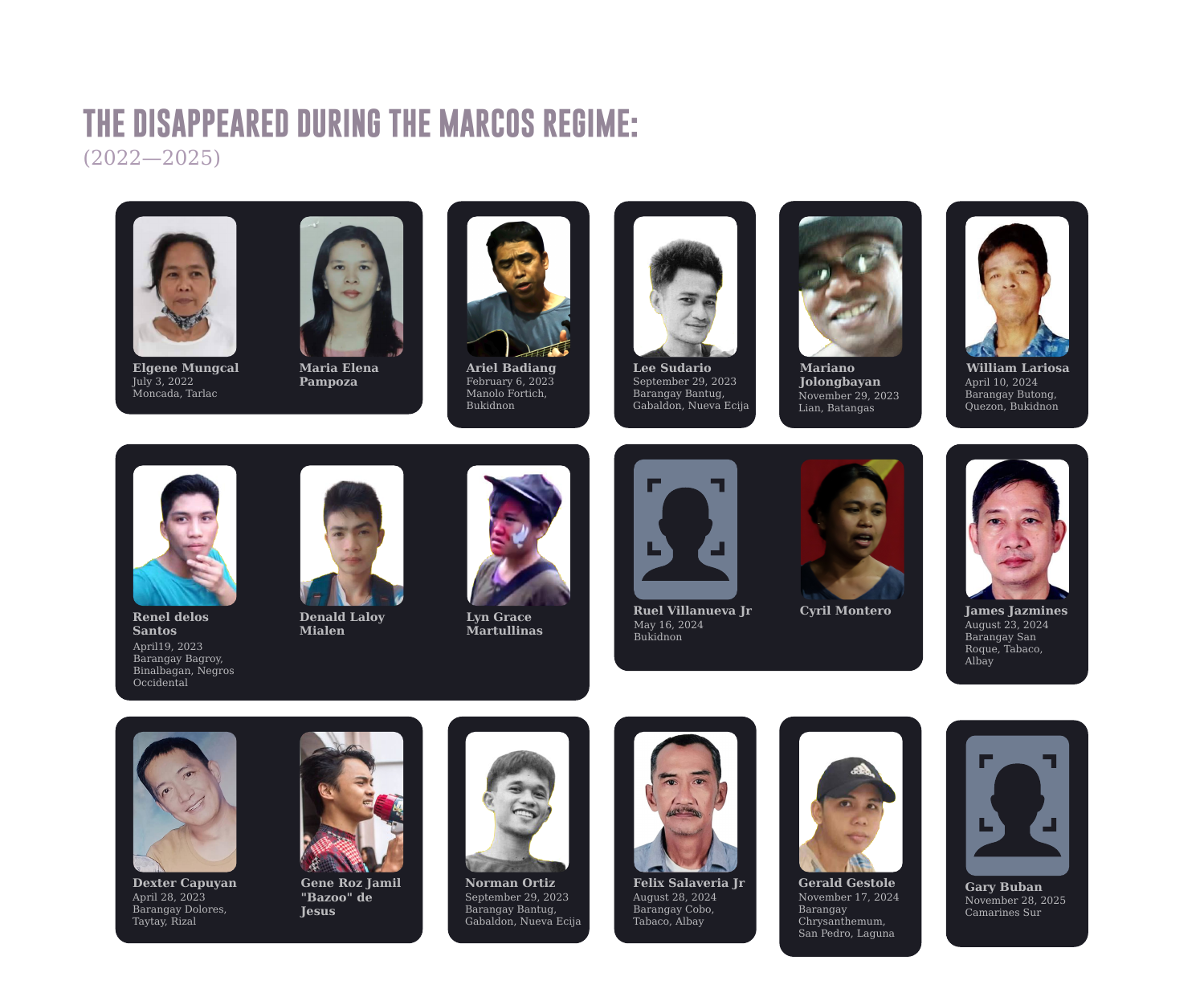
Ang Bayan also recorded no fewer than 12,187 victims of threats, persecution, and intimidation. The number may be much higher considering the thousands paraded and forcibly “surrendered” by the military as NPA members or supporters in urban and rural areas. In many of these “surrender” cases, the military used aid distribution as an opportunity to photograph residents and claim they had “surrendered.”
Military terrorism in communities
With the dastardly aim of “crushing” the people’s army in the countryside or “preventing its return,” AFP and PNP combat operations subjugate many rural communities. Battalions of soldiers and police remain deployed in numerous peasant and national minority communities, even in towns and provinces previously declared under Stable Internal Peace and Security (SIPS).
No fewer than 7,645 victims of forced evacuation and displacement were recorded by AB. The number of residents affected by harsh food and economic blockades reached 182,064.
Thirty cases of aerial bombing, strafing, and shelling were recorded. These terrorist attacks occurred in Quezon, Oriental Mindoro, Northern Samar, Capiz, and Bukidnon.
Mindoro Island. In Oriental Mindoro, 203rd Bde fascist troopers indiscriminately strafed from helicopters and fired artillery shells from the afternoon of September 9 until the early hours of September 10. The AFP carried out the operations after it clashed with the NPA on the morning of September 9 in Sitio Tugas, Barangay San Vicente.
The strafing and artillery shelling targeted not only the forests but also the farms and communities of the Mangyan people, as well as areas where NPA units are expected to withdraw. These forced the evacuation of hundreds of terrorized Mangyan residents, including children, women, and elders from Sitio Tugas and Sitio Swerte of Barangay San Vicente and nearby communities.
The 203rd IBde did the same in Mansalay, Oriental Mindoro on March 1. The attack terrorized peasant and Mangyan-Hanunuo communities. Residents said the first round of gunfire from two Blackhawk helicopters occurred at 10 a.m. in Sitio Lomboy, Barangay Panaytayan. The helicopters returned at 2:30 p.m. and dropped four bombs while firing indiscriminately at the neighboring sitios of Lomboy, Abaka, and Matarayo. The butchers unleashed this aerial terror after fabricating a clash between the 4th IB and the NPA-Mindoro, despite having no NPA-Mindoro unit present in the area that day. The bombing in Mansalay followed an aerial strafing and bombing in Pola on February 19.
Northern Samar. The 8th ID dropped bombs on Barangay San Isidro, Las Navas early in the morning of July 31 at 2:30 a.m. Over the years, the 8th ID has focused its all-out attacks at Barangay San Isidro, repeatedly shelling, clearing, and eventually permanently occupying it with fascist troops. Since 2020, the 8th ID has shelled the forests surrounding the village at least once a year—forests that serve as the main food and livelihood source for residents. People from San Isidro and neighboring barangays gather vegetables, hunt, fish, and collect rattan there. Many also cultivate land and reside within that forest.
Capiz. AFP units’ loud bomb blasts, artillery shelling, and strafing disrupted the peace and rest of residents in Tapaz, Capiz in the early morning of August 22 at 2:30 a.m. This terrorized and forced several families to evacuate their community. The 301st IBde justified the terrorist attack with claims that it had a “major encounter” with the NPA at the boundaries of the barangays of Artuz, Tabon, and Agpalali in Tapaz.
Bukidnon. The AFP shelled Sitio Tubigon, Barangay Busdi, Malaybalay City, Bukidnon on July 1 and 2 after encountering an NPA unit nearby. The excessive shelling terrorized the peasant and Lumad communities in the area. The first four rounds of artillery fire hit at 12:30 p.m. on July 1, followed by two more rounds at 3:00 p.m. The AFP fired four more artillery shells early the next morning at 3:00 a.m.
US war games’ damage to livelihood. The local government and US troops imposed a “no-sail zone” to give way to war games and live-fire exercises and directly halted the livelihood of fisherfolk. The restrictions were enforced in April and May in coastal towns of Ilocos, Zambales, and Cagayan, reportedly affecting no fewer than 28,000 fishers. This food and economic blockade constitutes a violation of human rights.
Justice!
The Filipino people collectively clamor for justice for all victims of human rights violations by the US-Marcos regime. Various forms of protest and struggle were launched by different groups over the past year to give voice to the victims and their families
FFM and ISM events. Human rights groups conducted fact-finding missions (FFM) as a form of struggle and call for justice. These included missions held in Mindoro, Bulacan, and the international solidarity mission (ISM) conducted in October in Rizal, and on the islands of Mindoro, Samar, Leyte, and Negros.
From October 11 to 14, an ISM delegation visited the Philippines to investigate the effects of climate crisis, environmental plunder, and militarization on farming and indigenous communities in Rizal and on the islands of Mindoro, Samar, Leyte, and Negros. Defying AFP personnel’s harassment and intimidation, the investigative teams courageously and militantly pushed through with their mission.
On August 20, groups held an FFM in San Jose Del Monte City, Bulacan to document the 80th IB soldiers’ cases of human rights violations against residents. These included the military encampment in civilian communities, forced dismantling of local organizations, house-to-house operations, terrorist tagging, profiling, and threats of arrest.
A 30-person delegation composed of church people, human rights defenders, advocates of peasant rights, cultural workers, and other organizations visited Barangay Tungkong Mangga, one of the centers of these cases. They were joined by representatives from the Commission on Human Rights (CHR) Region 3.
In Mindoro, various groups including Karapatan-Southern Tagalog faced and resisted direct 203rd IBde military harassment and violence, aiming to prevent them from conducting the FFM on the island from February 23 to March 1.
The team specifically visited the towns of Pola, Bulalacao, and Mansalay in Oriental Mindoro, where a series of human rights violations were reported following clashes between the 203rd IBde and the NPA-Mindoro in February.
Free all political prisoners. Sustained campaigns and perseverance by families and lawyers compelled the release of several political detainees for lack of evidence in fabricated charges against them. From a total of 762 at the end of 2024, the number of political prisoners in the country has decreased to 696 at present.
Political prisoners and other inmates at the Negros Occidental District Jail-Male Dormitory (NODJ-MD) in Bago City, Negros Occidental launched a protest in August to resist repeated human rights violations inside the jail under Jail Warden JCINSP Atty. Crisyrel P. Awe, DSC. Awe was removed from office in August but reinstated a few months later. In response, political prisoners relaunched a protest hunger strike to continue condemning Awe.
Political prisoners nationwide periodically issue statements on major national issues. They also denounced the Bureau of Jail Management and Penology (BJMP) for imposing harsh and repressive policies on political detainees and their visitors.
Youths defy repression. Filipino youth continued to stand firm despite the brutality and violence of the Marcos regime’s armed forces against anti-corruption protests. Following the mass arrests of protesters on September 21, youth groups, lawyers, and human rights organizations immediately mobilized to secure the release of the detainees and seek justice.
To amplify the call for justice, victims of police violence during the September 21 Mendiola protest, also known as the Mendiola 277, formed on October 12 the Alyansa laban sa Korapsyon at Brutalidad ng Pulis (Alliance Against Corruption and Police Brutality) or AKAB. With their families, lawyers, and human rights groups, the alliance vowed to persevere in the fight for justice and accountability from abusive police and corrupt government officials.
They also joined the funeral march for Eric Saber, the worker killed by police during the indiscriminate shooting in Mendiola on September 21.
Revolutionary justice. The New People’s Army resolutely strives to enforce revolutionary justice in the countryside against cases of land grabbing, extrajudicial killings of peasants and hors de combat, and other human rights violations.
Over the past year, the NPA-Negros Island punished two AFP assets involved in pinpointing and killing NDFP peace consultant Ericson Acosta, and NPA-Negros Island spokesperson Ka Juanito Magbanua (Romeo Nanta). The NPA carried out separate armed actions in connection with these cases in October in Barangay Kamansi, Kabankalan City, and in November in Barangay Carabalan, Himamaylan City.
People’s movements and human rights defenders nationwide continue their militant struggle against the Marcos regime’s brutal rule. From legal and extra-legal actions to NPA armed actions, the people are relentlessly defending their rights and demanding justice. They expose, denounce, and hold Marcos accountable for his policies of state repression and terrorism, alongside his responsibility for massive corruption.