Concha Araneta-Bocala: Continuing the Tradition of Women Fighters
Some of her fellow FQS (First Quarter Storm) activists said she wouldn’t last in the hills because she was flat-footed. And Panay’s West Cordillera range had among the most rugged mountains, second only to the Cordilleras of Northern Luzon.
Some of her family members thought she wouldn’t last in the hills because she was not used to the hard life of peasants and farm workers. She was born and raised in a buena familia, a colegiala who excelled in the academics of an exclusive school, designed to prepare for a successful domestic or corporate life, to attend to the family business, and raise beautiful children who would later be sent to the next exclusive schools.
Some friends raised eyebrows and doubted if she would last in the hills because she was a woman. The late 1960s had strict stereotypes of women—for the nursery, the bed, the kitchen. Even during the ferment of the youth movement, society generally regarded women as submissive though attractive creatures, and only activists among women wore pants. Literally. Others wore miniskirts.
But she proved them all wrong. She not only overcame her physical, class, and gender limitations to survive in the mountains for more than five decades, but emerged as a revolutionary leader in the tradition of Panay’s strong, revolutionary women—Katipunan’s Generala Teresa Magbanua and the HMB’s (Hukbong Mapagpalaya ng Bayan) Kumander Waling-waling or Coronacion Chiva.
Crossing boundaries
Concha Araneta was a product of her time. Society was in a ferment. The economic crisis in the US brought about by its own imperialist aggression in Vietnam was being transferred to the US neocolonies including the Philippines. Newly-aware youth were questioning old traditions, building new ones. Workers were reeling from the effects of the economic crisis and peasants sinking deeper in poverty with the shrinking land frontiers. The Communist Party of the Philippines (CPP) was established in 1968 on the broad base of young student activists and union organizers, and the New People’s Army (NPA) among the peasants. Mao Zedong’s Cultural Revolution was inspiring youth in the Philippines and all over the world.
Resurgence of the women’s movement was among the results of this ferment. While schools were teaching “social graces” and home economics for women, activists were discussing social issues and systemic change outside the classrooms. While mass media, theatre, and advertisements were stereotyping women as fragile creatures on pedestals, commodities for sale, or glorified prisoners in their own homes, the national democratic movement, now with MAKIBAKA (Makabayang Kilusan ng Bagong Kababaihan) as the foremost women’s organization, was asserting that “a woman’s place is in the struggle.” And while the reactionary Armed Forces of the Philippines (AFP) was relegating women soldiers into its auxiliary services, the NPA was welcoming women and men into its ranks as equal comrades. The FQS of 1970 was not just a series of violently dispersed rallies, it was a spark that brought the liberating message of national democratic revolution to the whole country.
Then a student of the University of the Philippines, Concha was among the activists of the FQS. She would later become an NPA Red fighter in Panay, working and living among the indigenous Tumanduk in Panay alongside her husband, also an NPA guerrilla.
Transformative power of revolutionary commitment
Her four arrests and detentions, together with her participation in the spectacular escape of a group of political prisoners timed on Marcos’ birthday, are all well-known stuff for legends. But even with such determination and daring, Concha had to face her own personal struggles while pursuing the revolutionary path.
As a mother, she often longed for her children as it became more and more difficult for her to visit them with the military putting her on the wanted list. And comrades tell stories about how helplessly she once called out to the sky as she watched the passing military helicopter above carrying her infant away.
Her physical health, made even worse by the rigors of mountain life, would often compel her to be sent now and again for treatment in the urban areas, but she would always return to the armed struggle once treated. She was almost blind in one eye, the result of an encounter in Miag-ao, Iloilo. She suffered from anemia and chronic pneumonia. Once, while on an all-day march of retreat from an encounter, she collapsed unconscious along the way. A doctor and several medics who aided her until she regained consciousness asked for a stretcher but she shook off the service and continued to walk until they reached the harbor area. “They are all tired from the march,” she said, “it is not good to give them additional burdens because we may meet another encounter along the way and they will not be able to fight.”
In the early 1990s, when a large chunk of Panay forces degenerated into revisionist disorientation, Concha led the remaining forces in rallying to the Second Great Rectification Movement, in the face of threats and harassment from the splittist groups that were able to rip off the best firearms from the revolutionary forces.
She drafted the region’s 10-year summing-up paper which Party members, Red commanders and fighters of all fronts overwhelmingly approved. Of Panay Island’s four standing guerrilla fronts at that time, three were led by women. Women were also the secretaries of the urban committees. They all helped to propagate the lessons of the rectification movement, and Concha was with them discussing the summing-up papers down to the barangay level organizations. With perseverance, the revolutionary movement in Panay got back on track and regained strength.
In 2015, Concha was arrested for the fourth time while she was undergoing medical treatment in Iloilo. Even in detention, she made friends with her women prison guards, some even receiving acupuncture treatments from her. She continued to give interviews to the media to air her views about the Filipino people’s struggles, In 2016, being a peace consultant of the National Democratic Front of the Philippines’ (NDFP) peace panel, she was released to join the peace negotiations with the Duterte regime.
When the fascist Duterte regime unilaterally terminated the peace talks, she was designated by the regime as a “terrorist” and had to return to the hills. She could not even attend the burial of her husband who was summarily executed by the military. On August 15, 2024, 11 days short of turning 74, she was slain by the military in an encounter. Her body was turned over to the family only when it had started to decompose. It bore stab wounds instead of gunshot wounds and her face was extremely disfigured.
From a sheltered colegiala to a woman revolutionary leader, Ma. Concepcion “Concha” Araneta Bocala is a shining example of the transformative power of revolutionary commitment. She embodies the hundreds of brave women who broke the shackles of social discrimination, shattered societal stereotypes, and gave the best years of their lives to the service of the people.
Liberation of women
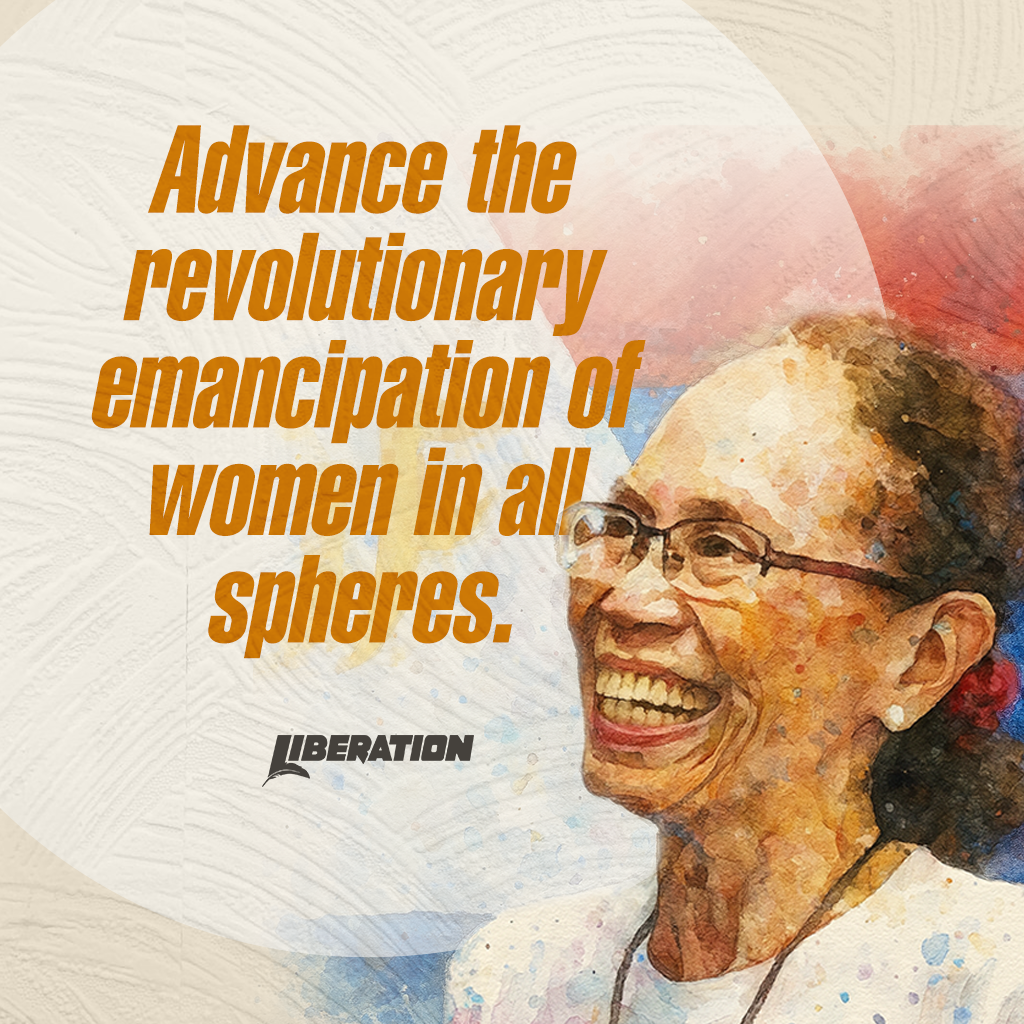
The National Democratic Front of the Philippines’ 12-point program has for its point 11 to “Advance the revolutionary emancipation of women in all spheres.” Concha’s life illustrated that by becoming part of the revolutionary struggle to liberate the people from national, class and gender oppression, a revolutionary woman starts the process of her own liberation. (by Silvia Madiaga)