Representing the Philippine revolution to all corners and peoples of the world
When Luis G. Jalandoni died last June 7 at a ripe age of 90, the National Democratic Front of the Philippines (NDFP) lost its longest-serving representative and ambassador, the one who not only started its foreign relations work but the Front’s very embodiment of proletarian internationalism and solidarity.
There was little suggestion in Ka Louie’s early life that he would be the Philippine revolutionary movement’s delegate in dialogues with governments, organizations, and revolutionary movements abroad. Even when sent to the big city to study where he excelled in one of the country’s elitist schools and graduating as class valedictorian, he always found himself back in Silay in Negros Occidental to live out his youth among farmers of his family’s vast landholdings. As he grappled with what to do next with his life after college, he chose to enter the seminary—again graduating as valedictorian—later to return to his province to serve the poorest of the poor as a member of the Roman Catholic clergy. He himself probably thought he would never leave his home province and would spend the rest of his days in his beloved Negros Island.
But Ka Louie was shown the harsh realities of feudalism and fascism that taught him lessons even his formidable educational training failed to fully explain. He saw the poor brutally oppressed and denied their humanity by cruel landlords and corrupt politicians. He saw farmers working like slaves from sun up to sun down with barely enough to eat at the end of the day but survive the way the candle burns against the wind. Between the immorally rich and the poor, Ka Louie realized who he should dedicate his life to and whose struggle he should embrace.
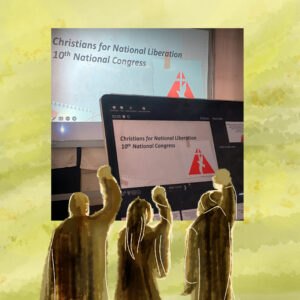
Death threats and imprisonment only fueled what was already a burning desire to serve the least of his brethren by any means necessary. He went as far as donating a great majority of his substantial inheritance to his cause. It became natural for him to join the Communist Party of the Philippines (CPP), helped establish the Christians for National Liberation (CNL) in 1970 and thereafter the NDFP itself. After his release from prison in 1974, he helped in organizing the first-ever workers’ uprising under martial law, the La Tondeña strike of 1975.
It was on that year that the top CPP leadership decided to send Ka Louie and by then wife Coni Ledesma abroad to begin NDFP’s foreign relations and international solidarity work.
Tireless diplomat
Already marked for assassination by the Marcos dictatorship, it took careful planning for Ka Louie and his young family to escape to Europe to begin their new work. He, his wife and their newborn son used passports under different names, each traveling separately. Their infant child had to travel as another couple’s son. Ka Louie even had to disguise himself heavily just to pass various immigration checks in the Philippines and abroad. He was finally reunited with his wife and son in Ireland after three months of clandestine travel.
It was in Utrecht, The Netherlands that they found permanent residence and where they established NDFP’s International Office. In 1977, Ka Louie was formally appointed as NDFP International Representative.
As such, Ka Louie was tireless in accomplishing the tasks entrusted to him and Ka Coni. They linked up with existing groups of workers, farmers, women, youth and students and helped form new ones in the international peace movement willing to support the NDFP and the revolutionary movement in the Philippines. He organized forums and seminars to gather political and material support to the revolution. They consolidated and expanded Philippine solidarity groups throughout Europe and, later, the rest of the world.
Ka Louie and Ka Coni met with governmental and intergovernmental organizations and established relations with many Churches. They started organizing work among migrant Filipino workers and seafarers not just in Europe but in other global regions as well. The couple traveled all over to establish solidarity relations with national liberation movements. Among the movements that established relations with the NDFP were The Pacifist Socialist of The Netherlands, The Panhellenic Socialist Movement of Greece, The National Liberation Front of Algeria, The Palestinian Liberation Organization (PLO), The Cooperative Labour Party of Great Britain, The Bulgarian Agrarian Party, The Sandanistas of Nicaragua, The Farabundo Marti National Liberation Front of El Salvador and the Guatemalan National Revolutionary Unity. These are aside from various Communist parties in many other nations.
The NDFP international representative was welcomed to Cuba at least four times. In 1987, Ka Louie attended the Non-Aligned Movement’s meeting in Zimbabwe where he successfully blocked the Corazon Aquino government’s treacherous attempt to be a member. In the same conference, he met with PLO chairperson Yasser Arafat who expressed admiration for the Philippine revolution. Ka Louie visited the Dominican Republic and Ecuador to meet with representatives from many Latin American countries. He also met with representatives of the European Left and gathered the support of 24 European Parliamentarians against the European Union and United States’ terror listing of the CPP, the New People’s Army and Prof. Jose Maria Sison. In 1987, and again in 2010, Ka Louie and Ka Coni visited New Zealand and Australia to meet with parliamentarians, workers groups and migrant Filipinos. In 1996, he visited India to attend an international forum with 900 other delegates from all over the world.
A polyglot, Ka Louie was comfortable addressing audiences in several of the world’s major languages, such as when he addressed hundreds of thousands of Venezuelans in fluent and rousing Spanish in Caracas. He also spoke Ilonggo, Filipino, English, German, and Dutch. During a break in the peace talks with Government of the Republic of the Philippines (GRP) negotiators in 2016, he bantered with counterpart Silvestro H. Bello III in Latin, to the delight of the Norwegian facilitators and journalists present. He talked to the foreign ministries of Belgium, The Netherlands, Italy, and Norway to help secure hosting and facilitation of the peace talks with the GRP. With Ka Louie as international representative, the NDFP was invited to many events and discussions in recognition of the revolution it represents.
Ka Louie took on other tasks to advance the revolution and to fight Ferdinand Marcos Sr.’s fascism in the Philippines. He was the NDFP representative at the Permanent People’s Tribunal in Antwerp, Belgium in November 1980 that declared the dictator unfit to govern. The tribunal recognized the NDFP as a legitimate representative of the Filipino people, recognizing as well the status of belligerency of the Philippine revolutionary movement.
Under Ka Louie’s helm, the NDFP International Office operated like the international offices of the PLO, the South African National Congress and other national liberation movements in disseminating information about the Philippine revolution. Utrecht also became home to other revolutionary asylum seekers such as Fidel V. Agcaoili, Joma Sison, Julie de Lima and others who fled persecution, even certain death, in the hands of the fascist regimes back home.
Principled negotiator
The Utrecht office also became the base on which the NDFP Negotiating Panel operated from 1989 to present. Ka Louie himself was appointed to the peace panel on that year, eventually becoming its chairperson from 1995 to 2016. With him as chief negotiator, the NDFP crafted and signed agreements with the Government of the Republic of the Philippines such as The Hague Joint Declaration, the Joint Agreement on Safety and Immunity Guarantees, the Comprehensive Agreement on Respect for Human Rights and International Humanitarian Law, and other documents praised by the international peace constituency as innovative and groundbreaking.
To further win global prestige for the Philippine revolution, Ka Louie helped in crafting NDFP’s Declaration of Adherence to International Humanitarian Law it submitted to the United Nations (UN) and the International Committee of the Red Cross in 1991. It is one of the first revolutionary movements in the world to declare such a commitment in the conduct of war. As a member of the National Council and National Executive Committee, Ka Louie also issued the NDFP’s Declaration and Program of Action for Filipino Children in the context of the civil war in the Philippines. It was also submitted to the UN in June 2012.
At the time of his death, Ka Louie was NDFP Negotiating Panel’s senior adviser. In being the NDFP’s longest-serving peace negotiator, he helped in gaining for the revolutionary movement a co-belligerent status in the Philippine civil war.
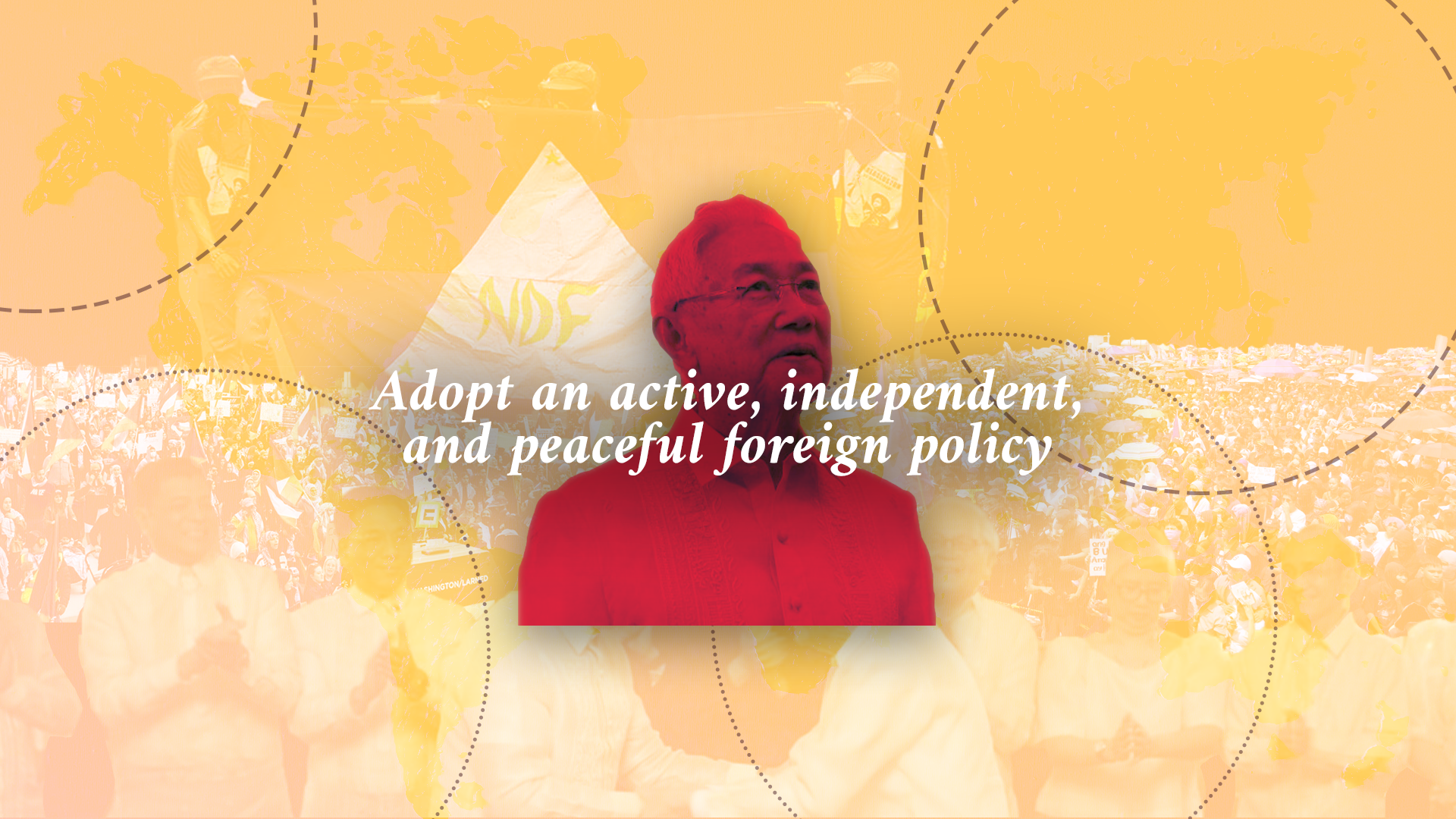
Active, independent and peaceful foreign policy
Ka Louie’s stellar performance as the revolutionary movement’s chief ambassador has prepared the National Democratic Government’s establishment of an active, independent and peaceful foreign policy upon seizure of national political power. With the help of the various liberation movements, governments and intergovernmental organizations Ka Louie made friends with across the globe, the new government shall reject and vigorously defend itself against all forms of foreign intervention and interference in the country’s internal affairs from all other states. The new government shall establish diplomatic and economic relations with all countries on the basis of mutual respect for each other’s sovereignty, independence, territorial integrity, mutual benefit, and the peaceful resolution of inter-state conflicts. It shall seek to develop close and warm relations with Third World and socialist countries as well as productive and mutually beneficial relations with capitalist countries.
All these shall be possible because of Ka Louie’s hard work and dedication to the cause of the national democratic revolution. The young man who seemed to refuse to leave Negros Island and the soft-spoken priest whose first greeting was always a wide smile had gained in more than six decades of service and struggle the broad and global support for the Filipino people’s revolution and future. (Leon Castro)