Leo Velasco: Guided by MLM and inspired by the masses
“Sinuhulan ako ng tatay ko na bibilhan niya ako ng motor huwag lang akong mag-NPA,” Leo Velasco once said. “Eh matagal ko nang hinihingi sa kanya yun.”
This was in 1970s when activism was spreading like wildfire. The idea of liberating the masses from oppression and exploitation was an attractive call.
Leo wanted to be a neurologist—a kind of doctor that is scarce in the Philippines. It was a very promising future for him. Yet, in his first year of medicine proper at the University of the Philippines, he decided to go underground. In an open letter he wrote for members of Progresibong Kilusang Medikal, he said his decision was prompted by his realization he won’t be able to cure his patients when there is a bigger disease in society that keeps its citizens even more ill.
So the motorcycle he always wanted now seemed to be a trivial thing. He now wanted something bigger than himself.
From medic to commander
A warrior of the people is not only good for battle but everything else—a medic, a teacher, sometimes a mediator, and most of the time, a problem solver. Armed not only with a rifle (which were few during that time) but also with the Marxist-Leninist-Maoist ideology, Leo was able to organize the locals and helped in establishing organs of political power.
He was among the cadres who gave the first-ever military training of the New People’s Army (NPA). But before they were able to teach military tactics to local commanders and team leaders, they realized they needed to address first a more basic issue—basic education.
It was prompted when a platoon commander from peasant origin asked a cadre from the city what the round thing attached to his watch was. It was a compass.
“Ano ang compass, kaddua?”
So the cadre explained what a compass is. “Ito yung nagsasabi saan ang timog, hilaga, silangan at kanluran. Lagi siyang nakaturo sa hilaga dahil sa magnet nito.”
“Ano ang magnet?”
There it was. “We need to start from the basics,” the cadre said. So the comrades who came from universities pooled in their knowledge and came up with modules for literacy and basic education on science and math.
When asked what they wanted to learn about, the peasants said they wanted to learn why there were different types of plants and trees, things closest to their lives. It meant that they needed to learn how species evolved to what they are today. During that time, there was no internet, nor a laptop with an electronic encyclopedia so the teachers had to rely on their stock knowledge. As the teachers realized none of them were capable of teaching this branch of science, Leo arrived at the camp. He came prepared to give a military training but he had to teach science first.
Because it is the army of the people, military work comes hand-in-hand with mass work. The people’s army to liberate the masses is the masses themselves. Leo understood this deeply. Thus, the basic science and math discussions would become instruction materials not only for the people’s army but also for the peasant masses they organized.
The military training that followed was a success. In the next years, the members of the NPA multiplied exponentially. It was able to expand in almost all regions and was able to establish several fronts nationwide. He was first assigned in the Cagayan Valley region as a medic, then eventually became one of the commanders of the New People’s Army in the region. Even when Leo rose up to one of the most important roles in the people’s army command, he held on to his dedication to the masses as he faced more pressing tasks at hand.
Asked when is it correct for an NPA fighting unit to leave its base in the context of worsening enemy attacks, Leo answered, “when the NPA is pushed into a purely military situation, when it can only do military work and not perform its mass work anymore, it is time to leave and rebuild another base.”
The second great rectification movement
There were five of them in the Executive Committee—Benito Tiamzon, Wilma Austria-Tiamzon, Ric Reyes and Arturo Tabara, and Leo. In 1989, Reyes and Tabara were pressuring the EC to make the strategic decision to launch the series of events that aimed to spark an insurrection to finally seize political power. At that time, Joma Sison came out with a document to reaffirm the basic principles of the Party—of a protracted people’s war (PPW) and seizing political power by encircling the cities from the countryside as the most realistic strategy and tactic for a semicolonial and semifeudal society.
It was a very long debate among the five. On one hand, the economic and political crises seemed more than ever ripe for revolution. On the other hand, the subjective forces—the revolutionary organizations and mass base had not reached the level of strength to launch such a decisive action and shifting from PPW to insurrection could spell the life and death of the revolution. The people’s army had big military formations, yes, but there were so many errors in premature regularization that had to be corrected. They couldn’t get a consensus. So they had to resort to voting.
From the NPA’s struggles during its infancy to its march in the middle phase pushing towards the advance sub-stage of the strategic defensive, Leo Velasco held the spirit of combating conservatism, to persevere in always looking and moving forward.
The Tiamzon couple voted to reaffirm. Reyes and Tabara voted for insurrection they were peddling. It was a 2-2. Leo broke the tie and voted to reaffirm. During that time, it was not an easy decision for him. (But to continue this story, the two EC members who voted for insurrectionism gave totally different orders on the ground. Eventually, they faced a trial for their offenses and were expelled from the Party. Looking back, if Leo had voted with Reyes and Tabara, Party cadres would have a more difficult time in carrying out the rectification movement and could have resulted in more setbacks.
Leo, since then, devoted himself to taking important duties in rectifying the mistakes of the Communist Party, the Army and the United Front. He led the military commission to advance warfare to the middle phase. He was not a military genius nor a shining tactician. He was a cadre whose standpoint and viewpoint remained firm against revisionism.
Firm in principle, flexible in tactics
Because of his duties, he went around the country guiding and coordinating with guerrilla fronts on military matters. He would also give training in military work. During that time, there were no cellphones with GPS yet. He taught comrades how to map grid coordinates and know their location in reference to the location of the enemy. Having this skill gave NPA fighters time to retreat or advance in their positions.
He was also ready to help resolve problems of different regions. He would gladly sit with comrades during an assessment or meeting to hear the matters at hand and was willing to give his sound advise.
One regional cadre recalled there was a time when some atas (tasks) had been interpreted differently and caused some confusion or disagreement among regional cadres. And because he was present, he was able to clarify the context of the tasks from the higher organ. When they realized the task was not applicable in some areas, he and the cadres crafted another plan that would achieve the same objectives.
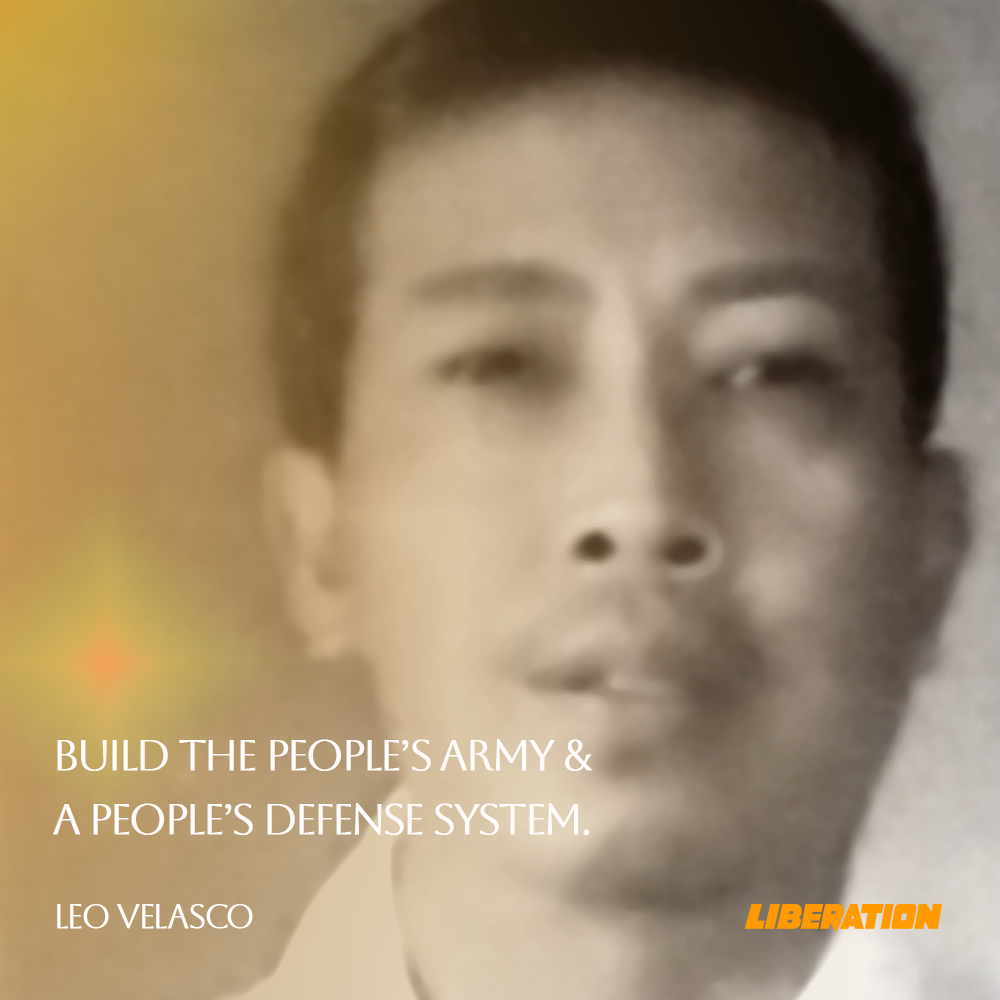
Enriching point number 3 of the NDFP’s 12-point program: Build the people‘s army and a people’s defense system.
With his leadership, the NPA was able to launch a series of centralized military training—for military trainers, snipers, and ordnance specialists. NPA fighters from different regions were able to share skills and experiences in guerrilla warfare, with the more advanced regions helping out other regions, which were relatively tailing. As a result, many regions, if not all, gained more confidence to launch tactical offensives with the right preparation and social investigation.
During the early 2000s, he was able to organize Operation Raindrops, a nationally coordinated military campaign. It was a call for all NPA units nationwide to launch tactical offensives, however small or big based on their capacity, within a specific time frame. In the usual principle of “centralized leadership and decentralized operations,” regions would launch offensives based on their own time frame within a general program. But with this campaign, the regional commands put military action as priority for the specific time that the national command directed, coordinated, and monitored. This was to test the capacity of the NPA to launch nationally coordinated campaigns as it looked forward to the middle phase of the strategic defensive—where such operations would be more prominent as the people’s war moved to the strategic stalemate. This was to also spread the enemy thin nationwide and divert its focus on specific areas.
This initiative showed a leap from that time’s existing military conservatism and gave a telling blow to the US-Estrada Regime’s “counterinsurgency” program, the Oplan Lambat Bitag.
On February 19, 2007 in Cagayan de Oro City, Leo—unarmed and assisting the region on some organizational problem in the urban area—was abducted by men wearing shirts bearing the logo of CIDG (Criminal Investigation and Detection Group). He became one of the 206 victims of enforced disappearances of the US-Arroyo Regime’s Oplan Bantay Laya.
From the NPA’s struggles during its infancy to its march in the middle phase pushing towards the advance sub-stage of the strategic defensive, Leo Velasco held the spirit of combating conservatism, to persevere in always looking and moving forward. He always upheld the armed struggle waged by the New People’s Army never losing sight of the ray of hope towards victory. While there is still that light, the younger fighters are now challenged to hold the torch on one hand and an armalite on the other, and win the revolution. For it is only through the armed revolution of the masses, guided by the Party, that oppression can be eliminated and people be genuinely free. (Mia Andres)