Various groups honor Ka Louie Jalandoni
From different regions of the Philippines to many parts of the world, organizations, parties, and groups paid tribute to Ka Luis Jalandoni (Ka Louie) for his contributions to the Philippine revolution and the global anti-imperialist movement. He was recognized as a steadfast advocate of peace, an internationalist, and a revolutionary.
According to the announcement of the Central Committee of the Communist Party of the Philippines (CPP) and the National Council of the National Democratic Front (NDF), Ka Louie passed away at exactly 9:05 a.m. in Utrecht, the Netherlands (3:05 p.m. Philippine time) on June 7. He was 90 years old. At the time of his passing, Ka Louie was with his comrades, his wife Ka Coni Ledesma, and his family.
“Ka Louie’s life was far from ordinary,” stated the Central Committee. The Party leadership said, “His contributions to building and strengthening the Party and the NDF, and to advancing the people’s democratic revolution—mainly through armed struggle as well as other forms of struggle, including peace negotiations—will never be erased.”
Ka Louie’s life
Ka Louie was born into a family of rich landlords and sugarcane plantation owners in Silay City, Negros Occidental on February 26, 1935. He studied and graduated from private schools in high school and college.
Ka Louie entered the priesthood vocation and was ordained as a priest of the Catholic Church. He served as the Bacolod Diocese Social Action Center (SAC) head, endearing him to the poor and the communities of farm workers on the island.
On February 17, 1972, Ka Louie was one of the founders of Christians for National Liberation (CNL), a group of Christians who fought against the Marcos Sr dictatorship. At its founding assembly, both Ka Louie and his wife Ka Coni were elected to the National Executive Board. The CNL later became one of the allied founding organizations of the NDFP in 1973.
Ka Louie became Party member in March 1972. After the declaration of martial law, Ka Louie joined the underground movement resisting the fascist dictatorship. During this time, Ka Louie and Ka Coni were arrested in 1973 and imprisoned at Fort Bonifacio.
Ka Louie was imprisoned for nearly a year in a dark, windowless cell with six or seven others. Successive protests and campaigns by religious and international human rights groups pressured the Marcos regime to release them in July 1974.
In 1975, he helped organize and coordinate the La Tondeña workers’ historic strike in Manila—the first major workers’ strike under martial law. The following year, Ka Louie went abroad to lead international relations work for the Party and to expose the Marcos dictatorship’s brutal crimes.
Because of threats to their lives and the certainty of prosecution if they returned to the Philippines, Ka Louie and Ka Coni sought and were granted political asylum in the Netherlands—becoming the first Filipinos to have it. In exile, Ka Louie worked diligently to strengthen support for the Philippine revolution.
In July 1977, Ka Louie was formally appointed as the International Representative of the NDFP. He played a vital role in establishing the NDFP International Office in Utrecht and in organizing global support for the Filipino people’s struggle against the US-Marcos dictatorship. He served as People’s Permanent Tribunal on the Philippines key organizer in 1980, which exposed the regime’s severe human rights violations and recognized the NDF as the genuine representative of the Filipino people.
As NDFP’s chief international representative, Ka Louie conducted proto-diplomatic work and established relations with foreign governments, international agencies, fraternal groups, and revolutionary movements and parties worldwide. He helped amplify the Filipino people’s voice by expressing the revolutionary movement’s just aspirations.
In 1989, Ka Louie was appointed NDFP chief peace talks negotiator with the Government of the Republic of the Philippines (GRP). Henceforth, Ka Louie became a key figure in the signing of significant agreements between NDFP and GRP representatives, including the The Hague Joint Declaration of 1992, the Joint Agreement for Safety and Immunity Guarantees, the Comprehensive Agreement on Respect for Human Rights and International Humanitarian Law, and other documents and agreements.
In 2016, Ka Louie formally stepped down as NDFP’s chief negotiator and then appointed senior adviser to the negotiating panel.
A model revolutionary
On behalf of all revolutionary groups in the Philippines, the CPP Central Committee expressed heartfelt gratitude to Ka Louie Jalandoni for dedicating his life to the Filipino people, the NDFP, and the Party. “We will forever cherish his immense contribution to advancing the people’s struggle for national and social liberation,” the Party leadership stated.
According to the Central Committee, as they mourn Ka Louie’s passing, they firmly vow to continue his legacy of selfless service, boundless humility, revolutionary integrity, and commitment to waging the people’s democratic revolution until victory is finally won.
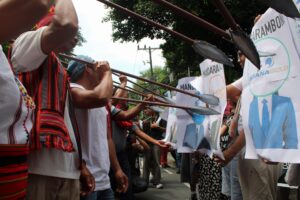
Honoring Ka Louie included the Party issuing an oath for Party members, Red commanders and fighters, and members of revolutionary mass organizations to recite. On June 12, NPA units across the country also conducted a silent 21-gun salute, on the order of the CPP Central Committee, to honor Ka Louie. The Central Committee’s tribute statement was read and discussed at these gatherings and secret assemblies in urban areas.
Aside from the Central Committee, NPA units, regional branches, and NDFP allied organizations also released tribute statements. These included the NDF International Office, CNL, League of Scientists for the People, Compatriots, National Peasant Association, Kabataang Makabayan, and NPA units. Most statements came from organizations based on Negros island, Ka Louie’s birthplace.
“We remember [him] as our beloved hero, who transcended his affluent landlord origin in Silay City, Negros Occidental and became one with the Negrosanon masses in their great struggle for national freedom and democracy,” NDF-Negros Island spokesperson Ka Bayani Obrero said.
The group vowed to recognize and uphold Ka Louie’s revolutionary legacy. They are determined to advance his example of wholehearted service to the masses, selfless sacrifice, and loyalty to the aspirations of the Negrosanon and Filipino masses.
Local and international recognition
Parties and organizations from Ireland, the United States, Afghanistan, Germany, Turkey, Kurdistan, and other countries recognized Ka Louie and his contributions. In the Philippines, numerous groups and institutions advocating for just and lasting peace in the country honored him.
These included Anti-Imperialist Action Ireland, Friends of the Filipino People in Struggle (FFPS), Communist (Maoist) Party of Afghanistan, Freedom Road Socialist Organization, Marxist Leninist Communist Party Turkey/Kurdistan, Marxist-Leninist Party of Germany (MLPD), Samidoun Palestinian Prisoner Solidarity Network, and Communist Party of Turkey-Marxist-Leninist (TKP-ML).
“Ka Louie’s contributions in the international work of the revolutionary movement in his almost 50 years abroad are invaluable,” FFPS chairperson Robert Reid said. The group thanked him for the guidance, advice, and inspiration he provided over the years.
Reid said, “True to his humble and kind nature, he gladly made time and effort to join our events and member gatherings on many occasions, sharing his experiences and boundless insights about the Philippine revolution and the role of international solidarity amongst the peoples of the world.”
“In the selfless and revolutionary spirit of Ka Louie, we will continue to expand and strengthen our solidarity work with the struggles of the Filipino people until a just and lasting peace in the Philippines is won!” Reid said.
In the Philippines, Ka Louie was recognized by various organizations including Bagong Alyansang Makabayan (Bayan), Koalisyong Makabayan, peace-oriented groups such as the Philippine Ecumenical Peace Platform (PEPP), and others.
“His lifelong commitment to fundamental revolutionary change in the Philippines and in the world serves as an inspiration to all who believe that indeed, a better world is possible and that the oppressed and exploited masses are the true movers of history,” Bayan stated.