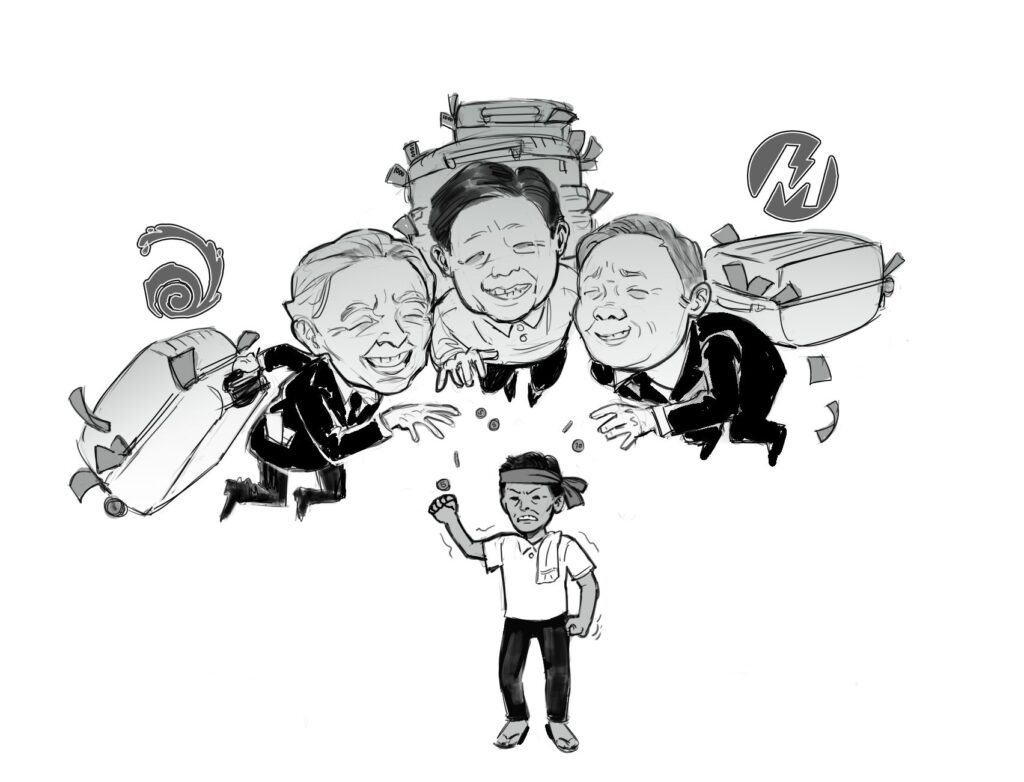
The hollow promise of "development" under the Marcos regime
In recent days, two announcements from the Marcos regime once again laid bare the utter emptiness of its promises and the burden it places on the Filipino people. First was the insulting ₱85 daily wage increase that regime officials described as “historic.” Second was the Philippines’ supposed attainment of “upper middle income” status according to the standards of the imperialist institution World Bank. These are nothing but advance boasts ahead of Ferdinand Marcos Jr.’s fourth State of the Nation Address (SONA) on July 27.
How far will ₱85 go?
The national average minimum wage stands at only ₱504–₱510. This is not even half of the estimated needed minimum wage of ₱1,200 to ₱1,312 per day. Even adding ₱85 to the National Capital Region (NCR) wage of ₱695/day, it still falls far short of what a family of five needs to live with dignity. Worse still, the ₱85 daily increase will be doled out by installment: ₱60 on July 19, and ₱25 in January 2027. If the ₱60 is divided according to the average spending of most families, 64% goes to food — or ₱34.40, which cannot even buy a single kilo of rice. The remaining ₱26 will be divided for transportation, utilities, and much more.
The wage increase is even lower in regions outside the NCR. In the past year, regional wage boards granted meager increases of only ₱20–₱39 per day. These were often split into two tranches as well.
The Marcos regime refused to grant even a modest wage increase to workers despite soaring inflation that has eroded the real value of wages. Nationwide, the inflation rate hit 7.2% in April, up from 2.4% in February. This came after the US war of aggression against Iran, which foreign and local companies exploited to jack up oil prices and rake in super-profits.
According to the regime’s own data, roughly 65% of Filipino families live far below decent living standards. Due to low wages, only about ₱78 per day is allocated per family member — far below the state’s own official poverty threshold of ₱91 per day.
Widespread price increases
Just as the regime and capitalists pull wages down across the country, they simultaneously drive up the prices of goods and the cost of services. People have been reeling from the oil price increases that began in March which have yet to return to previous levels. Exploiting the US war of aggression against Iran, oil companies nearly doubled the price of diesel (reaching ₱107–₱134.3/liter), along with gasoline, kerosene, and LPG.
Even before the “oil price shock,” prices of petroleum products have been climbing steadily. From January to February, companies raised oil prices seven times, resulting in a net increase of ₱3.80/liter for diesel and ₱5.40/liter for gasoline, even as the world price of crude oil remained below an average of $61.80 per barrel.
The oil price shock further drove up production and transportation costs, leading to higher prices of food and other basic necessities. It compounded already high prices caused by elevated production costs, including fertilizer, unregulated importation of expensive rice, and lack of support for local agriculture. In the NCR, the price of rice reached ₱56/kilo by June, while hitting ₱64/kilo in other areas like Zamboanga.
People are also burdened by high electricity and water charges. Meralco raised its rates in the NCR and nearby provinces from ₱13/kWh (January) to over ₱14/kWh (June). Major electricity distributors in the Visayas also raised their rates- in Cebu by ₱1.83, and in Iloilo by ₱2.33 per kilowatt. In Davao, rates were increased by ₱2/kWh starting January. Meanwhile, water companies in NCR, Cebu, and Davao implemented steep increases in service charges. This is while consumers suffer from the poor service of private utility companies.
No progress
The World Bank’s “upper-middle-income” designation is meaningless. It is not a measure of development but merely sets a country’s status for borrowing purposes. Contrary to the regime’s boasts, the trend of the local economy is downward, and it is not creating enough jobs for the people.
The regime failed to meet even its own target for gross domestic product (GDP) growth. In 2025, the country’s GDP grew by only 4.4%, and just 2.8% in the first quarter of 2026. Last year, manufacturing recorded its smallest growth in decades, reaching only 2.5%. Agriculture grew by a mere 2.6%.
Meanwhile, the wealth of corporations and the comprador bourgeoisie expanded. From 2020 to 2022, the net income of the largest corporations rose by 104%. The wealth of the 50 richest Filipinos also increased by 31%- all while they kept Filipino wages low and unable to sustain decent living.