Worsening conditions of rice farmers in Southern Tagalog
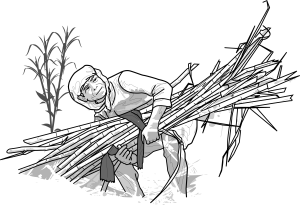
Southern Tagalog farmer Gale worries about where she can find work every time rice planting ends on a landlord’s land in their village. She only works here for six months: June to August and December to February. Beyond those months, her only option is to look for other sources of income to support her family. She is separated from her spouse, and is alone in raising her young child..
Gale is among a group of farmworkers under the “kabesilya” system in her village. The kabesilya serves as the “labor contractor” or the one who gathers farmworkers for landlord-assigned jobs. They handle four to 20 workers depending on the land area worked on. They also participate in production but they get an additional payment for each farmworker they recruit. In Gale’s village, the kabesilya is paid ₱10 for every person gathered for a job.
Like Gale, Frank works under the kabesilya system. Both endure the contract wage system, where they receive only ₱480 per person per hectare. The rice fields where they work require 10 people if the seed is local, or 15 people if the seed is hybrid. Gelyn usually takes home only ₱300-₱400 (₱700 maximum) as a planter. Their work starts at 5:30 in the morning and ends at 8 or 9 a.m.
Outside the planting season, Gale works as a caretaker in a resort in exchange for free lodging for her and her child. She has no salary except for an occasional “commission” whenever someone stays at the resort. Her fellow women workers in the kabesilya system engage in laundry, domestic help, or store keeper. To cope, some of them sell grilled food and snacks, or start small stores if they saved a little capital. They usually earn ₱180-600 from laundry work depending on the volume, while they earn ₱200-350 daily from wage work. Meanwhile, men like Frank work in construction in nearby areas, while others earn from driving tricycles.
Sampaguita picking is also a common livelihood outside planting season. They earn ₱10-50 per dipper depending on the season and the price of sampaguita. Scarce cold season sampaguita buds cost higher, while more bountiful summer buds cost lower.
Lack of livelihood in the countryside
Gale and Frank are among almost one million farmworkers who lost jobs in agriculture in May. The reactionary government’s latest Labor Force Survey reports that a total of 905,000 lost agricultural jobs, a factor in the 4.8% unemployment rate, or about 2.5 million Filipinos, in May. Agriculture and forestry, which make up 16.8% of total employment, lost 392,000 jobs compared with the previous year’s May. Fishing and aquaculture also lost 155,000 jobs. The sharpest drop was in rice planting, which lost 734,000 jobs.
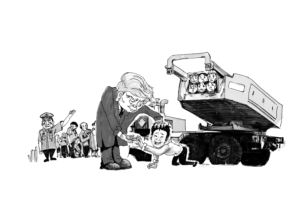
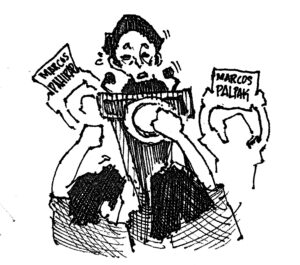
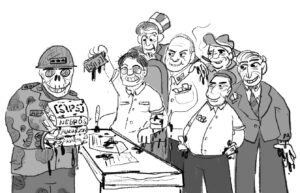
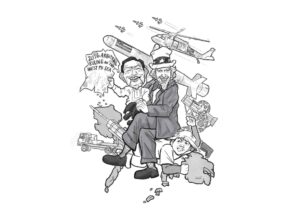
The Marcos regime blames fluctuating climate such as El Niño and other disasters. The truth is that this shows the continuing neglect of the reactionary state, now under the US-Marcos regime, toward agriculture and the large-scale seizure of land from peasants and indigenous peoples.
Revolution is the answer to rural joblessness
According to the Pambansang Katipunan ng mga Magbubukid (National Peasant Alliance), the condition of Gelyn, Federico, and the millions of landless farmers like them who have no choice but to seek various jobs is no surprise. Philippine agriculture is severely backward, low in productivity, and incapable of generating enough livelihood for the rural population.
Landlords exploit the huge number of farmworkers to suppress wages, already lower than the minimum wages in cities, ignore their welfare, and overwork them. They earn even lower from the temporary jobs they take between planting cycles.
Widespread rural joblessness justifies the right to fight for genuine land reform for revolutionary upliftment in the lives of the peasant masses, who make up the majority of the Filipino people. The Communist Party of the Philippines’ Revolutionary Guide to Land Reform, or RGRL, is the program to free the peasant masses from feudal and semifeudal forms of oppression and exploitation. It lays out the maximum program of free land distribution, and the minimum program of raising farm workers’ wages, eliminating usury, and other measures.
The victory of the people’s democratic revolution can win the Filipino people their democratic demands and rights, including land and a living wage.