Groups declare November 30 as Day of the Toiling Masses' Retribution
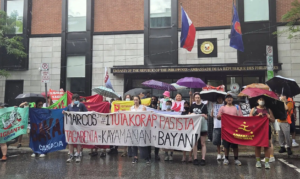
Kilusang Mayo Uno and other democratic organizations declared the upcoming November 30 as the Day of Retribution of the Toiling Masses, coinciding with the commemoration of Bonifacio Day.
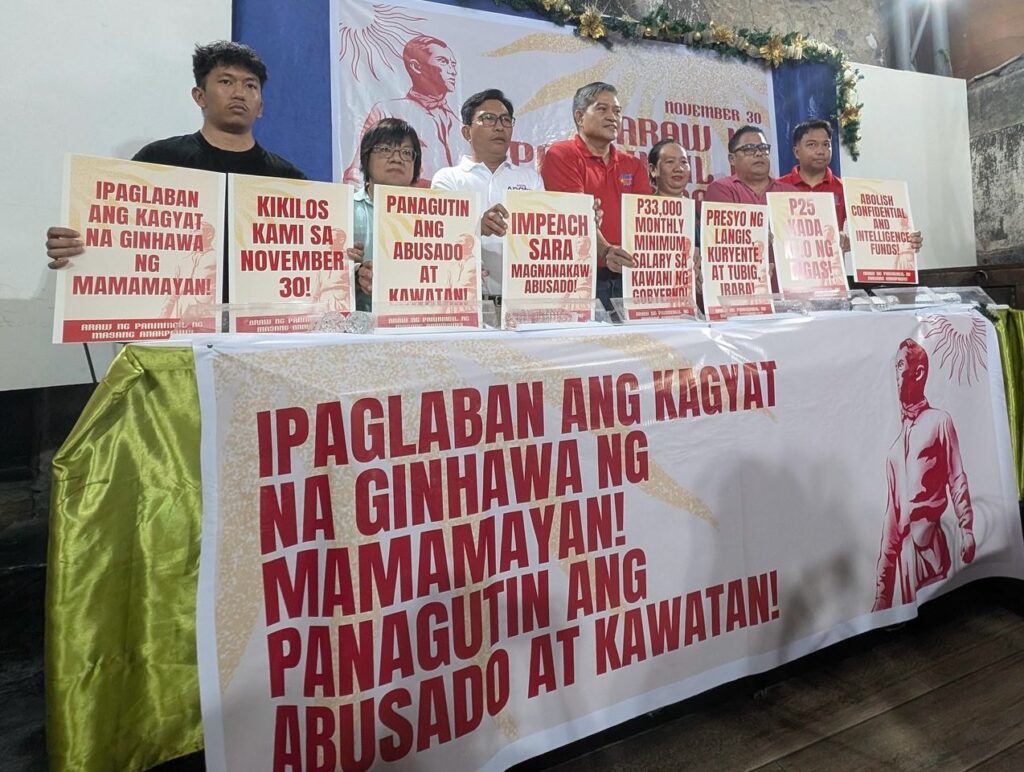
At a press conference on November 27, KMU, along with All Workers Unity and Bagong Alyansang Makabayan, announced that workers and the general public will carry out actions on this day to demand living wages, regular and decent work, and affordable food and services. At the same time, they will be demanding accountability from abusive and corrupt officials who steal the people’s funds.
“We workers have long been infuriated at the President Marcos government’s non-reaction,” KMU leader and Makabayan Coalition senatorial candidate Jerome Adonis stated. Workers have repeatedly demanded a substantial wage increase amid rising prices of goods.
“Workers need no paltry amount, not ₱35, not two tranches of meassly salary increments,” he added. This lowballing occurs amid the capitalist’s annual accumulation of millions of pesos in profit and an alleged increase in the Philippines’ GDP. They are calling for a legislated wage increase of ₱1,200.
“This amount is not a product of fantasy but is based on the actual needs of Filipino families,” he said. “Standardize workers’ wages nationwide, in private and public sectors.”
“Poverty is worsening among the general public, and among workers, and even government employees,” Ferdinand Gaite of Courage and Bayan Muna said. The salary of rank-and-file employees was only increased by ₱24/day or ₱530/month this year. This increase is too small for it to reach the ₱33,000/month their families need to be able to live decently.
Included among those enduring low wages are workers in BPOs run by multinational companies. BPO Industry Employees Network (BIEN) spokesperson Renzo Bajala said the wages in these companies keep getting lower while workers keep getting younger. The entry-level wage of ₱20,000-₱25,000 in 2004 is now down to ₱15,000.
Bajala is among the youth who dropped out of school to help with his family’s expenses. Many working students are also part of their sector, he said.
Due to low wages, they not only work in BPOs at night but also work as riders for food delivery and ride-hailing apps, virtual assistants, graphic designers, and other non-regular jobs in what is called the “gig economy.”
“This is proof that under the Marcos-Duterte administration, there is no decent work, and when work is available, the income or salary is not livable,” he said. He called for the abolition of regional wage boards. He said that work in call centers across the country is uniform, but provincial workers earn lower than those in NCR.
Aside from low income, workers also face far less job security.
“Job contracts that used to span six months now span only three,” contractual workers’ organization Kilos Na Manggagawa spokesperson Julie Gutierrez said. Contractual workers ask why those in power do not discuss their situation but are instead preoccupied with trivialities.
“It’s extremely difficult here in the Philippines, with a president who turns a deaf ear, and a vice president who is very vocal but only for her own sake,” she said.
Rural workers are given slave wages, Union of Agricultural Workers leader Ariel Casilao said. In the prevalent “pakyaw” (qouta) system in large haciendas and plantations, farmworkers only earn ₱250 for three days (of work), he said.
“We hear about how the vice president’s office and the president spend billions to distribute aid. But why can’t they afford workers’ family living wage when apparently they have money,” he said. “Workers are the economy’s producers.”
Farmworkers face repression and fascism when they demand what is rightfully theirs and organize.
“When we organize farmworkers in plantations and haciendas, we are harassed, red-tagged, hit with trumped-up charges,” Casilao said. This includes leaders and farmers of Hacienda Luisita and Isabela, who are constantly hounded by the military at their homes for “dialogues.”
The Migrante Pilipinas and Bayan joined the call for a ₱1,200 wage increase and the Day of the Retribution of the Toiling Masses.