Groups remember Ka Bel's proletarian militance
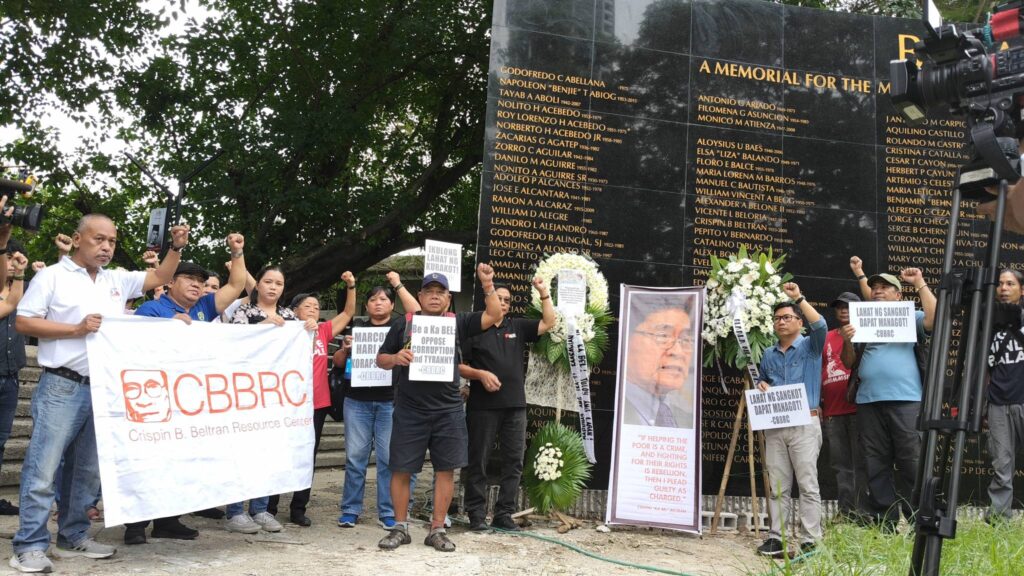
On January 8, progressive organizations of workers and the poor commemorated the life of the late labor leader and congressman Crispin “Ka Bel” Beltran on the celebration of his 93rd birth anniversary. Ka Bel was born on January 7, 1933. He passed away on May 20, 2008, at the age of 75.
The Crispin B. Beltran Resource Center (CBBRC) and Kilusang Mayo Uno led the commemorative program. The speakers traced Ka Bel’s life from being a taxi driver to his service as a representative of Bayan Muna and Anakpawis Partylist.
KMU regards Ka Bel as “a pillar of the labor movement, worker-leader, and patriotic legislator” who left a legacy of “honest, wholehearted, and selfless service to the poor and the oppressed.”
Kadamay’s Mimi Doringo, PISTON’s Mody Floranda, and ANGLO-KMU’s Malou Fabella remembered his life and struggle. Ofel Beltran-Balleta, Ka Bel’s daughter, also shared a personal reflection. She recounted how Ka Bel’s principles continue to live on in their family and in the organizations he founded.
History of proletarian militancy
Ka Bel’s patriotism awakened at a young age. During the Japanese occupation, he served as a courier for guerrilla forces. After the war, he began working as a taxi driver. From 1955 to 1963, he served as president of the Amalgamated Taxi Drivers Association and the Yellow Taxi Drivers’ Union.
He was elected vice president of the Confederation of Labor of the Philippines and the Philippine Alliance of Nationalist Organizations in the 1960s. There, he helped establish various unions such as KASAMA and PANALO. In 1980, he played a significant role in founding Kilusang Mayo Uno (KMU). He served as KMU general secretary while Felixberto “Ka Bert” Olalia was elected its chairperson. When Rolando “Ka Lando” Olalia, the succeeding chairperson, was assassinated in 1986, Ka Bel took his place and served until 2001.
In 1987, he ran for senator under Partido ng Bayan, a coalition of progressive forces formed after the EDSA Revolution. He garnered around 1.52 million votes, a substantial tally for a militant candidate, despite widespread electoral fraud (the so-called “dagdag-bawas” or addition-subtraction operation) and repression during Pres. Corazon Aquino’s term.
In the 2000s, he was elected to Congress three times. First, to the 12th Congress as the second nominee of Bayan Muna (2001–2004), second as the representative of Anakpawis Partylist (2004–2007) in the 13th Congress, and third as the representative again of the Anakpawis Partylist (2004–2010) in the 14th Congress. He did not finish his term because of his sudden death after accidentally falling while repairing the roof of his house.
From 2006 to 2007, then president Gloria Macapagal-Arroyo imprisoned him on fabricated rebellion charges later dismissed by the Supreme Court.
Beyond his patriotism, Ka Bel’s anti-imperialist stance stood out. He served as the first chairperson of the International Coordinating Committee of the International League of Peoples’ Struggle when it was founded in May 2001 in Zutphen, Netherlands, and continued until his death in 2008.
In 2008, Jose Maria Sison and the National Council of the National Democratic Front of the Philippines honored Ka Bel for his “fearless resistance to all forms of political repression.” He was also recognized by the Central Committee of the Communist Party of the Philippines as a “proletarian internationalist, hero of the working class, and of the Filipino people.”