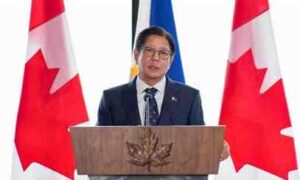
Marcos visit to Japan to strengthen military alliance for imperialist war
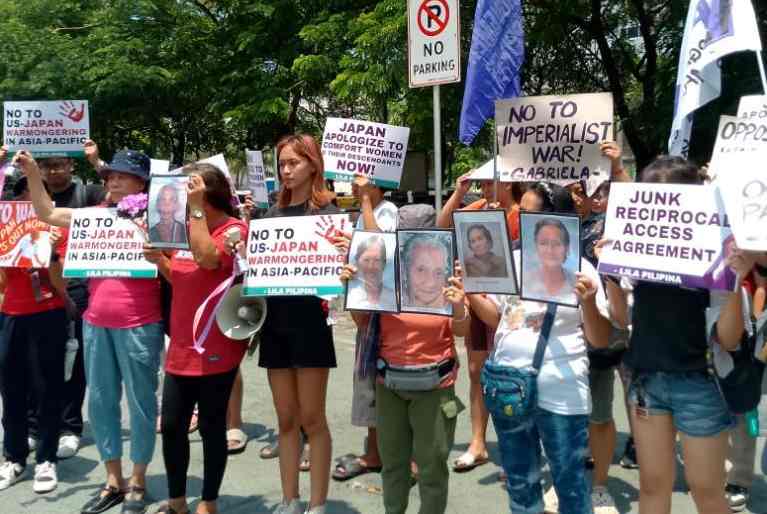
Progressive women’s and migrant organizations protested near the Japanese embassy on Roxas Boulevard on May 26 to demand justice, accountability, and official recognition of the brutality of Japan’s occupation of the Philippines, particularly the crimes against comfort women, during World War II. The protest coincided with the departure of President Ferdinand Marcos Jr for his 4-day state visit to the Japan.
The protesters also opposed new military agreements between Japan and the Philippines such as the Philippines-Japan Reciprocal Access Agreement (RAA) and the Acquisition and Cross-Servicing Agreement (ACSA). The Philippine Senate ratified the RAA in 2025. Philippine Foreign Affairs Secretary Theresa Lazaro and Japanese Foreign Minister Toshimitsu Motegi formally signed the ACSA on January 15. The RAA grants Japanese troops legal status while in the Philippines, while the ACSA allows Japan to stockpile weapons and other military equipment in the country.
National-democratic groups strongly oppose these agreements, which they say directly trample on the memory of all victims of the brutal Japanese occupation. The Marcos regime’s approval for Japanese soldiers to once again set foot on Philippine soil proves its subservience to the US war scheme in Asia, they said. The regime’s peddling of the country’s sovereignty to Japan and the US increases risking Filipinos’ lives.
Marcos’ primary aim in Japan is to strengthen the military alliance between the two countries. He is set to negotiate the purchase of offensive weapons, including the Type 88 Surface-to-Ship Missile, similar to those launched on Philippine soil in the recently concluded Balikatan and Salaknib war games. The Philippines is also set to purchase decommissioned warships from the Japan Maritime Self-Defense Force (MSDF). To pay for the weapons to be bought from Japan, Marcos will borrow ¥64.38 billion (approximately $413 million) from Japan’s Official Development Assistance (ODA) under the Maritime Safety Capability Improvement Project.
Marcos will also borrow from Japan for the Luzon Economic Corridor and other initiatives under Pax Silica. The projects under these schemes will appropriate Filipino people’s resources and land.
Crisis in Japan
Inside Japan, there has been continuing protests against the Takaichi government over its militarist measures, which run counter to the anti-war policy enshrined in their Constitution (Article 9). The Japanese people also opposed the cabinet’s revision of the “Three Principles on Transfer of Defense Equipment and Technology,” a traditional policy that prohibits Japan from selling and exporting offensive weapons (such as missiles and warships) to countries with active conflicts like the Philippines. These loosened restrictions now legally allow Japan to sell lethal weapons to the Philippines.
The Japanese people view these moves as an open invitation to war.
Both Takaichi and Marcos Jr are known across Asia as among the most subservient promoters of the US geopolitical agenda under the US Indo-Pacific Strategy. This strategy aims to encircle China with bases and missiles to “counter” its expanding influence in the Asia-Pacific. The US uses multilateral alliances—such as the US-Japan-Philippines trilateral relationship—to conduct multi-maritime exercises in the South China Sea. These naval operations directly challenge Chinese vessels, using the Philippines as a central launch pad for military operations in the region.