Thousands of Filipinos march to mark International Human Rights Day
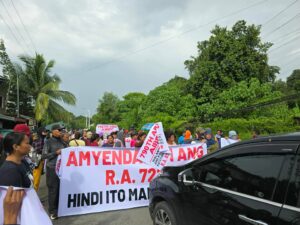
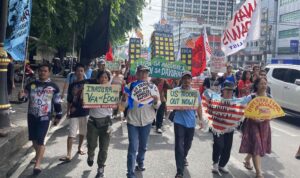
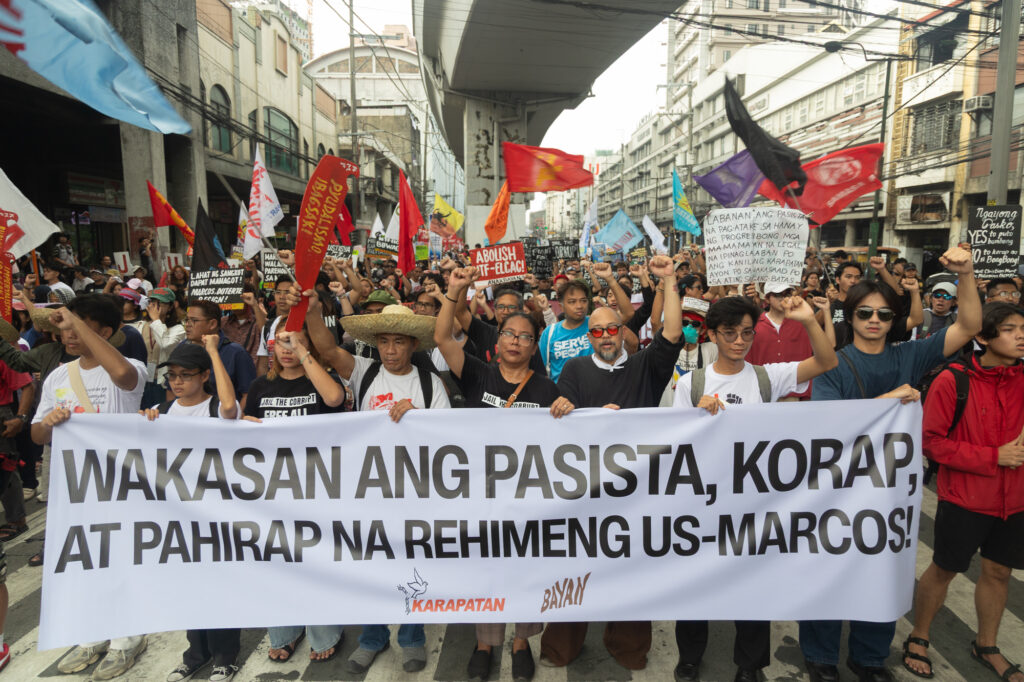
Thousands of Filipinos in various areas nationwide marched to commemorate the 77th International Human Rights Day on December 10. Karapatan and Bagong Alyansang Makabayan (Bayan) led the demonstrations in Manila and in 14 other cities and provinces.
The yearly commemoration of International Human Rights Day began with the adoption of United Nations General Assembly Resolution 217 on December 10, 1948. It promulgated the Universal Declaration of Human Rights, which recognizes that all people, regardless of race, gender, religion, or nationality, possess equal inherent dignity and rights.
In Manila, thousands joined the gathering and program at Liwasang Bonifacio, followed by a march toward Mendiola. Organizations from Southern Tagalog provinces joined the protest, alongside NCR-based groups. The groups and sectors collectively called for the end of the fascist, corrupt, and oppressive US-Marcos Jr regime.
They condemned the US-Marcos regime for its serious violations of human rights and international humanitarian law (IHL). They also expressed outrage over rampant government bureaucratic corruption.
In May 2025, the Marcos regime implemented the National Action Plan for Unity, Peace, and Development (NAP-UPD) 2025–2028. This framework intensified political repression against the Filipino people. The National Task Force-Elcac mainly carried out its implementation.
Karapatan’s records show that the Marcos regime’s state forces perpetrated human rights violations against at least 11 million Filipinos. These include victims of extrajudicial killings, enforced disappearances, arbitrary arrests, forced or fake surrenders, indiscriminate shootings and bombings, forced evacuations and threats, harassment and intimidation, including red-tagging.
At least 696 political prisoners remain in detention, 163 of whom were arrested under Marcos. Of the total number of political prisoners, 136 are women, 93 are elderly, and 89 are ailing. Also detained are 12 National Democratic Front of the Philippines (NDFP) consultants and staff members involved in peace negotiations.
“These scourges augment the suffering of peasants, workers, and the middle class who can barely withstand the severe economic crisis,” Karapatan said. It added that the situation is worsened by the threat of war the US provokes against its rival China amid tensions in the West Philippine Sea.
Concluding the Mendiola protest, groups burned effigies illustrating Marcos and Sara Duterte as the king and queen of fascism and corruption in the country. The effigy depicted Marcos and Duterte carrying rifles while sitting on suitcased cash symbolizing corruption.
Various groups and sectors also launched protests and activities elsewhere in the country.
In Baguio City, the Cordillera Human Rights Alliance (CHRA) led the march and gathering. Hundreds joined the program, exhibit, and cultural night held at Malcolm Square.
In Tabuk City, Kalinga, a prayer rally was held by the Justice and Peace Advocates of Kalinga (JPAK), people’s organizations, the Apostolic Vicariate of Tabuk, the United Church of Christ in the Philippines-Tabuk, and the Episcopal Church of the Philippines. They expressed strong opposition to the Marcos regime’s corruption and fascism at the march. A forum followed.
In Mountain Province, human rights groups and people’s organizations held a forum discussing rampant corruption and serious human rights violations in the province.
In Ilocos Norte, Kaammoyo ti Kappia (KTK, or Peace), the peasant group Alyansa dagiti Mannalon iti Ilocos Norte and the fisherfolk group Daklis picketed in Laoag City. They reiterated the appeal of peasants and fisherfolk in the province for the local government to dialogue regarding their grievances.
In Central Luzon, regional chapters of Karapatan and Bayan led actions in Tarlac, Nueva Ecija, and Bulacan. “These protests confront the escalating attacks on civilians and human rights defenders across the region,” Karapatan-Central Luzon said. They declared that they would not be silenced, intimidated, or cowered by the Marcos regime’s suppression attempts.
In Bicol, democratic organizations staged mobilizations in Legazpi City, Albay, and Naga City, Camarines Sur. They caravanned around Legazpi City then held a program at Peñaranda Park.
In Panay, Panay Alliance Karapatan and Bayan-Panay led the march of hundreds in Iloilo, Aklan, and Capiz. Hundreds also joined the march in Iloilo City, which concluded with a program in front of the Iloilo Provincial Capitol. In Capiz, around 200 Capizeños protested at Plaza Bandstand in Roxas City. In Aklan, groups held their program in a Kalibo City plaza.
In Bacolod City, various sectors marched under the leadership of the One Negros Ecumenical Council (ONE-C), Taumbayan Ayaw sa Magnanakaw at Abusado Network Alliance (TAMA NA, or People Against Thieves and Abusers)-Negros, and Human Rights Advocates in Negros (HRAN). They marched through the city and held a program at the Bacolod City Public Plaza Replica.
In Cebu City, groups gathered at Fuente Osmeña Circle, marched and held a program at the Police Regional Office 7, where they denounced police and military repression against the people. They ended the march at Colon Street.
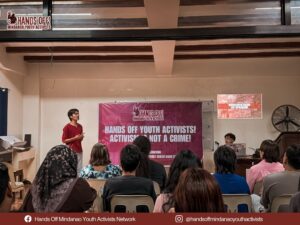
In Davao City, groups held a program at Freedom Park. Pakighiusa sa Anawim (Panaw)-Mindanao launched a two-day Mindanao Human Rights Summit on December 9–10, gathering more than 300 delegates from all over Mindanao.
Meanwhile, the International Coalition for Human Rights in the Philippines (ICHRP) expressed its support for the Filipino people’s struggle for human rights. The global organization called on international organizations and institutions to stand with Filipinos in holding the Marcos regime accountable and advancing the people’s struggle for democracy and human rights.