US-Marcos regime brings catastrophic devastation to the people
The US-Marcos regime brings more suffering, not prosperity for the new year, as 2025 begins. On the year’s first day alone, the public was battered with a new series of price hikes and utility charges. These are new assaults on people’s livelihood and worsening living conditions.
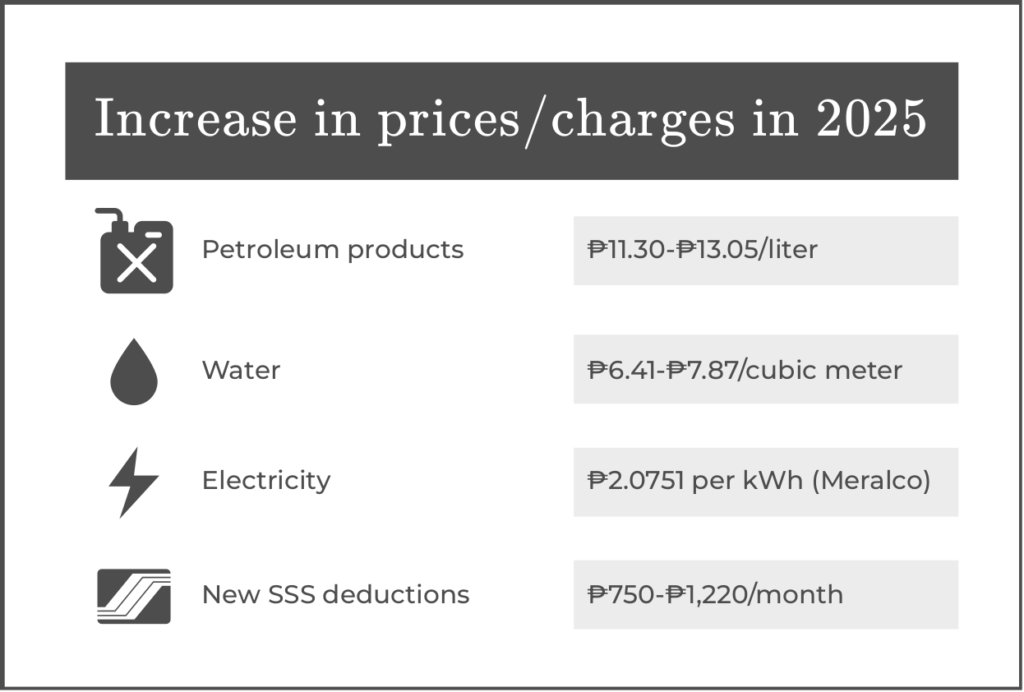
The third in a series of increases in water service charge in Metro Manila took effect on January 1, with Maynilad Water Services charging ₱7.32 and Manila Water Company ₱5.95 per cubic meter. A ₱0.70 to ₱1/liter increase in petroleum product prices was announced on January 3 to start on the second week of the month. Meanwhile, power companies will also charge higher electricity rates this January based on the ₱3.05 billion increase allowed by the Energy Regulatory Board for the entire year.
On top of all these is the additional 1% increase in salary deductions for Social Security Service. This is the fourth since 2018, which pushed ordinary workers’ monthly salary deductions by 12% to 15%.
These burdens add to the long list of hardships Ferdinand Marcos Jr imposed since coming to power.
In the past year, oil companies raised petroleum prices at least 31 times. This resulted in net increases of ₱13.05 per liter of gasoline, ₱11.30 per liter of diesel, and ₱6.95 per kilo of LPG (equivalent to ₱83 per 11-kilogram tank). These increases add to expenses in public transport, fishing, farming, manufacturing, fuel and overall transportation. In November 2024, jeepney drivers reported losing up to ₱2,000 in 25 days of plying their routes. Meanwhile, fisherfolk reported reducing their fishing time from 6-8 to 4-6 hours due to high fuel prices, which account for 80% of their fishing expenses.
Oil companies continued to amass higher profits. Petron, the country’s largest oil company, increased it profits to ₱17.3 billion in the first half of the year alone. The next four largest companies meanwhile earned ₱1.7-₱7 billion profits in the same period. The US-Marcos regime partook of the superprofits gained from high oil prices by imposing layers of taxes on consumers.
The regime also allowed power companies to raise its rates by up to six times. In Metro Manila and nearby provinces covered by Meralco, this meant increases of up to ₱2.07/kwh or an additional ₱415.02/month for a family consuming 200 kwh monthly. This eats up to 17% of a worker’s minimum wage. In other parts of the country, power distributors’ charges sometimes surged to ₱19/kwh.
The regime defended the companies’ “need” to raise its rates to supposedly “recover” generation charge increases caused by increases in electricity price in the Wholesale Electricity Spot Market (WESM). Like oil, WESM is monopolized by the biggest comprador bourgeoisie having shares or directly owning the distributing companies. Among these is Meralco, which generates and sells energy to WESM through Meralco PowerGen Corporation and Cebu Energy Development Corporation, and enters into Power Supply Agreements with its own companies.
While people toil to avoid service disconnection, Meralco boasts of a sure ₱43 billion target net profit for 2024, 17% more than its 2023 profit.
In 2024, water rates in Metro Manila increased by up to ₱7.87 per cubic meter. This is the second in the 5-step rate increases started in 2023. This forms part of the 5-year program approved by the Metropolitan Water and Sewerage System (MWSS) for companies to “recover” their inflation-driven “losses” and to add infrastructure for “efficient” services. The program supposedly targets a ₱19.25 to ₱20.37 per cubic meter total increase by the end of 2027, but after three years, increases have already reached ₱18.48 to ₱20.40.
Aside from the two NCR companies, Davao City Water also imposed steep rate increases of up to 32%. This is part of the total 60% increase since 2022. This is equivalent to a ₱60-₱80 increase in charges for families consuming 20 cubic meters per month.
Conversely, the reactionary state has given little to zero relief to people. Fourteen regional wage boards ordered a very insignificant ₱31.29 average daily wage increase. Wage increase for agricultural workers (₱21/day) is lowest and the highest is for non-agricultural workers (₱75/day), both in Calabarzon. Nine regions increased wages of domestic help by ₱500-₱1000/month. This is a gross insult to workers who need a minimum of ₱1,200/day to decently support a family of five.
Meanwhile, the regime mandated early in 2024 a mere ₱200 increase in the salary of the lowest-paid employees. The order did not cover contractuals under job order/contract of service and local government employees.