Economic crisis directly attacks women
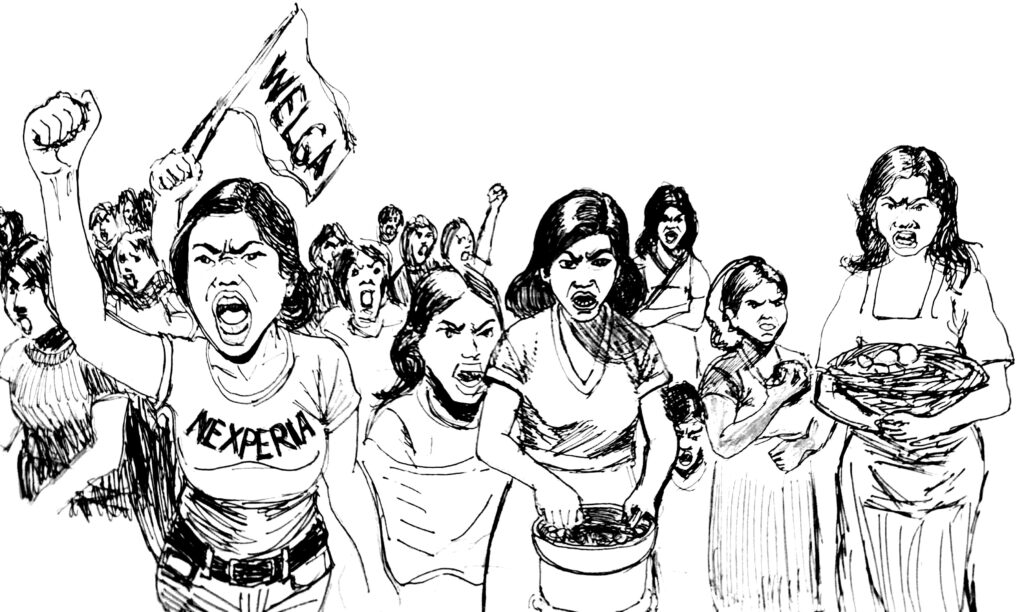
Thousands of women marked the International Day of Working Women amid a raging economic and political crisis. They described the collapse of the standard of living of Filipino families as an assault on women, a direct result of the neoliberal policies of deregulation, privatization and liberalization implemented by successive reactionary regimes. They condemned the current Ferdinand Marcos Jr regime for its failure to lower the prices of food and other goods, as well as allowing private companies to raise charges for public utilities.
The impact of economic collapse, lack of jobs, low wages and low income, and privatized and high costs of social services on women and children is undeniable. The price of rice, meat and fish remains high, despite the regime’s promises to lower it through additional imports. Electricity and water charges have increased, and LRT charges will increase starting April 2. Price increases of LPG and other petroleum products remain unabated.
Women and other sectors gathered and held a collective dance protest in Manila, Laguna, Batangas, Baguio, Tabuk City in Kalinga; Iloilo, Capiz and Aklan in Panay; Naga and Legazpi in Bicol, and in Davao.
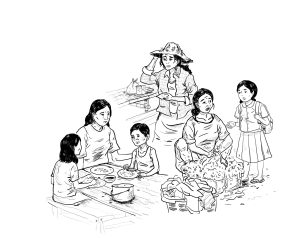
The state does not count almost half of women aged 15-65 in the country’s “labor force”. They are considered unproductive, even though they toil with their husbands in the fields, streets and other places where they can squeeze a little income.
Women recognized as having jobs are in the service sector where contractualization is widespread and where they earn minimum or low wages. They are not regular even in large companies. Within the government, four out of every 10 employees under the job order/contract of service arrangement are women.
In general, they receive lower wages compared to men. They are employed in jobs “suitable” to their “traditional” roles which are more often in the lower ranks of production and bureaucracy. As students, they are usually pushed into courses in sewing, beauty care, and secretarial work that have low wages and often have irregular work days. Jobs with greater potential for regularization and higher positions are reserved for men.
Unionized workers are very few, but unionized women are even fewer. Most of the remaining unions are in traditional industries dominated by men, such as manufacturing and construction.
Not surprisingly, women comprise majority of those terminated by capitalists. In recent years, thousands of women lost their jobs when foreign garment companies inside export processing zones in Cebu closed. Meanwhile, the jobs of women who make up to 55% of business process outsourcing or BPO employees are at risk, with the use of artificial intelligence by foreign companies.
Apart from widespread redundancy-driven layoffs, discrimination also cause many women’s dismissal from work. Large companies deliberately do not hire pregnant or married women (because they might get pregnant). They are laid off after giving birth as they are not covered by the maternity leave law. The capitalists and the state provide no support to women with young children.
The inequality and poverty women endure is even starker in the countryside. In several decades of implementing land reform, only 19% of women hold emancipation patents and 31% in certificate of land ownership agreement or CLOA.
The lack of land and scarcity of work force millions of women to go abroad to earn. Six out of every 10 Filipino migrants are women. Their jobs are of low quality and vulnerable to abuse, extreme exploitation and human trafficking. Among the victims of human trafficking is Mary Jane Veloso, imprisoned for 15 years in Indonesia, who survived the death penalty and, although still imprisoned, was returned to the country, through the persistence of her relatives, friends and supporters.
In terms of health, the state’s policies are not only a burden, but deadly for women. Until now, the state has not addressed maternal mortality or the death of women giving birth. From January to August 2024, 470 maternal deaths were recorded, equivalent to 59 dying in childbirth per month. In the past year, maternal deaths reached 1,868.
Health facilities for women are not only inadequate, but also privatized. More than half (58%) of maternity facilities are private and charge tens of thousands of pesos for normal childbirth, and much more for caesarean birth. Check-ups and treatment of women’s diseases such as breast and cervical cancer are very expensive. In 2022, 33,079 new cases of breast cancer were recorded, where 11,857 were recorded to have died, equivalent to 32 women per day.
The state’s protection for women, especially young women, is not enough. In 2023, there were 142,276 cases of teenage pregnancies, and 390 young women gave birth every day. Of this number, 3,343 were pregnancies of children aged 15 and below and 99% of these cases were the result of statutory rape or rape by older men who used power or authority.
The state’s lack of protection for children against sexual exploitation is worse. Worldwide, the Philippines is the production center of child sexual abuse materials. In 2023, the Philippines received almost 3 million, equivalent to over 7,500 complaints per day of suspected online child sexual exploitation. These remain unchecked due to the state’s failure to respond to the majority of these complaints.
Amid crisis and poverty, violence against women has intensified. In limited police reports, there were 12,046 cases of various types of violence against women from January to November 2024, higher than the 11,585 cases in 2023. Only one in 10 cases of violence against women is reported to the police due to distrust of authorities. Victim’s disclosure has been made even more difficult in the era of social media with the pervasive culture of blaming victims, forcing them to remain silence in the belief that reporting the crime will change nothing.