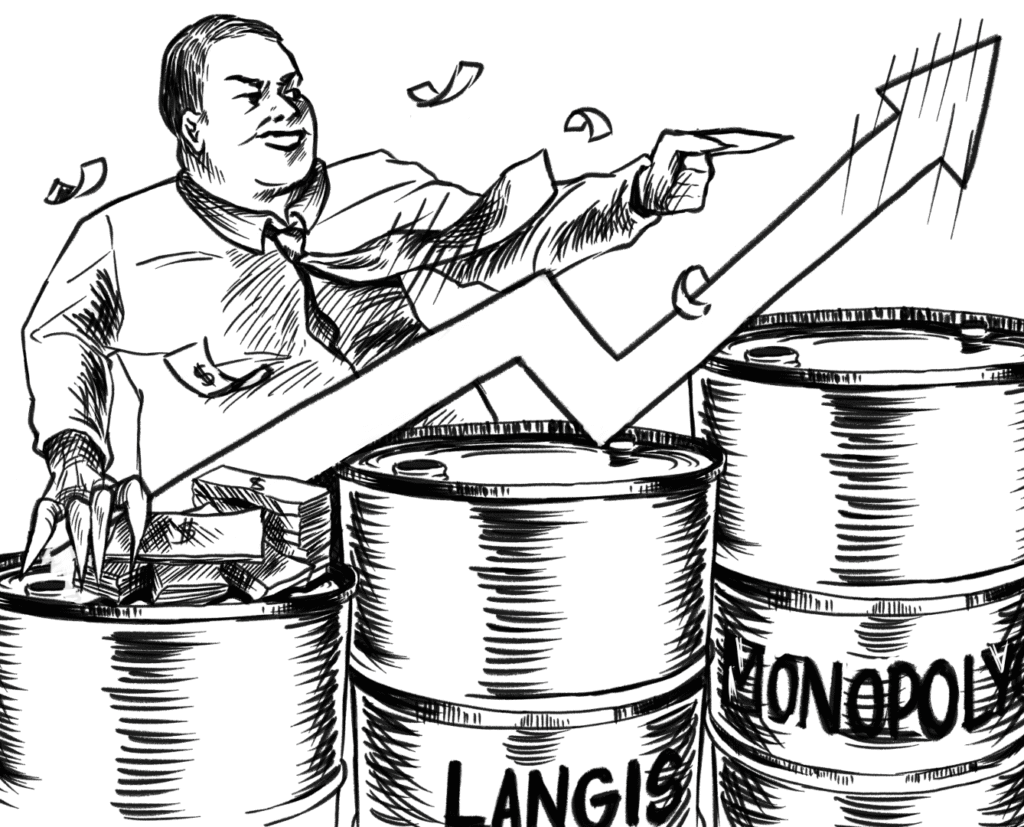
Manipulation, speculation and monopoly pricing of oil
Every Tuesday, the prices of petroleum products change in the Philippines. From January to May 20, prices rose eleven times while decreasing ten times. The increases are larger than the decreases, which resulted in a net rise of ₱4 per liter for gasoline and ₱3.80 per liter for diesel.
On May 20, democratic groups led by Bayan Muna protested anew against another large price increase (₱1.30 per liter for gasoline; ₱1.80 for diesel, and ₱0.95–₱1.40 for kerosene). This happened despite the continuous decline in the world price of crude oil since April, by as much as $10 per barrel.
Oil companies and the Department of Energy (DoE) always claim that price increases “mirror fluctuations in the price of crude oil on the world market.” Among the reasons cited are production cuts by the Organization of the Petroleum Exporting Countries (OPEC), increased demand in cold countries, as well as the outbreak of armed conflicts related to oil producers.
Manipulation and monopoly pricing
The Philippines is not an oil producer. Only one refinery remains in the country. In 2024, the Philippines consumed an average of about 471,000 barrels of various petroleum products per day, 95–99% of which are imported. In 2022, 78.2% of imported oil was refined, while only 21.8% was imported as crude oil.
Thus, local oil prices are truly affected by the fluctuating price of crude oil worldwide, but not directly. Changes in refining costs, supply or refinery process problems, locally imposed taxes (12% VAT and excise), transportation costs, and the exchange rate between the peso and dollar have a more direct effect on local prices.
Overall, the OPEC+’s cartel actions affect prices because they control 40% of the supply and 80% of oil reserves worldwide. The cartel can set the selling price of crude oil in the market far above its production cost. Saudi Arabia’s Aramco, for example, produced crude oil at a cost of $11.80 per barrel in 2024. This year, the selling price on the world market is about $31 per barrel.
OPEC+ manipulates the price of crude oil in the world market by coordinating supply cuts or increases. One study states that up to 30% of the world oil price results from OPEC+ manipulation of supply.
OPEC+ last set a production cut in November 2023. Member countries agreed to reduce production by 2.2 million barrels per day to stop the then-declining price of crude oil. But starting this April, the eight largest producers agreed to gradually increase supply over the next three months. Observers say this move responds to Iran’s violation of the agreed production quota, and at the same time, counters the US threat to flood the market with relatively cheaper shale oil. The US is not part of OPEC+, and any movement in its oil production threatens to take market share from OPEC+.
In daily trading, speculation in so-called “futures trading” also affects the fluctuation of oil prices. This is a system of trading on future prices of oil yet to be produced and used. The price of “futures” is set according to speculation on market movements, possible production bottlenecks, and geopolitical events such as the sudden outbreak of wars or uprisings. But according to a recent study, 60–65% of oil price movements within a trading day now result from “algorithmic trading,” or the buying and selling of “futures” according to technical data movements. This no longer has anything to do with actual market movements or world events.
Deregulated manipulation
In the Philippines, oil companies further boost local prices using the Oil Deregulation Law, a law that removed state control over the industry. Under this law, the state allows companies to “adjust” their prices according to movements in the world market and to directly pass on any changes to consumers. The law was passed to promote “free competition” in the sector.
Instead of “competition,” the law created a cartel-like situation where oil companies find it easy to manipulate, overprice, and collude. Oil companies have no obligation to inform the state and the public how much of the price change is due to changes in the world market price; how much is due to refining, storage, and transportation; and how much is claimed as profit. In 2019, the state tried to require companies to publish these figures, but companies actively opposed and blocked this.
Local prices have in the past been proven to rise more than the increase in the price of crude oil on the world market. In a study by Ibon Foundation covering price changes from 1999 to 2011, local oil prices were 20–22% higher than the increase in world oil prices. Two of the largest oil companies in the country, Shell and Caltex, are subsidiaries of multinational companies, which engage in price manipulation and speculation on a global scale.