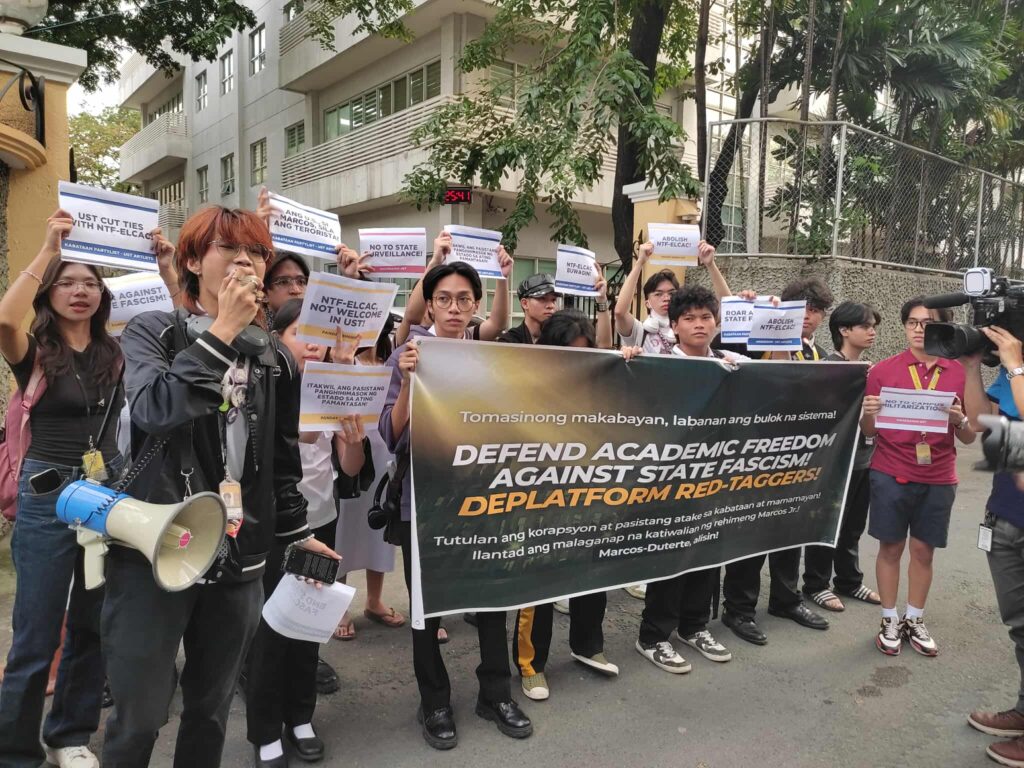
UST students refute lies of NTF-Elcac and its traitorous agents
Students of the University of Santo Tomas (UST) resolutely confronted the lies and garbage spewed by the National Security Council, National Task Force (NTF)-Elcac, and its traitor-agents who gave a “presentation” during a campus forum on November 6. In the forum, a Philosophy student bravely and militantly debated with the NTF-Elcac speakers against their red-tagging and repressive campaign.
Despite the earlier UST Political Science Department declaration that it would exclude NTF-Elcac from the forum due to widespread criticism, it still allowed the participation of NTF-Elcac director Jose Joel Egco, and Arian Jane Ramos, an NTF-Elcac paid follower and traitor to the people’s national democratic cause. Ramos is an official of the Buklod Kapayapaan Federations, a group of “former rebels” established by the Armed Forces of the Philippines and NTF-Elcac.
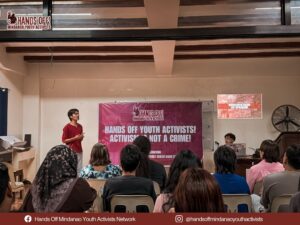
Philosophy student and UST Kabataan Party-list member Raven Racelis spoke and asked questions at the forum titled “Preventing Terror Grooming: The Philippine Experience.” NTF-Elcac speakers mocked and insulted her for exposing the agency’s fascist objectives and red-tagging.
The forum discussed topics such as “terror grooming,” “recruitment practices,” “experiences of former rebels,” and “analysis of the state’s counterinsurgency policies.” Racelis said the forum was deeply offensive because it baselessly accused discussions and studies of mass organizations of being “ideological grooming” and even showed photos of rallies associated with the armed revolutionary movement.
“How did studying poverty, history, and social conflict become terror grooming? Since when did critical thinking become a crime?” Racelis said. He also condemned NTF-Elcac for labeling legal democratic youth organizations as the revolutionary movement’s “recruitment grounds.”
The UST Central Student Council and other campus organizations opposed the forum. “Tomasinos stand with the people in struggle, not as tools of the fascist state! We strongly oppose NTF-Elcac and the blood and fear it has spread among the people!” the council declared.
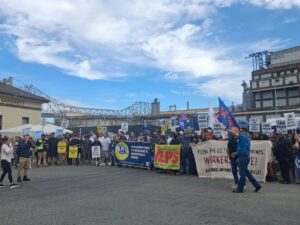
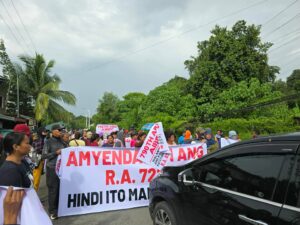
On the afternoon of November 5, UST students led by progressive campus groups launched a protest against NTF-Elcac’s intervention. “Tomasinos know that the fake forum serves as a state tool to propagate its propaganda that vilifies criticism and defends the repressive state’s rotten system,” Anakbayan UST spokesperson Dex Frogoso said.
Various groups, including Karapatan, expressed support for the struggle of UST students. “NTF-ELCAC has no place in schools and universities,” former Kabataan Representative and Karapatan national council member Raoul Danniel Manuel said.
Karapatan warned against the growing pattern of state agencies’ intervention in schools and universities in pushing the government’s “whole-of-nation approach,” which normalizes militarization and surveillance of students and youth. “This kind of fear-mongering is meant to silence dissent and discourage collective action,” Manuel added.
Framed within the CVE doctrine
This AFP and NTF-Elcac tactic originates and is framed under the US doctrine of “countering violent extremism” (CVE). The CVE labels as “extremism” or “radical ideologies” any idea considered a “threat” to the ruling system. It is used as a cover to suppress all forms of expression and resistance against the state.
It portrays “extremism” as the driver behind people’s resistance, including legitimate and just armed struggle against the reactionary ruling state. Contrary to what the CVE suggests, these are not caused merely by ideas and beliefs but by the concrete conditions of oppression, exploitation, and state violence.
The CVE was first adopted under the Obama administration in the US in 2014. It was used during the anti-Muslim campaign and foments Islamophobia, while simultaneously targeting progressive political activists. The doctrine depicted Muslims and activists as “inherently violent.”
The CVE was used to police and monitor community leaders to profile individuals based on their behavior, especially regarding religion, race, and politics. It aims to track the “radicalization” of individuals allegedly leading to “terrorism.” It is also called “soft counterterrorism.”
Even without having committed any act, an individual’s behavior and mindset could already be labeled “terrorist.” This violates basic human rights such as the rights to privacy, expression, assembly, and organization. It instills fear and leads to “self-surveillance” to avoid suspicion, weakening and damaging communities.