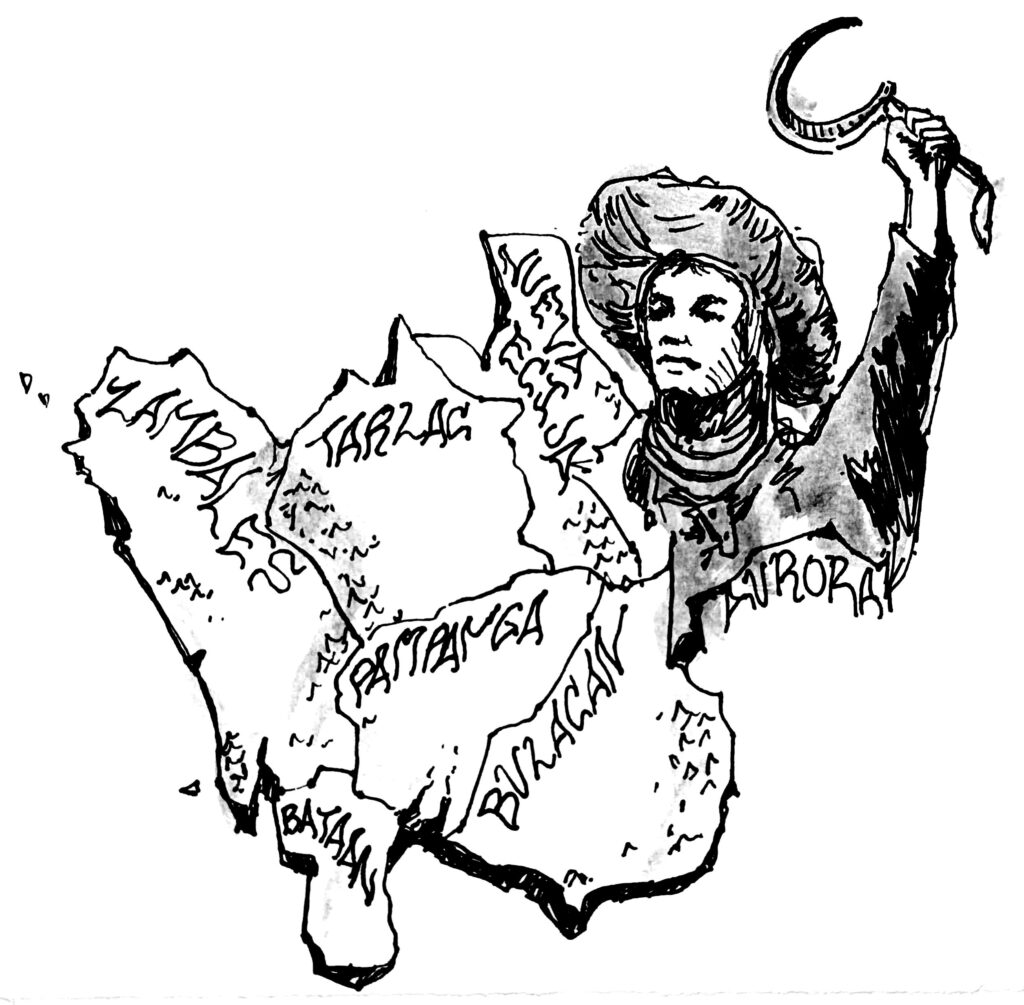
Central Luzon farmers oppose land grabbing and land-use conversion
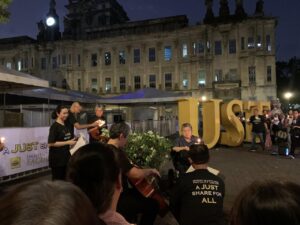
Farmers from Central Luzon staged a protest camp from March 24 to 28 in front of the Department of Agrarian Reform in Quezon City to express vehement opposition to widespread land-use conversion, land grabbing, and state fascism in the region. Over five days, the Kilusang Magbubukid ng Pilipinas (KMP) led programs and discussions with their supporters from various democratic sectors. The camp ended with their participation in a protest at Liwasang Bonifacio to hold Rodrigo Duterte accountable for his crimes against humanity. On the final night of the camp, participants lit candles for victims of at least 22 massacres targeting farmers under the Duterte regime, alongside victims of the regime’s fake war on drugs.
Central Luzon is called the Rice Granary of the Philippines for its high rice production (20% of the national total). It has the largest area dedicated to rice production (705,078 hectares) and the highest yield at 5.13 metric tons per hectare.
Over the past decades, thousands of hectares of rice fields have been converted to residential, commercial, and industrial use. The region has also been swamped with infrastructure projects, mostly large roads, resulting in the displacement of farmers and destruction of farmlands. According to state data, farmland areas in the region decreased by up to 29% between 1991 and 2012, at a rate of nearly 9,000 hectares per year. Between 2012 and 2022, an additional 82,269 hectares of farmland were lost, equivalent to 18.44% of the region’s total agricultural land.
According to KMP, the government treats Central Luzon like a blank slate for infrastructure and real estate projects. It denounced the damage to livelihoods and ecology caused by the Marcos regime’s Build Better More program (2023-2028), a continuation of Duterte’s Build, Build, Build program (2017-2022). Seventeen of the total 149 “flagship projects” are located in Central Luzon. Twelve of these are transportation infrastructure projects (airports and roads), eight of which are already in progress. The New Clark City project, a massive undertaking covering nearly 10,000 hectares, was not included in the list of “flagship projects” despite being in the implementation process.
According to 2022 government data, these projects account for 99% of the ₱1.54 trillion investments pouring into the region. Of this investment, 56% is foreign debt (under Japan’s “official development assistance”), while 41% falls under public-private partnership schemes or joint ventures with major comprador bourgeoisie.
Two of the regime’s “flagship projects” are the Central Luzon Link Expressway (CLLEX) and North Luzon East Expressway (NLEE). Like previous expressways, these projects have cut through rice fields. Foreign loans from the imperialist institution JICA fund both projects.
KMP’s study found these projects will result in the loss of up to 704 hectares of farmland. This would mean a reduction in rice production by up to 4,641 metric tons or 3,017 metric tons of rice annually. Farmers said this reduction is enough to feed those the state considers “food poor” in Bataan, Pampanga, and Aurora provinces for an entire year.
These projects also make remaining farmlands prone to prolonged and frequent flooding caused by the reduced soil capacity to absorb rainwater.
In addition to these projects, the Marcos regime conspires with the biggest comprador bourgeoisie for a new wave of agricultural land-use conversions in the region. These include 290 hectares of farmland designated for Ayala Land Inc.’s Crescendo residential-industrial project; farmlands adjacent to expressways planned for commercial establishments by SM Prime; and 200 hectares in Tarlac City slated for conversion into an “economic zone” by Aboitiz Infracapital.
According to KMP, allowing corporations to destroy agricultural lands puts to risk national food security and endangers millions of Filipinos with disasters.