Neglect and land grabbing lead to agricultural job loss
The economic situation of the peasant masses in the countryside continues to worsen. Most farmers have little or no land and have no other means of livelihood.
The US-Marcos regime cannot conceal this, even with manipulated statistics. The Philippine Statistics Authority (PSA) recently reported that more than 609,000 lost their jobs in the agriculture sector from March 2024 to April 2025. An estimated 483,000 of these are rice farmers. According to data from Ibon Foundation, up to two million lost their jobs in agriculture in 2024, while 276,000 fisherfolk lost their jobs in 2024.
The worsening livelihood crisis in the countryside mainly results from the backward state of agriculture and lack of industry. Kilusang Magbubukid ng Pilipinas chairperson Danilo Ramos said the continued increase in the number of unemployed is not simply a matter of “mismatched skills.” He said this is a direct effect of stagnant agriculturial and industrial sectors, which supposedly provide sustainable jobs.
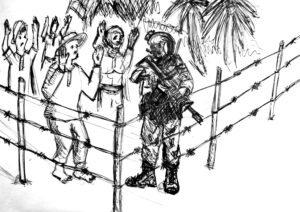
The poverty situation of the peasant masses is worsened by climate change, successive typhoons and disasters, the continued drop in farmgate prices, the influx of imported agricultural products, land use conversion, militarization, and many other factors.
The dire situation of farmers is further deteriorating under the US-Marcos regime. In addition to the bogus Comprehensive Agrarian Reform Program (CARP), it implemented other neoliberal programs such as the Support to Parcelization of Lands for Individual Tilting (SPLIT), New Agrarian Emancipation Act (NAEA), Build Better More, and EO 18 or Green Lanes for Strategic Investment for energy projects.
These policies result in the eviction of farmers from their land, division of land to facilitate control of farmers, while favoring landlords, the oligarchy, and foreign investors. Examples of this include the eviction of farmers from Lupang Ramos in Cavite, Hacienda Tinang in Tarlac, the BTL community in Bukidnon, and the most glaring example of CARP’s emptiness, Hacienda Luisita of the Cojuangco-Aquino family.
From July 2022 to January 2025, the Department of Agrarian Reform (DAR) brags of having distributed nearly 195,000 land titles. However, 68% of these came from SPLIT—subdivided collective Certificates of Land Ownership Award (CLOA) and not new land distributed to landless farmers. Despite the large budget, the SPLIT program achieved only 12% of its target.
To make it appear that the US-Marcos regime fulfills its duty to farmers, he went around various provinces to distribute worthless titles. In reality, SPLIT and NAEA are schemes to prepare land for the “free market,” where agricultural land will be sold, leased, or converted to other uses.
Ramos said, “These programs aim not to ensure farmers’ rights but to pave the way for real estate, infrastructure, and energy companies to acquire land under CARP.”
According to KMP data, only 28% of land parcels are owned by farmers, thus 7 to 8 out of 10 farmers do not own land. Landlords own 20% of farmland while 68% of all farms are squeezed into 13% of the land.
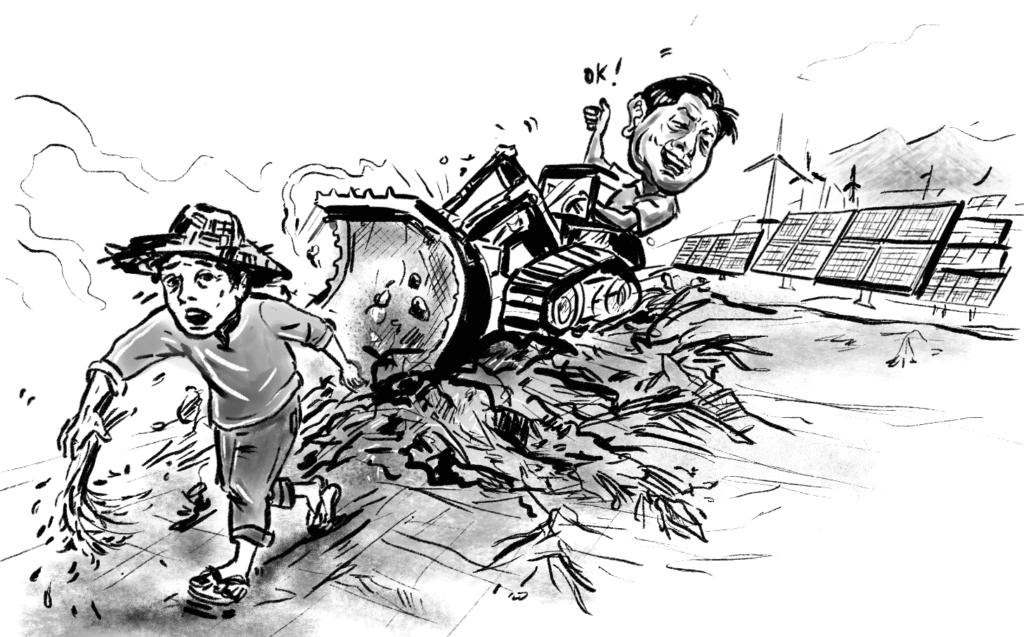
Under the banner of “green” development, the US-Marcos regime accelerated granting of permits to companies, especially foreign investors, to grab land. Renewable energy projects worth ₱5.239 trillion threaten to displace thousands of residents.
In addition are the 207 infrastructure projects like the Bulacan International Airport, New Clark City Pampanga, and the TARI estate in Hacienda Luisita that will displace farmers and indigenous people, destroy livelihoods, and raise land prices to the benefit of investors.