Correspondence Rectification movement in Southern Tagalog: Internalize theory, learn from one’s own practice
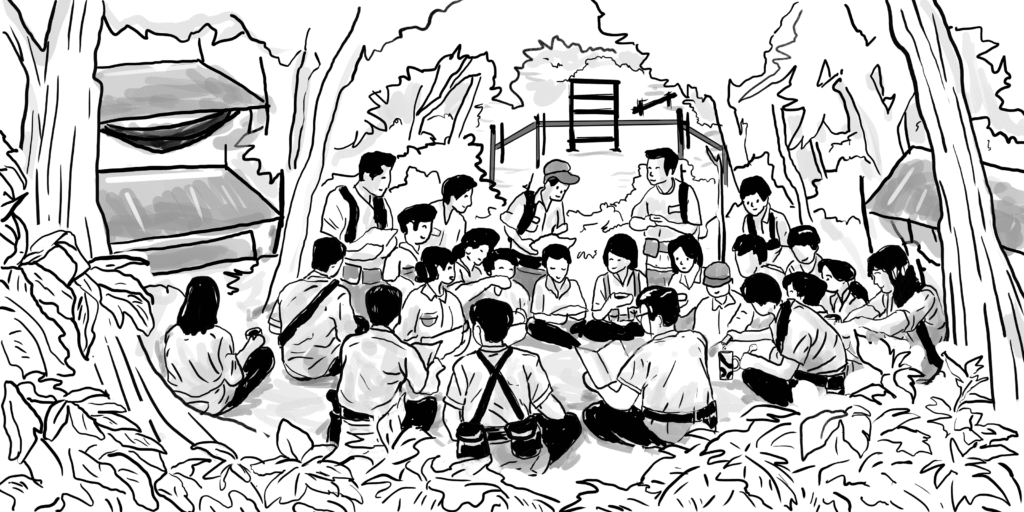
Amid the unrelenting military operations since 2024, a mass work and military work conference was successfully launched in a guerrilla front in Southern Tagalog. The gathering of New People’s Army (NPA) units primarily aimed to sum up and share experiences to better confront the Armed Forces of the Philippines (AFP)’s intensifying annihilation campaign in the subregion. The participants included a mix of senior, middle-aged, and younger cadres. More than half of the participants were youth.
Study, rectify, advance
The conference opened with two case studies in mass work. These were drawn from the experience of two people’s army units over roughly a year. The main points discussed were the units’ methods in mass work: balancing expansion and consolidation, and the duration of its encampment and its proximity to the masses’ communities. Conservatism in mass work and favoritism toward certain bases were sharply identified and are now being rectified.
It emphasized the key role of educational, propaganda, cultural, and medical work in effective and deep-reaching mass work. A good example of this was a squad’s release of a primer that discussed the masses’ current situation and problems in a town, as well as the their rich revolutionary history gathered from social investigation. The primer was effectively used to unite the masses and establish groups and branches of revolutionary mass organizations in the said town.
It also highlighted how important it is for the people’s army carrying out mass work to participate in production and provide medical services. The positive and negative experiences underscored the decisive role of correct Party leadership and firm unity in advancing the people’s army’s mass work despite obstacles, hardships, and changing situations. After presenting the case studies, the “Basic Principles of Mass Work in the Countryside” was reviewed.
Case studies of both successful and failed tactical offensives as well as some defensive battles, were next presented and discussed. These case studies highlighted the importance of intelligence work and organizing and mobilizing the masses for this work.
As with mass work, the case studies underscored the need for the absolute leadership of the Party over the people’s army to forge unity regardless of the confronting situation. Without such Party leadership, the people’s army’s main task of defending against and defeating the enemy, will not be effectively performed. Afterwards, Mao Zedong’s “Problems of Strategy in China’s Revolutionary War” was studied.
At the core of summing up experiences in mass work and military work, and studying the underlying theories, was the cadres’ grasp and deepening understanding of the basic principles of guerrilla warfare in the strategic defensive stage and in the context of the NPA’s restrengthening after setbacks caused by internal weaknesses and in facing enemy attacks.
Discussions over coffee were held during some evening sessions where they shared experiences in recruiting young peasants, indigenous people, and young intellectuals. These provided valuable lessons and inspiration on how to invigorate NPA recruitment and how to strengthen and improve the Red fighters amid intense battles with the enemy.
To identify the ideological roots of weaknesses and problems, Mao’s “Special Course on Empiricism” and “On Practice” were also studied. This aimed to effectively target the empiricist tendency in thinking and action shown by the case studies. Such tendencies manifested particularly in being satisfied with unsynthesized data about the social and economic situation of the masses, a shallow grasp of the areas’ revolutionary history, and low-quality intelligence work. The guerrilla front’s experience made it clear that incomplete and insufficient social investigation and class analysis result in inappropriate political policies and programs and military plans.
At the end of the conference, participants were asked to reflect. Ka Lima said “We must purge subjectivism and individualism from every fiber of our being, as well as arrogance, complacency in all aspects. This is very easy to say, but truly a challenge in practice. We must remould our way of thinking to sharpen our analysis of things and make correct steps to solve problems.”
“Fight to strengthen! Strengthen while fighting!” This is the call of the rectification movement to the revolutionaries in Southern Tagalog.
Despite the military situation they will face, the spirit of Red commanders, political guides, and fighters remained high as the units dispersed to shoulder the new tasks set by the conference. The challenge for the Party and people’s army in the current critical stage of the revolutionary movement is clear: Shoulder the increasing and expanding tasks and sacrifices with unwavering spirit to serve the people and confidence in the revolution’s correctness and victory.