SCMB Railway and LEC projects to serve US imperialist interests
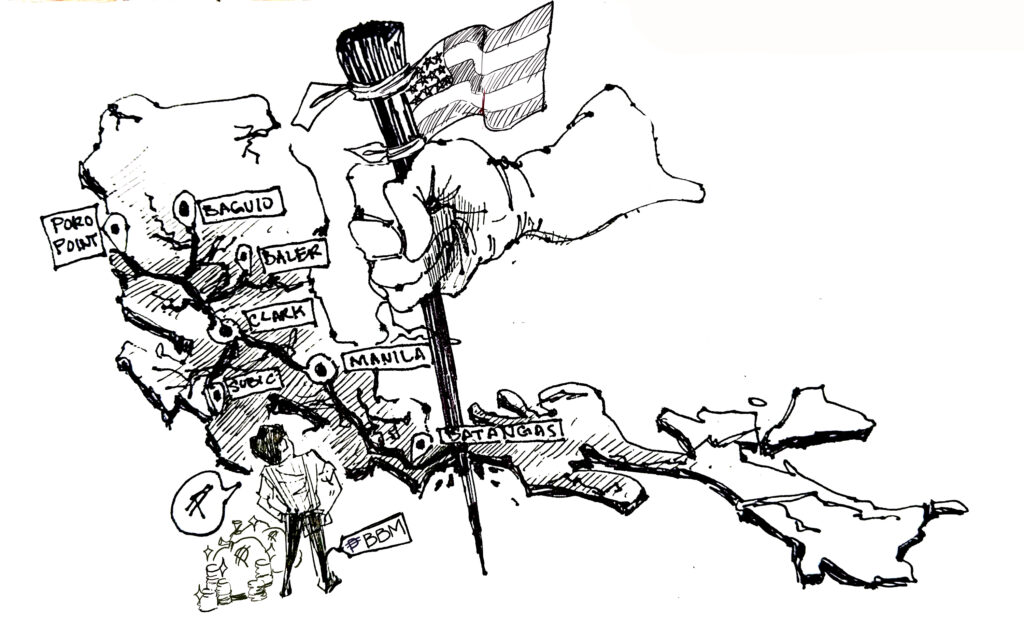
On June 26, the Marcos regime and the US Trade and Development Agency (USTDA) signed an agreement for a US government loan of $3.8 million to fund initial research and studies for the Subic-Clark-Manila-Batangas (SCMB) Railway project. The project aims to establish a rail system for transporting goods to allegedly reduce congestion at the Manila port.
The 250-kilometer SCMB Railway will connect Subic and Clark, traverse the National Capital Region, and end at the Batangas port. According to USTDA’s plan, the Subic-Clark segment will begin construction in 2027-2028, while the Clark-Manila-Batangas segment will start in 2028-2029. The project aims to start railway operations in the early part of 2030. The entire project is estimated to cost $3.2 billion.
The Duterte regime first offered the rail project between Subic and Clark to the Chinese government in 2016. China promised to fund it in 2018 but withdrew in 2022. When the Marcos regime came to power, the project was revived and extended to Batangas at the behest of the US.
This project was subsumed under the so-called Luzon Economic Corridor (LEC), a trilateral program among the US, the Philippines, and Japan that aims to expedite the dumping of their capital, personnel, and equipment in the form of infrastructure projects in renewable energy, ports, airports, bridges, and roads. The LEC is the first project of the US Partnership for Global Infrastructure and Investment and is a key part of its Indo-Pacific strategy against China, specifically to counter the latter’s Belt and Road Initiative.
Besides the SCMB Railway, 27 other infrastructure projects have also been placed under the LEC, including the expansion of Clark International Airport, Bataan-Cavite Interlink Bridge, Subic Bay (Redondo-Ilanin) Bridge, Central Luzon Link Expressway, North Luzon East Expressway, Laguna Lakeshore Road Network Development, Kalaanan Irrigation Project, North-South Commuter Railway, New Clark City Extension Railway, and Southern Batangas Airport.
The SCMB Railway and other infrastructure will be built for the use of foreign companies, such as American manufacturing and battery companies that aim to profit from the Philippines’ rich resources of nickel, cobalt, copper, and bauxite.
The US, together with Japan and NATO countries, aims to pour up to $100 billion in capital over the next 10 years. Most of this funding will take the form of loans and private capital, which will be exempt from taxes, and have no direct links to the local economy.
Alongside its economic objectives, the SCMB Railway and other projects under the LEC have clear military and geopolitical aims. The SCMB Railway and the network of bridges and roads will connect major “EDCA sites” or US military bases in Luzon, and will facilitate the transport of weapons, personnel, and military vehicles along them. It will also ease military transport in other parts of Luzon. Meanwhile, the Clark airport expansion will serve US warplanes, already having extensive hangars and parking at the adjacent Basa International Airport.
The LEC’s military objective became even clearer with the recent US Congress announcement about plans to build an ammunition factory in Subic. Earlier, the US had leased a large warehouse in Subic to store military equipment supposedly as part of disaster preparedness.
Beyond the Philippines, the LEC is part of the broader US strategy to contain China’s growing influence in Southeast Asia. American investment remains dominant in the region but many countries favor Chinese investment for large infrastructure, manufacturing, and mining projects, and thus remain open to geopolitical engagement. Unlike the Philippines, ASEAN countries avoid being tied to an exclusive military alliance with the US.