Fact-finding mission in Mindoro Standing up for the Mindoro masses
Various groups, including Karapatan-Southern Tagalog, bravely confronted the 203rd IBde’s brazen military harassment and violence, to carry out a fact-finding mission (FFM) on the island of Mindoro from February 23 to March 1.
The team sought to determine the condition of the Mangyan and peasant masses gripped by militarization and military terrorist rule. No less than 10 combat battalions of the military are stationed in Mindoro for “counter-insurgency” operations. In their investigation, they recorded the military’s various violations of international humanitarian law which protects civilians in areas with armed conflict.
The team specifically visited the towns of Pola, Bulalacao, and Mansalay in Oriental Mindoro where a series of human rights violations were reported following the encounters of the 203rd IBde with the New People’s Army (NPA)-Mindoro in February. Upon the team’s arrival on the island, a de facto martial law was already imposed in the barangays.
In Pola, the team was blocked and prohibited from entering three distressed villages. Officials claimed the community was in good condition. But interviews with residents revealed to the team the residents’ anguish following the aerial strafing conducted by the military after a 3-hour gunfire exchange. This forced them to evacuate. A mother and her 3-month-old baby were severely traumatized.
After the incident, the military convened barangay officials to implement a lockdown in the communities. They imposed a curfew and searches, and threatened to charge anyone who disobeyed orders.
Soldiers used the community school as barracks and erected checkpoints. They illegally arrested and accused some coconut farmers of being Red fighters. The soldiers were forced to release them after proving they were residents of the area. Coconut farmers suffered significant income losses because they were prohibited or afraid to work. The price of copra could have been high. Even resorts were prohibited from accepting tourists. Meanwhile, schools in two barangays were closed for a week.
Residents complained having received no compensation or assistance from the state during several days of military restrictions.
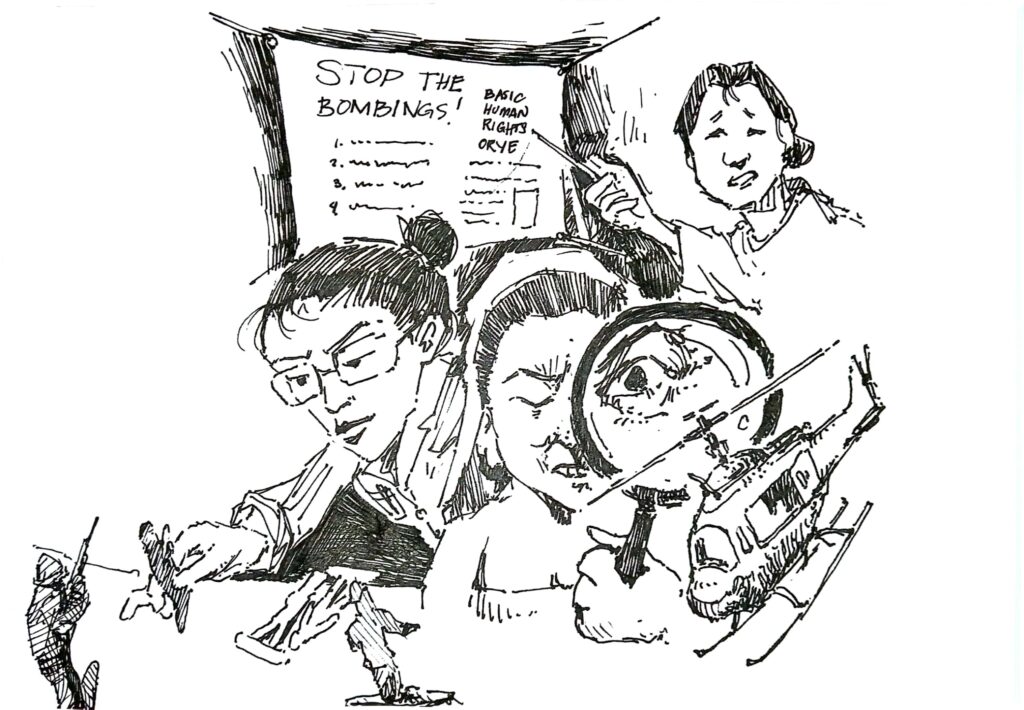
The team found a similar situation in two barangays in Bulalacao. Alongside interviewing residents, they distributed leaflets about the human rights situation in the Mindoro island.
The team launched a Basic Human Rights Orientation for the Mangyan-Hanunuo indigenous people to inform them of their basic rights to protect themselves against military harassments.
In Mansalay, the team interviewed residents of one of the affected barangays. Before leaving the island, the team held a candle lighting and offered prayers at a church in Calapan.
During the FFM, two military intelligence personnel harassed and assaulted three team members while they were resting. One was pulled by the arm while the two others were threatened, and two agents even attempted to throw objects at the team. Throughout the FFM, military personnel relentlessly surveilled them.
Despite these challenges, the FFM successfully reported the results of their investigation to the public on March 5 in Quezon City. The team promised to return to the island of Mindoro to continue upholding the rights of the Mindoreño masses.
On the very day of their departure on March 1, the 203rd IBde reportedly began a new series of aerial strafing and bombing in Mansalay, Oriental Mindoro. Residents said two Blackhawk helicopters released a volley of gunfire twice on three adjacent sitios in Barangay Panaytayan, terrorizing civilians. The local unit of the New People’s Army denied that any of their units were hit in the area where bullets were rained.