Correspondence PKM establishes chapter amid military operations in Negros
The Communist Party of the Philippines, the New People’s Army, and the entire revolutionary movement in Negros remain determined to strengthen their area’s mass base. They exert their full strength, courage, and resolve to carry out mass work, guided by the rectification movement, amid relentless military operations in the guerrilla front.
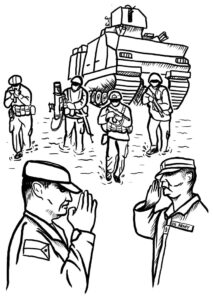
Throughout almost the entire month of August, the AFP and SAF-PNP intensified and expanded their military operations in the mountains of one guerrilla front in Negros. They deployed more than 600–700 forces in 32 columns (9–12 elements each) of fascist troops from five military battalions and one police battalion. Meanwhile, CAFGU elements are on alert in detachments and patrol bases in case of clashes between the military and NPA units.
The massive enemy presence aims to suppress the mass base, encircle, and crush the people’s army units and the entire revolutionary movement within the guerrilla front.
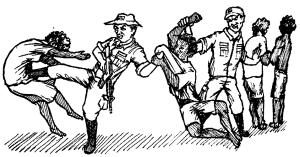
The AFP and PNP use surrendered traitors from the mass movement and the revolution. These traitors serve as guides to scour the area, unleash terror, and force civilians to surrender. They accompany soldiers in surveillance, taking pictures of houses and individuals they suspect as NPA supporters under the guise of a census. While agents and soldiers comb the communities, other soldiers are positioned at elevated and strategic terrain. These act as a blocking force at interior passageways and routes to adjacent barrios.
Strengthening the mass base
Amid all this, solid mass organizations were reestablished in Marcia, a village within the scope of the overall military operation. Majority of residents here are from the basic masses. Most of them are tenants of landlords who are not barangay residents.
Life for farmers in Marcia is difficult. They are victims of feudal and semi-feudal exploitation. The crop-sharing system takes a third of their harvest. The daily rate for wage earners is ₱300, while the piece-rate system pays ₱500. Piece-rate labor is more common than daily wages. To supplement income, farmers also raise livestock for sale.
CAFGU detachments and AFP patrol bases are positioned near the village. In recent years, the village endured severe militarization, where soldiers committed heinous military abuses and war crimes.
In response, the residents of Marcia unite closely to hurdle the problems they face in the economic, political, cultural and military spheres. Hundreds of families, numbering more than 2,000 individuals, are organized into chapters of Pambansang Katipunan ng mga Magbubukid (PKM), Makibaka, and Kabataang Makabayan (KM). Nearly a platoon of people’s militia has been mobilized for defense, with defense unit teams organized in every sitio, and a leading local Party branch in the village.
Establishing the chapter
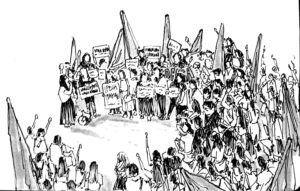
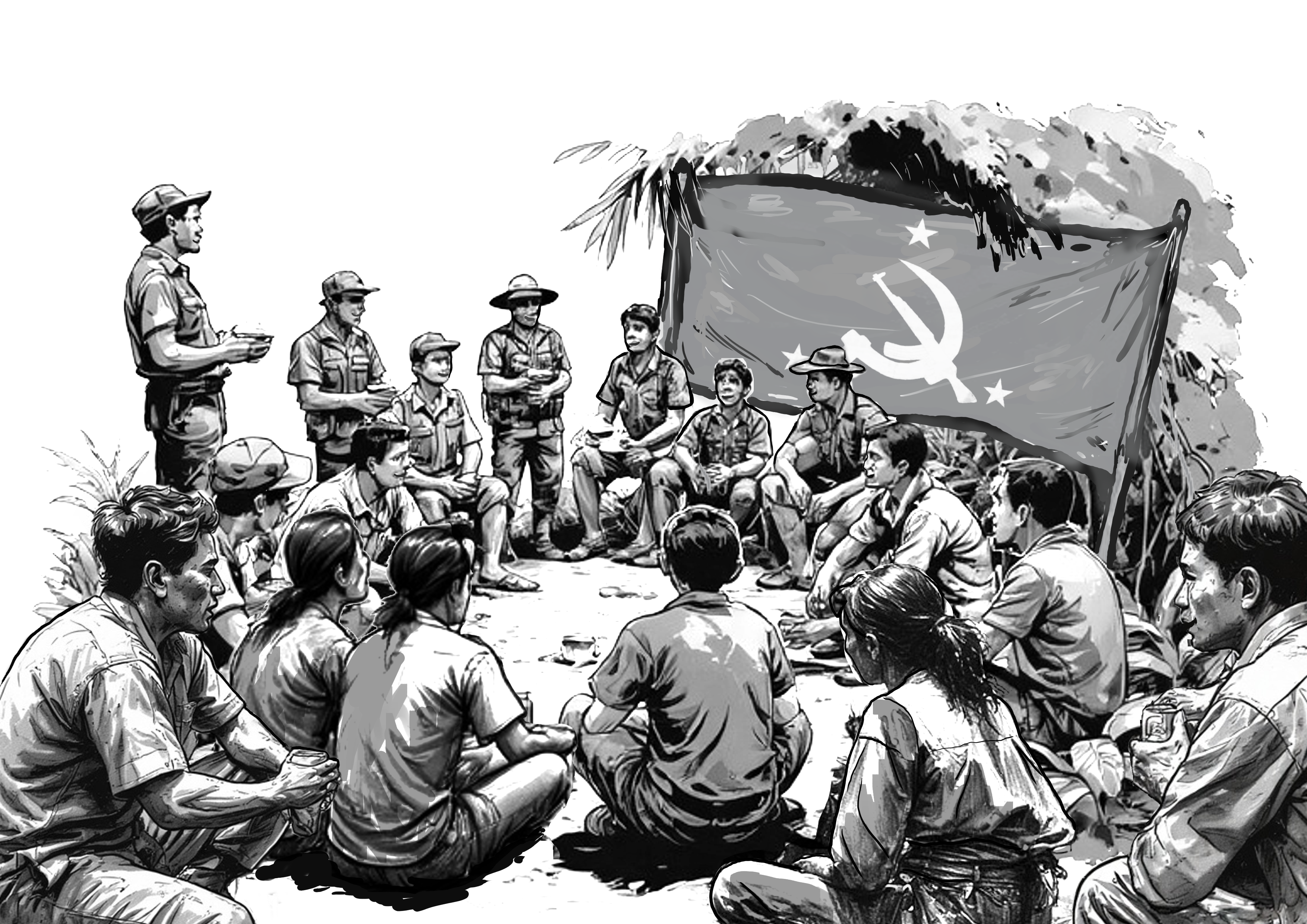
An assembly was recently held to reestablish the village’s PKM chapter. A security orientation opened the activity. The army commander praised the courage of the masses who pushed through with the mass meeting despite military forces operating only three kilometers away from their position.
Spearheaded by the army’s political instructor, they systematically discussed in the mass meeting the prepared documents summarizing their mass work in the area—its history, the latest results of social investigation, the subjective situation, structure and responsibilities, the one-year program, and the revolutionary mass organization’s policies. They focused on the barrio’s revolutionary history. Prominent in the discussion was about the unity of the entire movement since the 1960s during the time of KM, in the 1970s under Marcos Sr’s martial law, and the people’s army’s arrival and mass work in the village up to the present.
The Party, NPA units, and key mass leaders in the village conducted a series of consultation meetings prior to the activity. They created a comprehensive plan based on the overall plan of the front committee and section committee, and on the enemy’s actual movements. Within a week, they identified the tasks and requirements for carrying out the plan, including summing-up, investigation, and planning. An initial meeting was conducted to discuss drafts and study the prepared documents. They launched a campaign to unite the entire organized masses around these documents alongside the campaign for the study of the Revolution (the Party’s theoretical journal). They also launched a campaign to review the revolutionary guide to agrarian reform, a basic document of the CPP.
Second part: Rectification movement and the establishment of the mass organization.