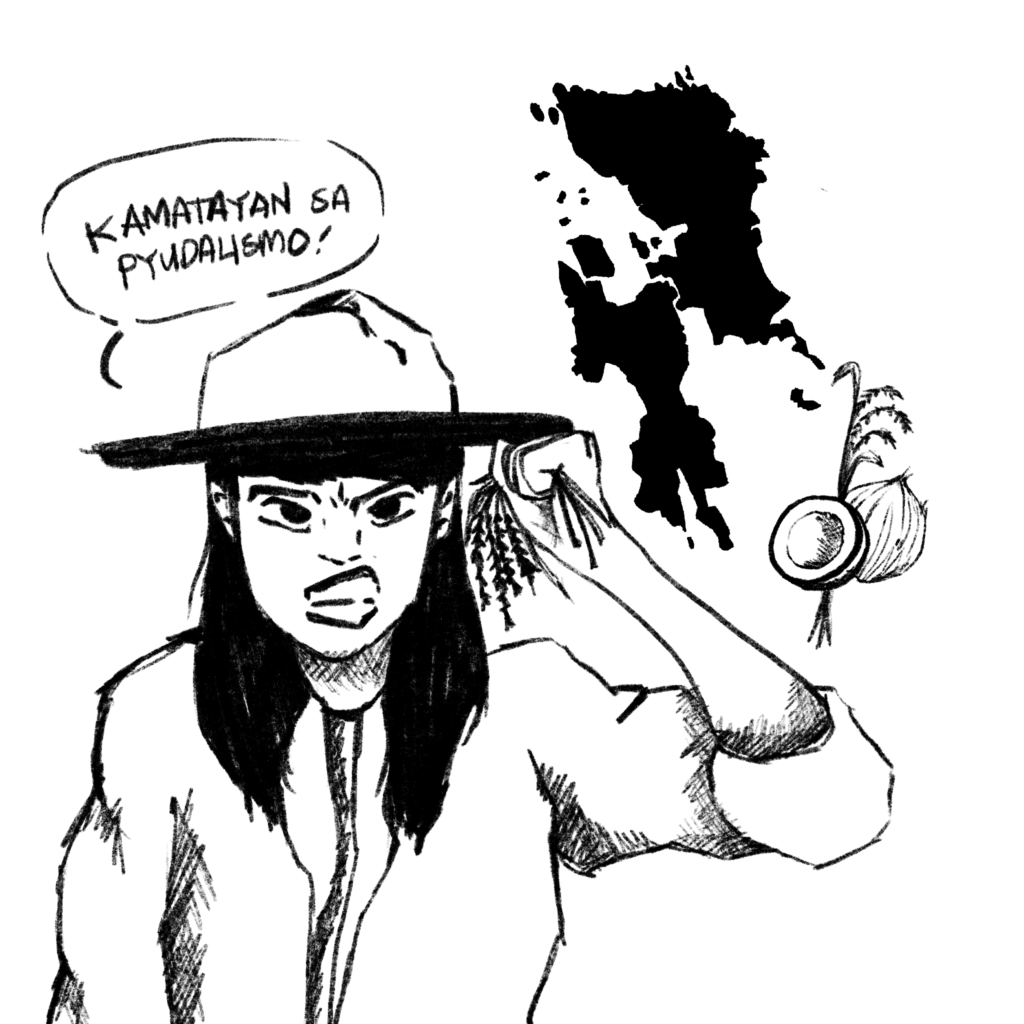
Feudal and semi-feudal exploitation in Eastern Visayas
Eastern Visayas ranks second in having the fewest farmers who own land, and fourth in having the most landless tillers. This indicates the continuing feudal and semi-feudal exploitation of peasants in the area.
The region only has an estimated 17.6% of more than 1.89 million farmers, or 209,240, who can be considered “land owners,” while 82.4% or 980,000 are landless, which could even rise when including the 84,825 “land owners” but categorized as “owner-like possession”—those who occupy land without title and are vulnerable to eviction from the farms they till. Meanwhile, 5,835 hectares of farmland in the region are owned by only 97 corporations.
About 67% of the region’s farms are mainly devoted to cash crops or products exported to foreign markets. The region ranks sixth among top coconut producers and second in abaca. Rice fields account for 23.6% of the total farmland area in the region, and most of these still rely on rainwater. Between 2014 and 2024, only 1,023 hectares of rice fields were added to coverage of irrigation services.
Many farms still rely on carabaos, and manual threshing and pounding of rice. There are only 129 tractors, 2,586 harvester threshers, and 1,199 rice mills available in region’s more than 4,000 barangays. Only a few landlords have control over other essential production equipment.
In rice fields, coconut farms, and abaca plantations, 75-25 and 50-50 share tenancy arrangements are widespread. There is also the “tinulo” (one-third) arrangement which, in practice, is also 75-25. Farmers actually earn far less because they shoulder almost all production expenses.
Usury is also severe in the region. Lenders number 3,175, with 73% being individual moneylenders. Microfinancing institutions also exploit the farmers’ situation. A study revealed interest rates reaching 144%-163% over six months, or 24%-27% per month.
“Cash to palay” lending schemes are also typical in areas with vast rice fields. In this arrangement, every ₱1,000 pre-harvest loan must be repaid with two sacks of palay after harvest. This is equivalent to buying palay at ₱10 per kilo despite the ₱15 per kilo prevailing market price.
A pawn or mortgage system is also in place, which is also used as a means of land grabbing. Another example of usury in the region is the mortgaging of teachers’ ATM cards or the honoraria of barangay officials and employees. A study showed that usurers can earn 6-9% interest per month depending on which quarter of the honorarium is pawned.
Low wages also prevail, where ₱350 is the highest for construction work, clearing rice fields, and coconut farm work. In copra production, workers earn ₱5 per tree for harvesting fruits, ₱15 per 100 pieces for hauling coconuts, and ₱30-₱35 per 100 pieces for husking. In other areas, pay for hauling is set per sack, amounting to ₱3 per kilo for transporting products beyond two kilometers.
In rice harvesting, the “winalo” (one-eighth) arrangement is common, while some use the “inupat” (one-fourth) arrangement. In these, for every eight or four gantas or sacks of harvested rice, seven or three go to the landowner and only one to the harvester.
Cheating in farmgate sales is also prevalent through weight manipulation. In coconuts, a high deduction rate for moisture content is imposed. A study showed that 56 kilos are deducted from 600 kilos of copra due to moisture calculation. At a price of ₱20 per kilo, landlords-entrepreneurs gain ₱1,120 for every 100 kilos of copra.
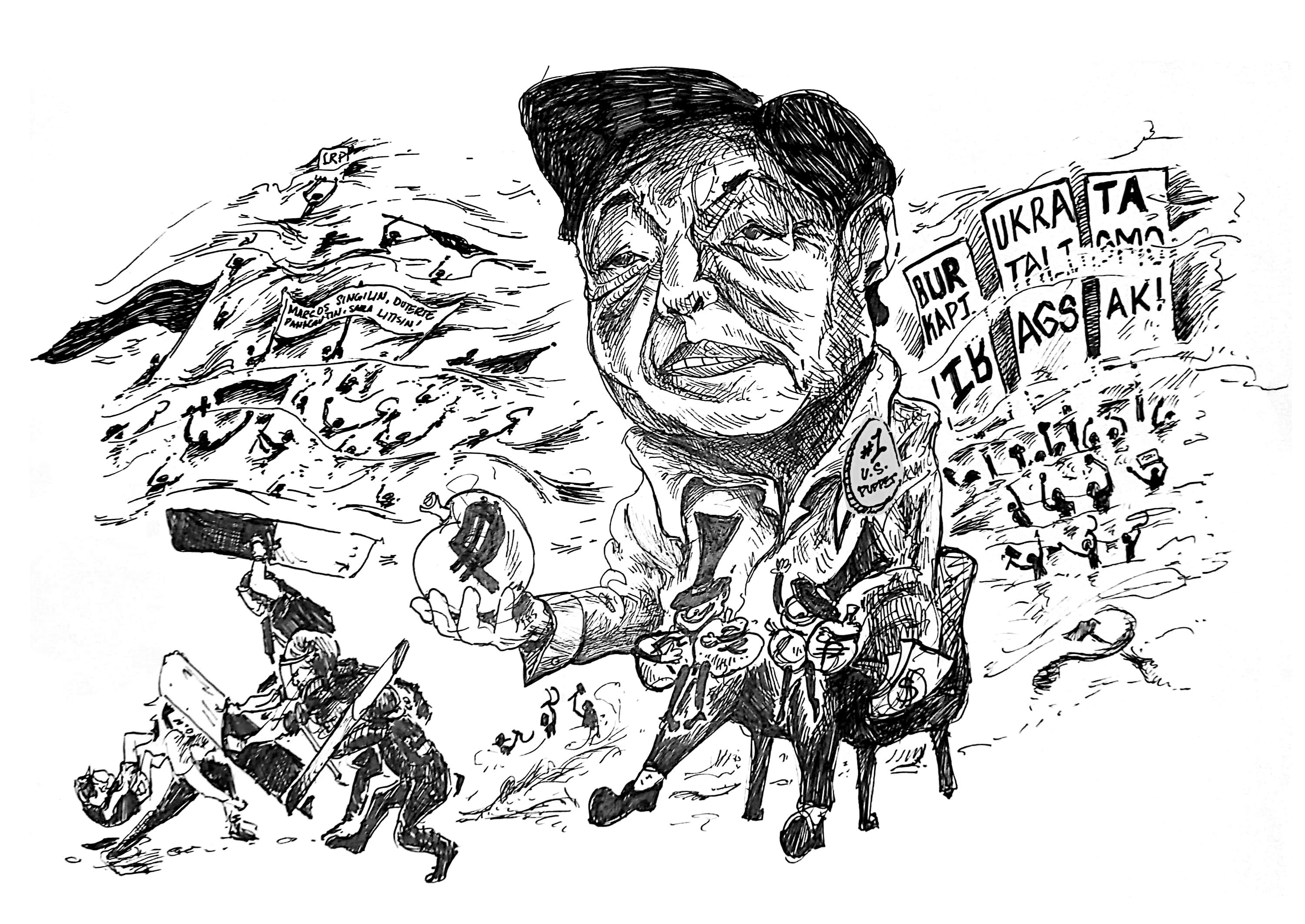
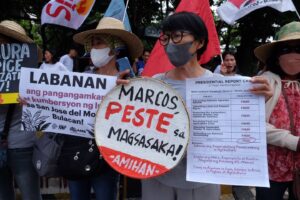
Faced with multi-layered problems in Eastern Visayas and across the country, farmers have no other course but to collectively exterminate the Marcos regime pest and eliminate the feudal and semifeudal exploitation which they endure everyday.