The bureaucrat-capitalist military's gross corruption
As the corruption of the bureaucrat-capitalist system becomes exposed, the stench from the military’s bureaucrat-capitalists comes as no surprise. Anomalous infrastructure projects involving the Armed Forces of the Philippines (AFP) in collusion with corrupt contractors were recently exposed. A large portion of this (₱50 billion) was also reportedly part of the unprogrammed appropriations for 2026 drawn from the president’s pork barrel.
About ₱15 billion was plundered and squandered from 944 military infrastructure projects under the Tatag ng Imprastraktura para sa Kapayapaan at Seguridad (TIKAS, or Structural Strength for Peace and Security) Convergence Program from 2023 to the present. A Senate hearing disclosed that 421 of these were ghost projects while 648 were listed as “completed” contrary to having halted construction at initial stages, rendering them unusable.
AFP Chief Romeo Brawner Jr deceives the public by denying the military’s role in the TIKAS funds embezzlement, especially considering that the AFP Unified Command commanders and Department of Public Works and Highways (DPWH) regional directors determine the nature and location of these projects. The Department of National Defense (DND) and DPWH jointly oversee the setting of standards, planning, and monitoring through the TIKAS Central Technical Working Group. Likewise, all TIKAS projects are located within or around military camps.
Corruption inherent in the bureaucracy
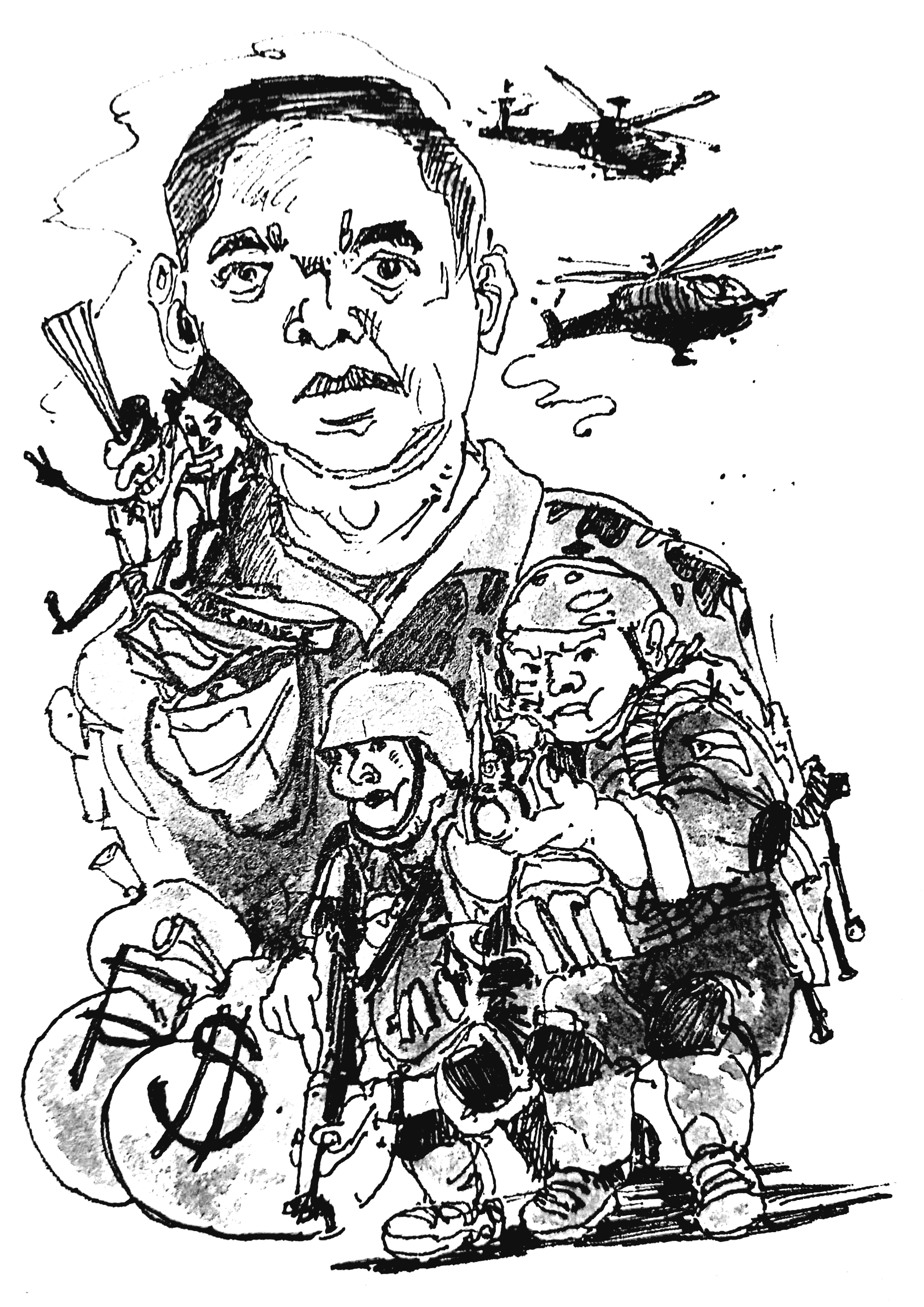
Like their corrupt counterparts in the civilian bureaucracy, the military bureaucrat-capitalists exploit their state positions to amass wealth. US imperialism established the fascist AFP in 1935 to serve as the pillar of the puppet state created in 1946. It expanded massively to 142,000 soldiers under the Marcos Sr dictatorship to brutally enforce martial law. It has since continually fattened on bribes, contracts, and favors from successive ruling cliques from Corazon Aquino to the present regime.
Over the decades, generals have been documented earning from overpriced military procurement contracts for weapons, howitzers, armored vehicles, jet fighters, helicopters, and ships. Generals have been exposed to pocket 10–30 percent kickbacks from contracts for ammunition and firearms. Ghost deliveries of supplies, fake transactions for weapons and equipment, and collusion with suppliers and contractors are rampant. In 2011, the anomalous tradition of “pabaon” (take home gift) surfaced, where the DND yearly pooled up to ₱1.5 billion in budget funds as rewards for retiring generals. Even fully state-funded pension of rank-and-file soldiers are plundered through payments to thousands of “ghost retirees.”
Generals customarily construct luxurious offices and beautify camps to draw large kickbacks. They are also notorious for frequent overseas vacations with their families, expensive cars and houses, and overall luxurious lifestyles.
In 2018, another senator exposed the widespread corruption of the “Davao Group,” composed of generals close to Rodrigo Duterte, in the procurement of weapons and military equipment under the guise of AFP “modernization.” This October, the Ombudsman charged a colonel who serves as Vice President Sara Duterte’s security group head for involvement in the embezzlement of ₱125 million in confidential and intelligence funds.
The AFP and NTF-Elcac tandem
Military officials also pocket large sums from counterinsurgency programs such as E-CLIP, used for the fake “surrender” of civilians, and from infrastructure projects under the NTF-Elcac’s Barangay Development Program (BDP).
In the case of BDP’s, AFP units decide on which barangays farm-to-market roads (FMR) will be built. Many of these are ghost projects, while others are duplicates, overpriced, substandard, or built in unsafe or unsuitable parts of the barangay. AFP battalions guard these projects.
In Northern Mindanao, for example, the AFP and NTF-Elcac received ₱17.6 billion in 2020 for 142 FMRs. Many of the villages benefiting from these have AFP camps, detachments, or RCSP presence. The most expensive FMRs cost ₱67.5 million per kilometer—five times the national average. Nearly all the contracts were clinched by Ulticon Builders, which was close to the then Duterte regime.
In Samar, the NTF-Elcac took four years by 2024 to complete cementing a 400-meter road soldiers built in the middle of rice fields. The project cost a staggering ₱14 million, or ₱35,000 per meter. The road ended merely at the edge of a neighboring barangay, far from town centers.
At the same time, soldiers also steal funds meant for supposed surrenderee civilians. Even rice and canned goods labeled as aid are merely displayed for photo-ops and returned after staging the ceremonies against the revolutionary movement.