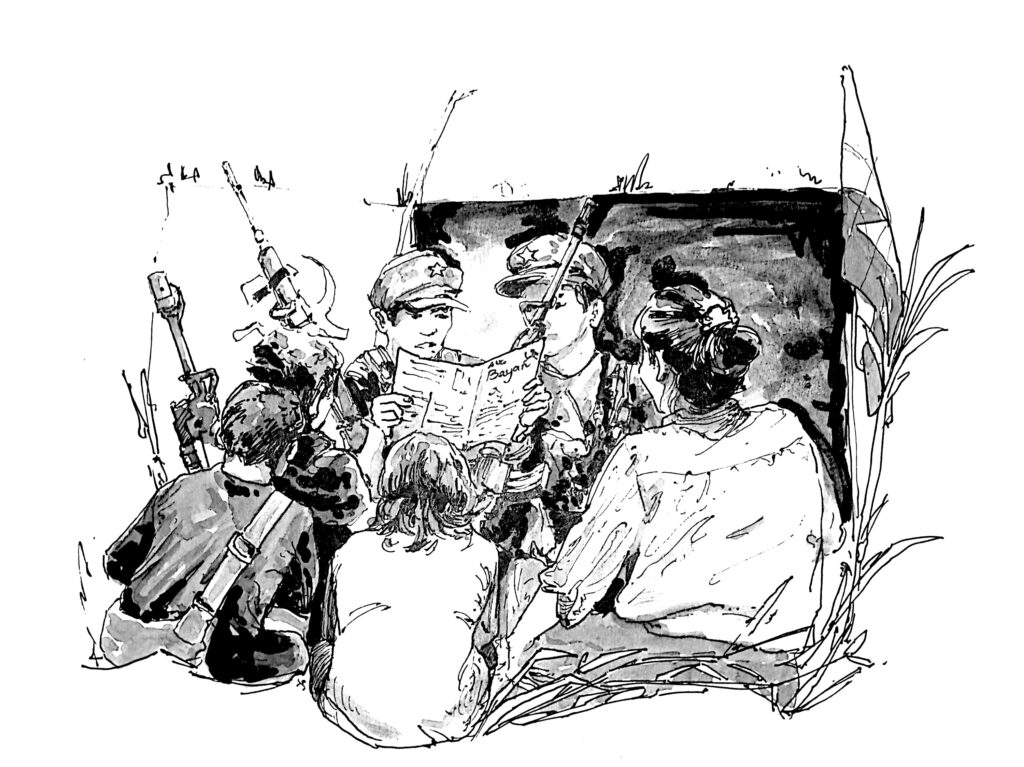
Correspondence Education to forge communist fighters
In the people’s army, study is essential to mold fighters as proletarian revolutionaries.
The Party committee within Southern Tagalog NPA unit Luntian ensures raising the level of theoretical grasp of Marxism-Leninism-Maoism. It firmly links theory with the unit’s concrete revolutionary practice.
“The challenge in implementing education work in the people’s army lies in the military situation we face,” unit commander Ka Reymundo said. For nearly a year, Luntian constantly maneuvered from the intensified operations of the Armed Forces of the Philippines. The AFP deployed more troops in the guerrilla front. It also intensified the use of modern weapons and technology.
Invigorating Party education
Luntian’s education campaign focuses on reviewing history and the Party’s basic analyses and lines. It abides by the practical guide set by the Party’s rectification movement. Since 2024, the unit has launched regular and special courses to review mistakes and weaknesses and to sharpen comrades as communists. Among the courses are Bureaucratism, Commandism and Liberalism, Rectify Errors and Rebuild the Party, Communists Must be Advanced Elements of the Proletariat, the Party Constitution, and Program for the People’s Democratic Revolution.
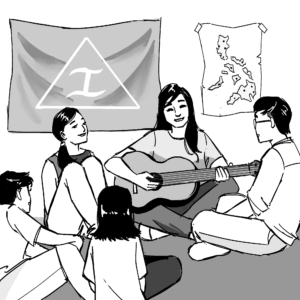
The studies are held concurrently with the Kolektibong Basa at Kolektibong Talakayan (KBKT, or Collective Reading and Collective Discussion) program for study materials. This helps students familiarize with course content. It encouraged comrades who previously had little interest in reading or discussions. When missed, the fighters themselves ask: “Don’t we have KBKT?”
Rebokabularyo (revolutionary vocabulary) also became a daily activity. This activity introduces and explains technical terms, laws, and significant personalities found in the daily study topics.
Central Committee and Regional Committee messages are promptly discussed whenever they arrive, usually on the anniversaries of the Party and the Army. Cadres and Party members at various levels, as well as the revolutionary masses, attend these discussions.
Targetting weaknesses
Study sessions are closely linked to the comrades’ concrete revolutionary practice. Examples are drawn from the unit’s actual experiences and the comrades’ own practice.
Study sessions thus become venues for unifying assessments and syntheses on issues the unit has faced.
Comrades are encouraged to reflect back on their own revolutionary practice during study sessions and use it as a guide for self-assessment. During discussions, comrades more openly raise individuals’ mistakes and weaknesses.
“Study sessions often strike me on what really needs to be done and what wholehearted service truly means,” one student said at the assessment after a study session that tackled ways to excel as a proletarian.
Combating empiricism
Raising the comrades’ practice to a theoretical level is key to combating empiricism. It guides assessments and syntheses. Its goal is to elevate revolutionary practice.
In the study sessions, comrades are encouraged to be more critical of themselves and others concerning incorrect work styles. These help much in combating many of the unit’s individual and collective weaknesses. They are also key to resolving conflicts arising from differing ideas, practices, and styles.
“There are contradictions in identifying what is right and wrong in practice, the persistence of empiricism and individualism, which the unit continuously confronts,” Ka Reymundo said. He thinks these struggles are progressing. The comrades’ wrong habits and practices are gradually changing.
“The unit now further tightens its implementation of unities,” he added.