The spirit of Andres Bonifacio lives Thousands of Filipinos rise again against corruption
Thousands of Filipinos once again marched in the streets on November 30 across different parts of the country to protest rampant government corruption. The protest marked the 162nd birth anniversary of the father of the Filipino revolution, Andres Bonifacio.
The people’s demands resonated that day—from holding all those involved in corruption accountable, dismantling political dynasties, to calling for the resignation of President Ferdinand Marcos Jr, Vice President Sara Duterte, and other corrupt officials.
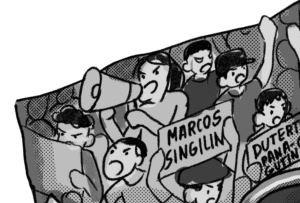
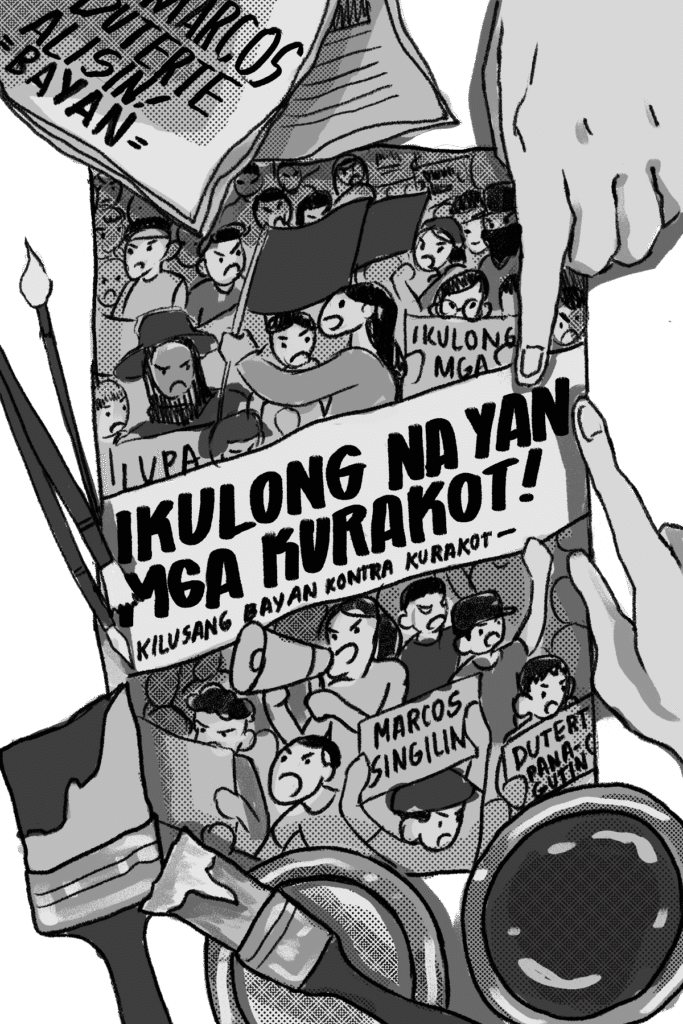
Led by Kilusang Bayan Kontra Kurakot (KBKK, or People’s Movement Against Corruption), more than 20,000 gathered at Luneta Park in Manila for the protest Baha sa Luneta 2.0. The Marcos regime attempted to foil the action by forbidding them from gathering and holding a program. The attempt failed to silence the people’s clamor for accountability and justice.
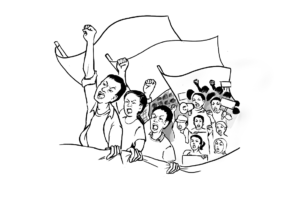
Various groups, forces, and sectors participated in the action, including workers, peasants, urban poor, students, women, and church people. As it had previously declared, KBKK openly welcomed the various demands of groups, including calls for Marcos and Duterte to step down and for the setting up of a transition council.
Thousands also gathered at the protest Trillion Peso March 2.0 held on EDSA in Quezon City. It was led by the Catholic Church and other groups and parties forming the Trillion Peso March Movement (TPMM).
Before the protests, KBKK tried but failed to unite with TPMM for a single protest in Metro Manila. The TPMM groups, particularly Akbayan, refused to allow KBKK groups to raise issues directly implicating Marcos in systemic corruption.
Outside Metro Manila, KBKK allied groups mobilized in Baguio City, La Union, Ilocos Sur, Ilocos Norte, Isabela, Tarlac, Calamba City, Cavite, Oriental Mindoro, Legazpi City, Naga City, Antique, Capiz, Aklan, Iloilo City, Bacolod City, Cebu City, Tacloban City, Davao City, Cagayan de Oro City, and General Santos City. Reports also mentioned mass gatherings and marches of priests and church leaders with the people in no less than 86 dioceses across the country.
Overseas, nearly 2,000 Filipino migrants and allies in 30 cities across 23 countries joined the global anti-corruption protest. The recently formed KBKK-Global led these protests.
Step down versus step up
The difference between the groups’ calls regarding holding Marcos himself accountable became clearer. Akbayan, one of the leading groups in TPMM, refused to recognize the extent of Marcos’ corruption and instead called for him to “step up” in the fight against corruption. This sharply contrasted with KBKK’s position pointing to Marcos’ major accountability for systemic government corruption.
Akbayan also urged Marcos to prioritize the “anti-dynasty bill,” despite his family representing the most entrenched political dynasty.
Bagong Alyansang Makabayan (Bayan, a part of KBKK) called for Marcos to “step down” (resign now). The demand aimed to allow a free and thorough investigation into corruption and to make him answer for his crimes against the Filipino people.
After the KBKK Luneta Park protest, Bayan led the march to Mendiola to hold Marcos accountable. The group called for the resignation of both Marcos and Duterte. Their demand was to replace them with a national transition council. As before, thousands of police blocked their march, forcing them to hold their program in front of the University of the East on Recto Avenue. Joining Bayan were forces from Partido Lakas ng Masa, Bukluran ng Manggagawang Pilipino, and Sanlakas.
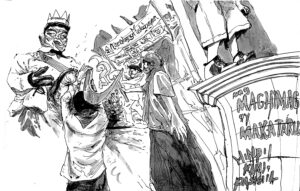
At the end of the program on Recto Avenue, the protesters destroyed an effigy of Marcos wearing a crown and a sash painted with the US flag.