Reject Hegseth and the US "deterrence strategy" against China
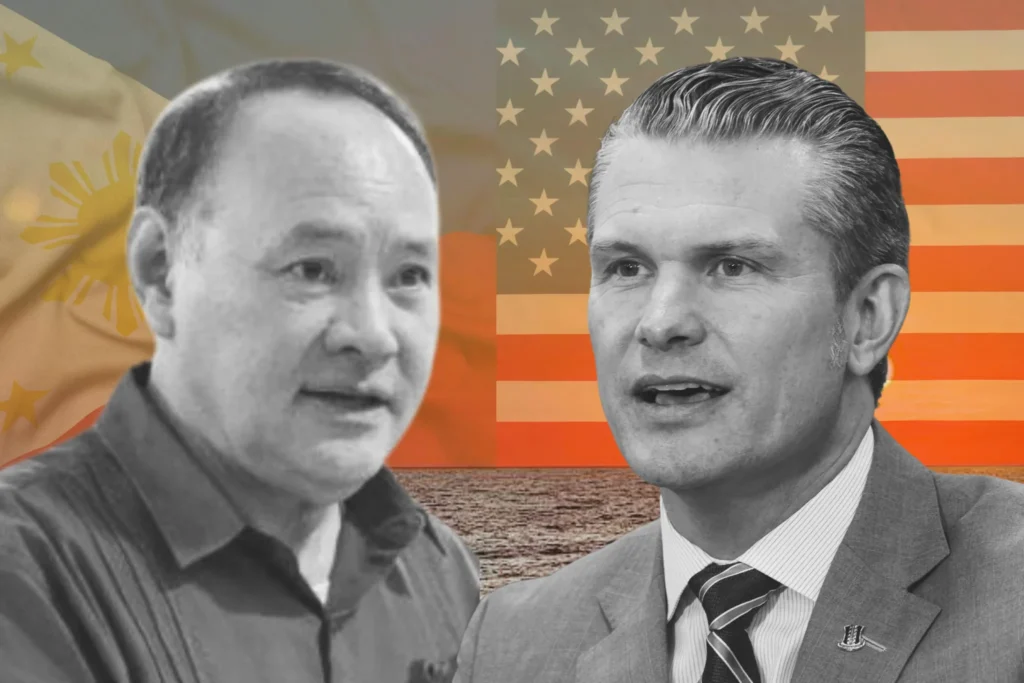
The recent Manila visit by US Defense Sec. Pete Hegseth served as occasion for the US government to declare what it calls its “deterrence strategy” against “communist Chinese aggression” in the South China Sea, purportedly to “achieve peace through strength” to “prevent war.” This declaration was immediately welcomed and echoed by the puppet Marcos regime led by his officials Defense Sec. Gilbert Teodoro, who did not hide his slavishness by expressing full support to the policy expounded by Hegseth. Teodoro showed utmost delight over the decision of the US to reward the subservience of the Philippine government with a commitment to continue the $500 million Foreign Military Financing package promised last year.
The Filipino people must vigorously reject and denounce this so-called US “deterrence strategy,” which is nothing more than a plan to deploy more and more American troops, naval ships and other war equipment in the Philippines, Japan, South Korea and other countries. This strategy is geared towards heightening US war preparations and provocations in the Asia-Pacific region, in line with the US strategic goal of “containing” the growth of its imperialist rival China.
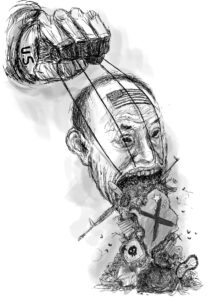
The US “deterrence strategy” impinges on Philippine sovereignty by forcibly binding the country to US war plans, undermining its capacity to exercise an independent foreign policy. By adhering to the US geopolitical strategy, the Marcos regime restricted the Philippines’ ability to pursue various foreign policy options, particularly peaceful and diplomatic means, for engaging with China for mutual benefit. Marcos is allowing the US to have a tighter control of the Philippine armed forces through so-called joint trainings to teach Philippine soldiers to operate American equipment and deepening dependence on US military supplies. The US panders to the Philippine government by claiming that American and Filipino soldiers stand “shoulder-to-shoulder,” when the truth is the US uses the AFP as mere pawns in its game of strategy to secure its hegemony in Asia.
Military deterrence is a policy that the US has repeatedly invoked in the past to justify the forward deployment of its military forces. Instead of preventing wars, this policy has instead invariably increased the possibility of armed conflict, as its actions are perceived by US rivals as aggressive and hostile. The most recent example is Ukraine, where the aggressive push to bring Ukraine into the NATO, and the presence and deployment of US military advisers, trainers and missile systems along the country’s eastern border provoked Russia to carry out a military assault on Ukraine in 2022.
The “deterrence” policy also leads to an arms race in which the US and its imperialist rivals allocate increasing amounts of public resources for the development and production of weapons. To reduce the cost of transporting war matériel, the US also plans to fully utilize the Aurora Pacific Economic Zone and Freeport Authority as a hub for the production of military drones and other weapons and equipment.
The US policy of “deterrence” is a policy aligns with its strategy of “containing China,” by projecting overwhelming military power in the seas surrounding China’s eastern coasts, particularly in countries that the US considers as the “first island chain”. This approach will only lead to further escalation of military tensions in the South China Sea and other parts of the region, as China attempts to reciprocate US actions by deploying its own coastal and naval forces. This increases the dangers of miscalculations and igniting open military conflict.
During his visit, Hegseth announced the US military’s plans to deploy more war equipment in the Philippines, particularly the NMESIS (Navy Marine Expeditionary Ship Interdiction System) anti-ship missile system, which is capable of firing missiles to a distance of 185 kilometers. He also announced plans to deploy unmanned surface vehicles that can be used for a range of purposes for the US Navy.
These are planned to be deployed during the upcoming Balikatan exercises, just as the US deployed the Typhon missile system last year, which remains under the full control of US troops in the Philippines. This clearly demonstrates how US war games in the Philippines are being used as a smokescreen for the US tactic of prepositioning of forward-deploying its war equipment. This year’s Balikatan exercises are being carried out under the overall framework of the US military’s Project Convergence Capstone 5, involving “leave-behind capabilities” for use of its “Indo-Pacom warfighting network,” and simulation of actual conflict and offensive activities.
Local and international media are projecting the Hegseth visit as US support for the Philippines against China, when in fact, it is the Philippines that is being forced to support the US in its strategy of containing China to prevent it from growing its economic and military power. In its push against China and to protect American economic interests, the Trump government has ordered further increases in tariffs on Chinese commodities, to which China has responded with its own tariffs on American products.
If Hegseth’s statements are to be believed, the US under the Trump government will shift its focus from Europe and increasingly deploy more of its military forces to Asia, including the Middle East. This also explains why Trump wants to end soonest its commitments to the war in Ukraine and push for a ceasefire with Russia. It recently launched a missile strike against Yemen and the Houthi forces, ordered by Trump and coordinated by Hegseth himself, and released at least $3 billion worth of bombs to support Israel and ruthless bombing of Gaza.
This situation presents the Filipino people with an urgent need to amplify their patriotic indignation and demand to break free from US military control. This military control of the Philippines is exercised through the presence of thousands of American troops in US military bases in the Philippines, conducting non-stop war games and prepositioning war matériel at EDCA sites, providing military aid for aerial bombing and the brutal counterinsurgency war, and US-dictated “AFP modernization” using foreign military financing that requires the AFP to exclusively use American equipment, fostering greater reliance.
They must protest the Balikatan and all other war games set to be conducted by the US in the Philippines that increasingly heightens military tensions in the region and drags the country into the US conflict with China,demand the demilitarization of the South China Sea, and the resolution of maritime conflicts through peaceful dialogue. They must stand up firmly and demand the immediate dismantling of all US military bases and facilities, the pull-out of American military troops, the abrogation of the Enhanced Defense Cooperation Agreement (EDCA), the Visiting Forces Agreement (VFA) and other unequal military agreements and an end to military aid to the repressive Marcos regime.