Defense of land and anti-feudal struggles in Isabela
Amid many challenges, the peasants’ four struggles for their right to land in Isabela continue. Since 2019, they have launched campouts, collective farming, dialogues, petitions, and confrontations against landlords and government agencies.
Two farming communities are fighting for their right to their homesteads in central Isabela. The area is being grabbed to augment the wider agro-industrial zone used for large poultry farms, warehouses, and melon and sugarcane plantations, among others.
These areas include the more than 20-hectare homestead of rice fields, cornfields, and melon farms tilled by 20 families. These families were tenants for over 40 years then turned agrarian reform beneficiaries. Their collective action reclaimed the seized farms, stopped the sale of the land, and halted rent collection. They also stopped police and military harassment and house-to-house intimidation.
In another town, peasants are fighting for over 20 hectares of homestead land planted with rice, corn, and vegetables. The land is being cultivated by 17 peasant families who have been tenants for 50 years. In 2021, a landlord relative suddenly arrived carrying a fake “reconstituted” title and claiming the land. The peasants have since actively fought for their right to the land despite repression and human rights violations.
Peasants continue to defend their right to cultivate in two areas in southern Isabela. Farmers being dispossessed of almost 70 hectares of land by a mining company remain and are covertly farming there for their consumption and livelihood. In another town, peasants are opposing the seizure of 50 hectares of land under the guise of the government’s National Greening Program.
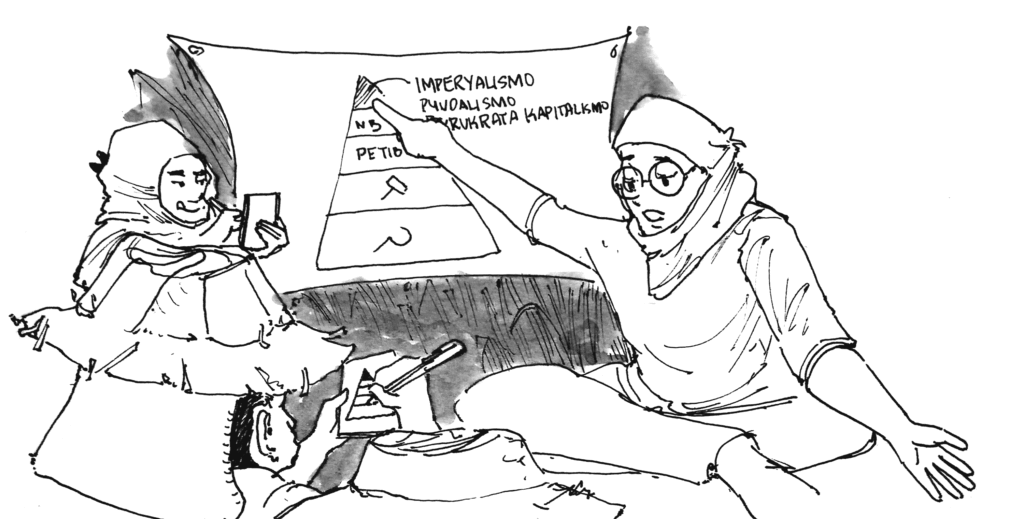
Political education is crucial to raising militancy
For the past six years, political education has played a major role in raising the militancy and strengthening the peasants’ resolve in their struggle. It effectively shielded against the cruelty of landlords, the Armed Forces of the Philippines and the Philippine National Police.
Across the four campaigns in Isabela, the conduct of political studies is ensured at different stages of the peasants’ collective actions. Discussions are adapted to specific conditions, the changing situation, and the planned collective actions.
They prepared and studied the campaign papers related to the land grabbing issue they face. They studied the peasants’ legal status, the land’s history, and their rights to it. They link these to the peasant class’ overall struggle by discussing the fight for genuine land reform.
With the establishment of peasant associations, they also discuss their organizations’ orientation. They tackle issues such as excessive rice importation, the construction of US military bases in the region through the Enhanced Defense Cooperation Agreement, and other national issues whenever they join rallies.
They also formally study the Short Course on Philippine Society and Revolution and the Special Mass Course. As their revolutionary consciousness deepens, they discuss the revolutionary orientation and tasks of the National Peasant Association. They also occasionally study Ang Bayan.
The peasants’ studies also focus on human rights conditions and resistance to the police, military, and National Task Force-Elcac’s surrender campaign. They use these to shield against the relentless attacks on their unity and attempts to derail their land struggle. The communities resolutely stand against intimidation and deceit from traitorous “former rebels.”
“These [studies] must continue among their other members since their local land struggles are becoming more violent and difficult,” the organizers’ report said.