Strengthen the people's power amid the intensifying political crisis of the US-Marcos Regime
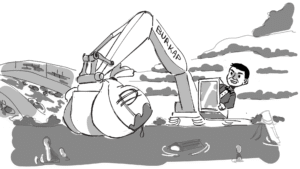
The Marcos regime is being shaken by a severe political crisis. This follows revelations by a former ally and aide in Congress that Marcos himself is at the top of a large bureaucratic capitalist syndicate within the government that collects kickbacks and bribes from hundreds of billions of pesos in infrastructure projects. The public was not surprised by this revelation, however, it has further fueled their burning anger towards Marcos’s grand schemes of corruption and theft of public funds.
Blamed and scapegoated by Marcos, former Congressman Zaldy Co spoke out, stating that Marcos himself instructed him, as the head of the budget committee in Congress, to insert a ₱100 billion worth of projects into the 2025 budget. He revealed that he personally delivered suitcases full of kickback money to Marcos’s home and Malacañang.
This corresponds to previous testimony in the Senate by Roberto Bernardo, a former high-ranking official of the Department of Public Works and Highways (DPWH), who delivered billions of pesos in kickbacks from infrastructure projects to key Malacañang officials.
Leaders of the Iglesia ni Cristo took advantage of the widespread protest movement against corruption. Its believers were gathered in Luneta to showcase their strength and warn Marcos not to touch the businesses that were exposed as partners of the Discaya in questionable projects. The Dutertes and other allies of the anti-Marcos factions mounted their rallies in an attempt to urge military officials to turn against Marcos.
Desperate to clean Marcos’ muddied reputation, it is now being claimed that he knows nothing about the billions of pesos in kickbacks being brought to the palace, and that his close officials merely used his name. Panic-stricken, the highest-ranking cabinet official, the budget secretary, and several key officials were hastily removed, further deepening the fractures within the Marcos faction.
Malacañang is now scrambling to conceal the mountains of money embezzled by Marcos from public funds. He has the cooperation of certain groups like Akbayan, which pose as anti-corruption advocates, but shield him by questioning the revelations that he himself is involved and at the top of the corruption scheme. They harp on the possibility that equally corrupt Sara Duterte will assume power, to stifle the people’s call to end the US-Marcos regime.
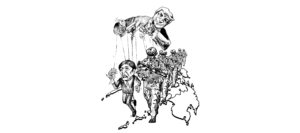
Marcos’ imperialist masters are closely watching development. Through their control of the Armed Forces of the Philippines (AFP), US support for Marcos remains intact. They promote the idea that the “destabilization” against Marcos is a scheme orchestrated by China. However, they are prepared to shift their support to another faction that continues to uphold US economic, political, and military interests in the country. They are closely linked and provide funding to the Akbayan group as its reserve horse, even as they remain open to installing a more militaristic faction in power, especially to suppress the growing progressive and patriotic mass movement.
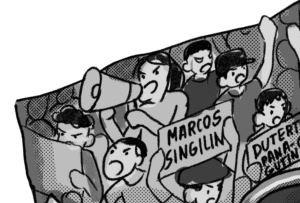
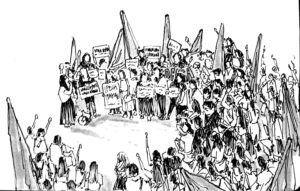
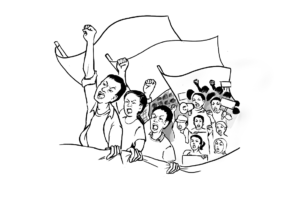
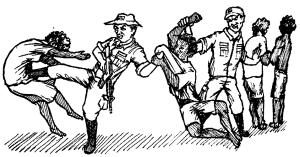
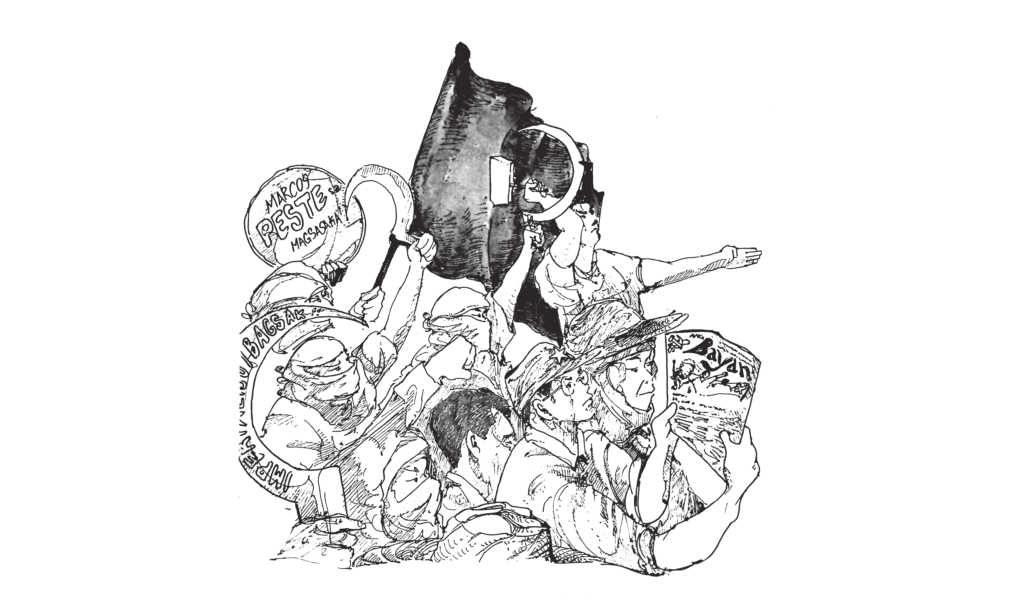
The surge of anti-corruption protests continue. Walkouts and protests by student youth continue across the country. A broad movement is emerging among workers, impoverished communities, and various democratic classes and sectors. The Marcos regime responds with fascist violence and intimidation to silence the rising voices of the people.
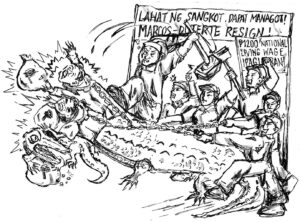
On November 30, the day commemorating Andres Bonifacio, the hero of the Filipino working class, a massive outpouring of the people is expected at Luneta and various parts of the country to express their anger against corruption. In line with the call to hold accountable all those involved in corruption, the people’s demand for the ousting or resignation of Marcos and Duterte continues to grow stronger.
There is now a growing call to establish a “transition council” that would govern the state and prepare the process for establishing a new government. This reflects the deep dismay and lack of trust among the broad masses of the people in the legal processes of the ruling state and in the elected government officials. As the crisis of the ruling system under Marcos persists, the consensus among different strata of Filipino society for such a council is expected to strengthen.
This potential council will emerge and be shaped by the process of ousting the US-Marcos regime. If realized, it will become a new battleground for the desired changes. The people must insist on democratic representation against the domination of the ruling classes. The strength of democratic sectors being developed in the course of the movement against corruption and bureaucratic capitalism will serve as the foundation for future struggles.
It is vital, therefore, for the Filipino people to strengthen their organized ranks and the broad protest movement to oust Marcos and Duterte. It is crucial to galvanize and expand the participation of the working masses, urban poor, and peasants, who suffer the worst blows from corruption. This will undoubtedly shake the foundations of Marcos’s rule. Students face the great challenge to go into factories, communities, and countryside to help awaken and mobilize millions of people.
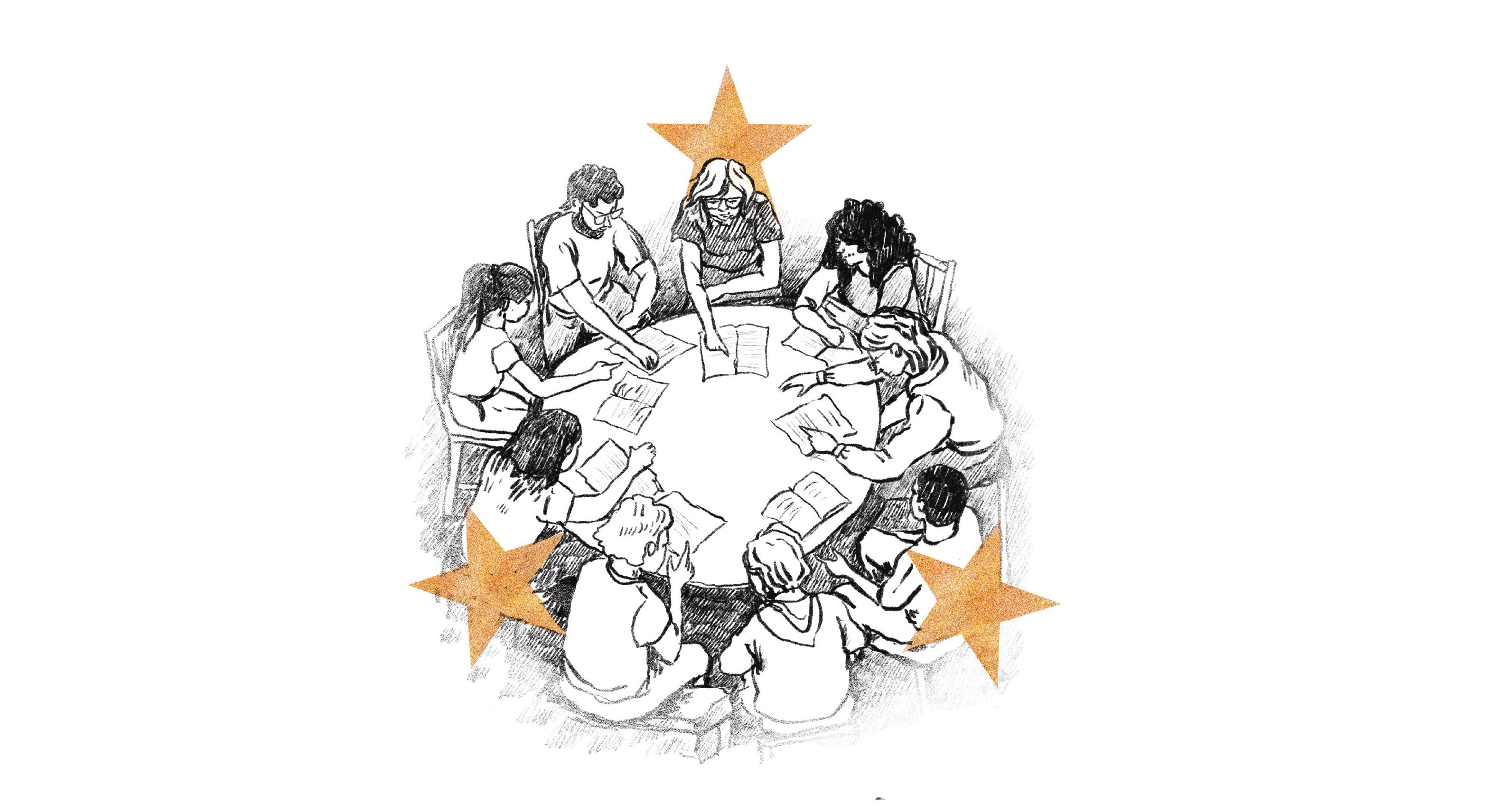
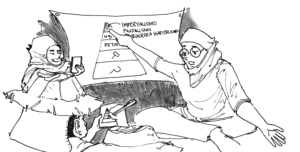
Raise the people’s awareness regarding the class analysis of the semi-colonial and semi-feudal social system in the Philippines. Historical knowledge about the people’s struggle against the rotten reactionary state must be deepened, along with the necessity for revolutionary struggle to completely change the system.
The situation is particularly favorable for the Party and revolutionary forces. The opportunity must be seized to strengthen the Party and its allied secret mass organizations, serving as a solid core and resilient framework for long-term struggles. Calls must be intensified to go to the countryside to continue building the organized and armed strength of the people, and to plant the seeds of a people’s government and a free and democratic order.