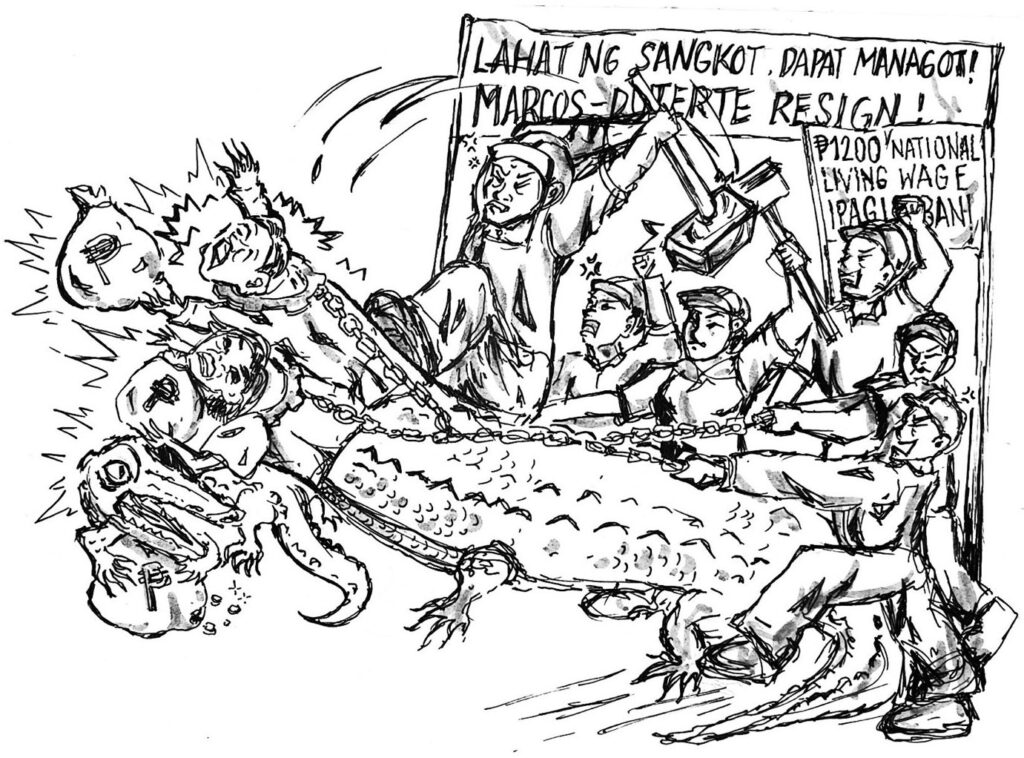
Working class suffers from deluge of corruption and oppression during disasters
The working class’ suffering is doubled whenever communities and roads are flooded. They often live in low-lying and flood-prone parts of cities where defective and profit-driven flood control projects were built. Their homes and communities are damaged, they lose income, work in unsafe conditions, and risk losing their jobs.
Hardest hit by the damage are low-wage workers, contractuals, the self-employed, and others who are actually jobless and semi-proletarian. They are categorized as “no work-no pay”, have almost no benefits and little to no savings.
One of them is Carl who single-handedly supports his family. Typhoon Tino submerged his home in Cebu. He and his siblings could not report for work a week after the storm’s onslaught as their damaged homes needed repairs. He spent all his salary, as well as his 13th month pay that his employer had released early for Christmas.
Forcing him to draw from his hard-earned savings while no corrupt officials were being held accountable infuriates him. “Being a victim of corruption is painful,” he said. “We have been robbed not only of money but also of our time and dignity as workers.”
In Balamban, Cebu, the Australian shipyard company Austal Limited, employing 1,500 Filipinos, was spared from flooding. Yet more than 40% of its workers were absent from work. These include Rico, a welder who lived in a Mandaue City area that was completely swept away when the dike broke and floodwaters surged from the Butuanon River.
“The shipyard is dry, but our village was submerged,” he said. He was given emergency leave, but without pay. During his four-day leave, he lost ₱2,000 in income. He received no rehabilitation assistance from either Austal or the government.
Forced work amid disaster
The BPO Industry Employees Network (BIEN) reported that at the height of typhoons Tino and Uwan, at least 98 BPO companies forced their employees to report for work.
“We were threatened with pay cuts unless we come in,” one call center agent in Metro Manila said. She trudged floodwaters and rode a jeep that broke down midway. “I missed my shift and got an e-mail warning.”
Another employee just wept while laughing as she struggled to work from home during a widespread power outage. “I accomplished nothing for three days and earned nothing,” she said. She had to work overtime without pay to meet her quota.
In Bulacan, online selling companies forced 200 women workers to report for work on November 11 for the “11-11 sale” discount day. Like others, they plodded through floods to reach their warehouse workplaces.
“Stories of hardship like these during grave disasters are infuriating,” the Kilusan ng Manggagawang Kababaihan (Movement of Women Workers) said. “Big companies prioritize profit over their workers’ safety.”
Bulacan is the center of the scandal involving anomalous flood control projects, followed by Cebu.
Protest to rise from flood and corruption
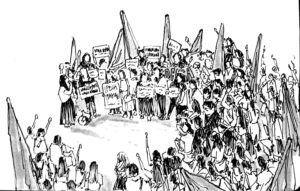
On November 14, the Kilusang Mayo Uno and at least 10 unions launched a “protest to rise from the flood and corruption crises.” Workers from Nexperia, Wyeth, Vanson Paper, Regan, Himmel, PLDT, Kowloon House, 4E Builders, and North Harbor and First Cavite Industrial Estate participated.
“The disasters’ onslaught further exposes the Marcos government’s incompetence in responding to calamities,” said KMU.
On November 18, workers under the alliance Working People Against Corruption announced the working class’ participation in the mobilization at Luneta on November 30.