EPIRA: 25-year burden on the Filipino masses
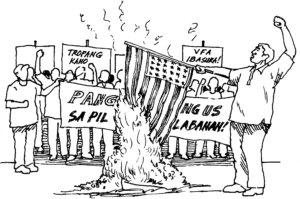
Progressive groups marched to Mendiola on June 8 to condemn the 25 years of the Electric Power Industry Reform Act (EPIRA) for burdening millions of Filipinos. This law made the Philippines the third-highest in electricity prices in all of Asia.
EPIRA was passed on June 8, 2001 amid then-high electricity prices and an unstable supply. It allegedly aimed to lower prices through competition, the unbundling of generation, transmission, distribution, and supply, and the resolution of the massive debt of the National Power Corporation (NAPOCOR).
NAPOCOR was established as a government corporation in 1936 to build and operate power facilities, especially in remote areas. Its debt reached ₱900 billion by December 2000, as it entered into agreements favorable to private companies (called independent power producers) during the Ramos regime. These contracts required NAPOCOR to pay for 70–100% of electricity even if only 20–40% was actually used. It also shouldered oil costs and peso-dollar exchange fluctuations, which further worsened its losses.
Widespread protests forced Gloria Macapagal-Arroyo to revise these contracts in 2002. This, along with massive debt and pressure from the Asian Development Bank, World Bank, and Japan Bank for International Cooperation, pushed EPIRA’s full enactment.
The law allowed large corporations to own companies for electricity generation and distribution. Most power plants are controlled by big comprador bourgeoisie such as Ramon Ang, Enrique Razon, Manny Pangilinan, the Aboitiz group, Ayala, and Lopez. San Miguel Corporation leads with 22.4% of the national grid, followed by Aboitiz with 21.75 percent.
While private companies profit, NAPOCOR’s debt remains high at ₱262 billion in June 2025. Electricity rates keep rising amid an unstable power supply in the country.
Multi-layered charges
EPIRA established the Wholesale Electricity Spot Market (WESM) where distributors buy electricity. Distributors, such as Meralco, are allowed to pass their costs on to consumers. These include the system loss charge, or fees for electricity lost due to old and damaged infrastructure, theft, and management failures. This system forced consumers to pay for electricity they did not use.
Consumers also bear the added burden of the 12% Value-Added Tax (VAT), imposed not just once but separately on each component of the bill—generation, transmission, distribution, metering, supply, and even the system loss charge.
EPIRA also reinforced the cross-subsidy scheme where consumers, instead of the government, shoulder subsidies for the poor and other obligations that should be covered by the state, such as senior citizen discounts, NAPOCOR debt payments, and others. These are passed on as “pass-through charges” or fees collected by distribution companies like Meralco for various agencies and power suppliers.
Struggle for pro-people service
Continue to expose and struggle to scrap EPIRA as it has brought nothing but suffering and damage to the people and the economy over the past 25 years. As long as big bourgeois corporations control this strategic industry, people will continue to suffer from expensive and unreliable electricity service. The struggle to scrap EPIRA is part of the broader fight against privatization, deregulation, and liberalization imposed by the International Monetary Fund and World Bank for decades.
Only through the victory of the people’s democratic revolution and the establishment of the dictatorship of the proletariat can an electricity industry truly serving the people be built. A new democratic government will advance national industrialization, where all social services including electricity will serve the people’s interests. The monopoly of bureaucrat capitalists, comprador bourgeoisie, and foreign capitalists over industries will be dismantled and placed under the management of a government of the people.