Marcos kills GRP-NDFP peace talks at 4th SONA—CPP
Ferdinand Marcos Jr’s declaration in his fourth state of the nation address that “there are no more guerrilla groups” in the Philippines is equivalent to declaring the end of the prospects for talking peace with the National Democratic Front of the Philippines, according to the Communist Party of the Philippines.
“He and the officials of the National Task Force (NTF)-Elcac stubbornly refuse to recognize and address the roots of the armed conflict,” the Party chief information officer Marco Valbuena said.
Under the Marcos regime, the representatives of the Government of the Republic of the Philippines and the NDFP have yet to sit down for formal peace talks. The Marcos regime has also not taken any meaningful steps since the GRP and NDFP signed the Oslo Joint Statement on November 23, 2023.
The Oslo Joint Statement is a declaration of intent or desire to reopen the peace talks and build the framework for how to carry them out. This is a general statement in which the aims of both sides converge: the NDFP seeks to resolve the “deeply rooted socio-economic and political issues” and “address the roots of the armed conflict,” while on the other side, the GRP aims for the “ending of the armed struggle” and “transformation of the CPP-NPA-NDFP.”
Formal negotiations between the GRP and NDFP stopped in 2017, under the Duterte regime. Since then, the Duterte and Marcos regimes have imposed numerous obstacles to reopening formal negotiations.
Valbuena said the recently released National Action Plan for Unity, Peace and Development (NAP-UPD) by the Marcos regime presents another new barrier to resuming peace talks. He says that, with the NAP-UPD framework, Marcos only aims to promote “local peace talks,” which is a euphemism for the military’s campaign of repression in peasant communities.
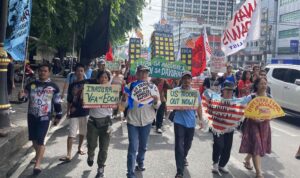
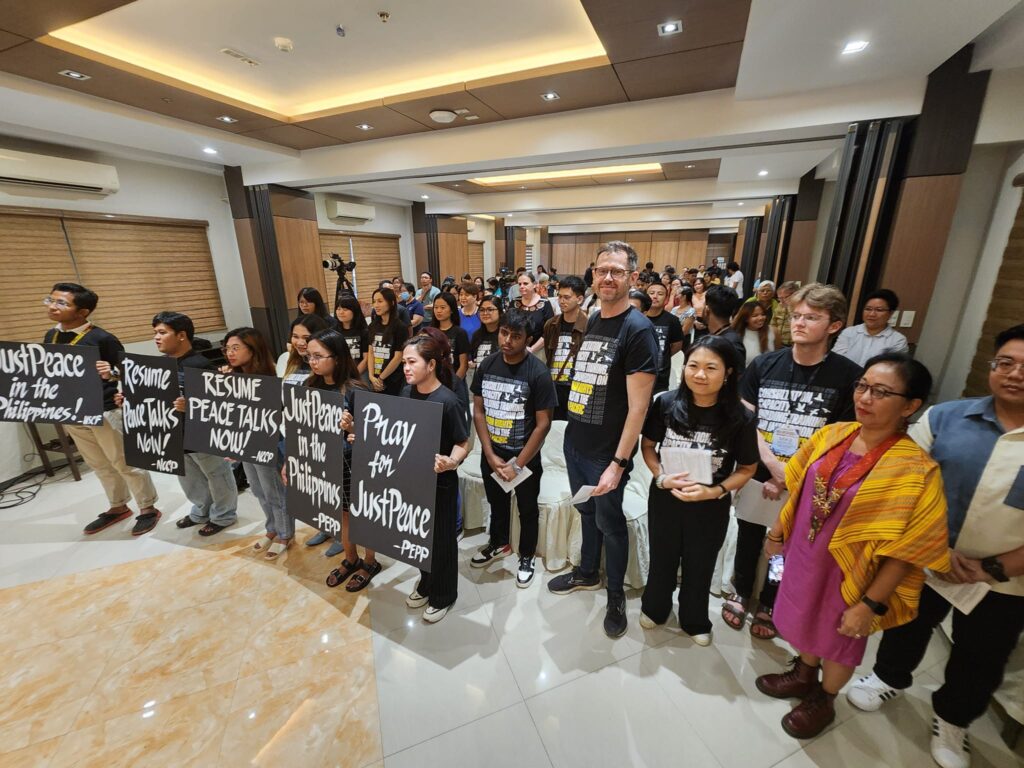
A few days before Marcos’s fourth SONA, the Philippine Ecumenical Peace Platform (PEPP), an association of leaders from various churches in the Philippines, called on the government to reopen the peace negotiations.
According to the PEPP, so long as the negotiations remain delayed, the roots of the armed conflict in the country persist and worsen. Severe poverty, hunger, low wages, landlessness, dispossession of the livelihoods of small fisherfolk, and militarized indigenous communities in the countryside continue to prevail, it says.
“Despite the hardships faced by ordinary Filipinos, a handful few get richer, exacerbating the widening inequality between the haves and have nots,” the PEPP says.
Additionally, there is also widespread violation of human rights and even of international humanitarian law in areas where there is armed conflict, according to the PEPP. The group openly criticized the NTF-Elcac, which is the primary agency of the Marcos regime to implement the policy of Red-tagging and the campaign of repression.
“With only three years remaining in his term, it is but prudent for Pres. Marcos Jr. not to treat the wounds of the nation lightly because there can be no peace without justice,” the PEPP says.
The group adds that, in the absence of a principled and sustainable solution such as a peace process that is compassionate, reconcilitory, collaborative, and committed, these still-unaddressed issues will continue to drive armed resistance.