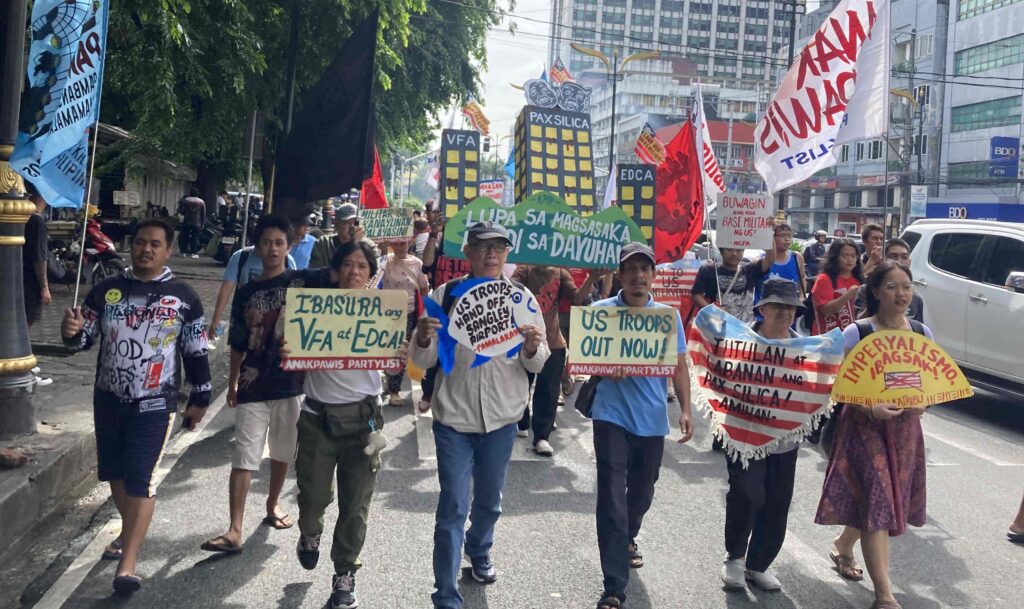
Fisherfolk group leads protest at US embassy
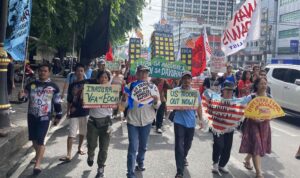
Various patriotic groups and sectors, led by Pamalakaya (National Federation of Small Fisherfolk Organizations in the Philippines), protested at the US Embassy on July 13 to denounce what they called an “actual threat” to national sovereignty posed by US imperialism in the Philippines. According to Pamalakaya, the mobilization is part of the commemoration of the 10th anniversary of the arbitral tribunal ruling on the West Philippine Sea (WPS) on July 12.
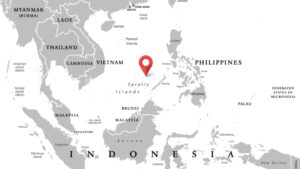
The group said that, unlike “state-sponsored” commemorations of the arbitral ruling’s victory, their action did not only focus on criticizing China as the sole violator of Philippine maritime rights in the country’s exclusive economic zone (EEZ). The group emphasized that, in reality, the US and its allies constitute a “clear and present danger” to Philippine national security and sovereignty.
The latest US threat is the planned construction of a 1,619-hectare economic security zone under the framework of the Pax Silica initiative, Pamalakaya said. The zone will be built in New Clark City in Tarlac and Pampanga, which will be designated as an “AI-native industrial acceleration hub.”
“A decade after the tribunal ruling, we are facing a bigger and more urgent threat to national sovereignty and territorial integrity–the U.S. direct military interventionism,” said Fernando Hicap, national chairperson of Pamalakaya. He added that under the guise of an economic zone, US facilities and installations are being built outright in the country, in collusion with the Marcos administration.
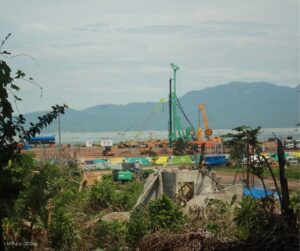
In addition, Pamalakaya criticized the US “rehabilitation” of the Sangley Point International Airport (SPIA) in Cavite City. The airport is located at the mouth of Manila Bay and has a direct route to the South China Sea. It will serve as a US military base and be integrated into the planned Luzon Economic Corridor.
“Similar to the installation of military facilities in at least nine EDCA sites across the country, the US aims to install in our civilian airport a forward operating base for its geopolitical agenda,” said Richard Catenza Pamalakaya-Cavite president. He noted that fishermen worry that the construction of a military facility in Manila Bay will disrupt the livelihoods of fisherfolk in Cavite, Bataan, and the National Capital Region.
The rogressive party-list of the poor Anakpawis, member of the Makabayan Coalition, also joined the mobilization at the US Embassy. It called on the Marcos administration to withdraw from these agreements with the US, which they claim put Filipinos at risk by escalating tensions toward an imperialist war against China.
“It is not speculation if we raise fear that these facilities are potential targets of US rival countries in the course of actual military confrontation. This will endanger civilian communities and infrastructures,” said Glo Fernandez, the party’s coordinator.
Anti-China, pro-US narrative
On July 12, the Marcos administration, led by US lackey Department of National Defense Secretary Gilberto Teodoro Jr, orchestrated grand commemorations across the country to mark the anniversary of the ruling. Aiming to stir the patriotism of Filipinos, the administration is using the anti-China sentiment as pretext to whitewash the image of US imperialism, and stand with it as master of the puppet Marcos regime.
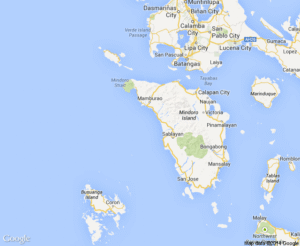
The Atin Ito Coalition of the pro-US Akbayan Party-list was the most active participant in these sham patriotic activities. The coalition was part of a march in Palawan led by the local government. While the coalition criticizes China, it turns a blind eye and remains silent against the direct presence of American troops and their war games in Palawan and other parts of the Philippines.
The Atin Ito Coalition also initiated the first public monument “dedicated to Filipino fishermen defending the country and rights in the WPS” in Quezon City. The coalition praised the fisherfolks for supposedly standing up to China, but offered no support for the voices of fishers opposing US war games, which impede their fishing activities due to “fishing bans.”