KM launches postering and grafitti operations for its anniversary
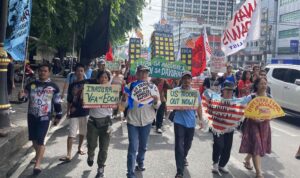
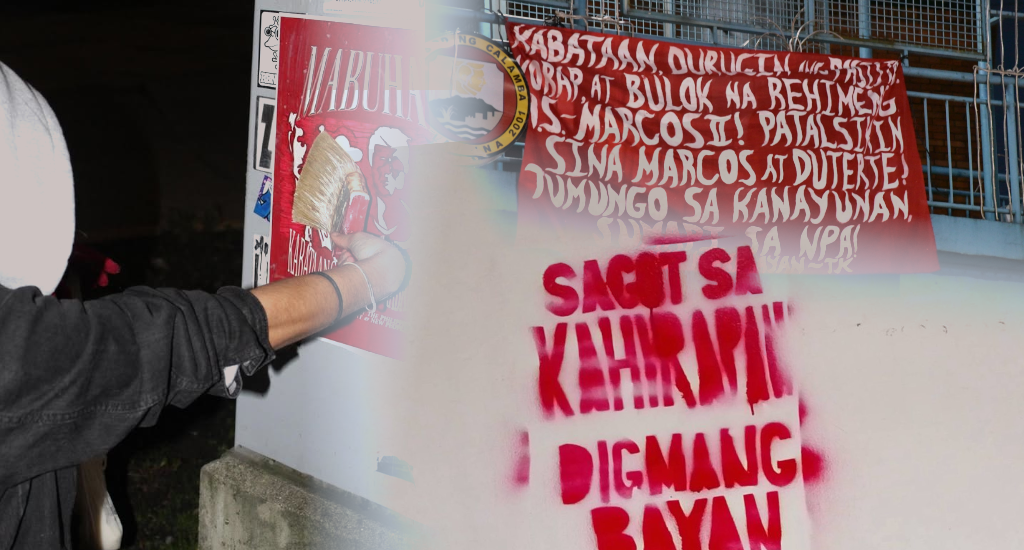
Marking its 61st anniversary, Kabataang Makabayan (KM) chapters in Manila and Laguna launched “dikit” (poster) and “pinta” (grafitti) operations (OP-OD) during the past two weeks. A KM chapter in Canada also reported holding a similar activity.
Comrade Jose Maria Sison founded KM on November 30, 1964. KM is the revolutionary organization of Filipino youth that supports and promotes the people’s democratic revolution. It is one of the allied organizations of the National Democratic Front of the Philippines.
In Manila, three chapters led the OP-OD at De La Salle University (DLSU)-Manila, DLS-College of St. Benilde (CSB), and the University of the Philippines (UP)-Manila.
“The revolution’s flame continues to blaze among the youth and students, whether in the countryside or here in the cities,” KM-Balangay Guiller Cadano and KM-Balangay Agaton Topacio said. They said that their members posted stickers and artworks on the DLSU-Manila and DLS-CSB buildings, including on one named after the bourgeois comprador Gokongwei.
The stickers and paintings carried calls for the youth to join the revolution, go to the countryside, and use their skills as intellectuals to fight for the interests of the oppressed masses.
“The crisis of corruption in government and the conflict between the reactionary Marcos and Duterte, the lack of opportunities, the threat of war and militarization provoked by the imperialist US, compels us now to join the revolution,” the two chapters stated. They added that this is the only way to defend the nation and protect ourselves from the worsening crisis.
KM-Balangay Maria Sheena Trinidad led the OP-OD at UP Manila. Some of the slogans posted and painted on the university walls read “Revolution is the Solution” and “Answer to Poverty, People’s War.”
KM-Balangay Rizalina Ilagan and KM-Southern Tagalog (KM-ST) members at UP Los Baños painted slogans supporting the people’s war on the walls of campus buildings. KM-ST also hung a streamer on the overpass at Calamba Crossing on November 30. Its message read: “Youth, crush the fascist, corrupt, and rotten US-Marcos regime! Oust Marcos and Duterte! Go to the countryside, join the NPA!”
A KM chapter in Canada composed of Filipino migrant and diaspora youth also reported launching the OP-OD. According to the chapter, spreading revolutionary activity among Filipino youth in Canada strengthens the revolutionary spirit that the Marcos regime and its imperialist allies cannot defeat.
Preparation and planning for OP-OD
One chapter reported that the propaganda officer had already led, convened and planned the actual OP-OD a month before. They collectively discussed and agreed on the OP-OD’s theme and design. They adapted the themes of the stickers and appeals to the character and distinct traits of the youth and students they wished to encourage and enlighten.
After the planning, the chapter spent the following weeks preparing artworks and designs for the stickers. The chapter assigned a team to gather and manage the materials needed for the OP-OD. The members agreed to include a QR code on the artworks to spread revolutionary media and statements, as well as the PRWC or Philippine Revolution Web Central, the revolutionary movement’s website,.
A week before carrying out the OP-OD, they held a series of command meetings and target site inspections. They also assigned and organized teams to be deployed in each building and area at these meetings. Some first time OP-OD participants were grouped together with more experienced members. This approach ensured careful and swift execution of the activity and safe withdrawal of the participants from the site.
The chapter also agreed on disguises for the comrades who would implement the OP-OD. They assigned “spotters” to each team to ensure security on the actual launch day of the OP-OD.
Amid all these preparations, the chapter adherence tightly to security protocols. Members took measures to prevent any leaks about the planned activity and timed the actual implementation carefully. The chapter also established a communication system through coded conversations to allow teams to exchange updates quickly. The chapter leadership encouraged members to refrain from transmitting information online or over the internet.