The scourge of high oil prices amid drought in Cagayan Valley
The weekly, nonstop, large-scale increase in oil prices plunges peasant livelihood in Cagayan Valley. They suffer a double whammy especially now a drought since the last week of February has affected rice fields, cornfields, and farms.
The region is expected to experience 11-20 dry days this April with even more days in May. Dry days are marked by less than one millimeter of rainfall. This means greater fuel consumption for water-pumping machines and land cultivation.
Gasoline prices in the region reached ₱95-₱97/liter, diesel ₱121-₱136/liter, and kerosene ₱148/liter in the last week of March. This results in twice the cost for machinery and irrigation, and higher prices for seeds, pesticides, and fertilizer because of transport. Prices are also being driven up by the Philippines’ total dependence on importing these goods, which is now being choked by the US war of aggression against Iran.
Manong Esto’s rice field
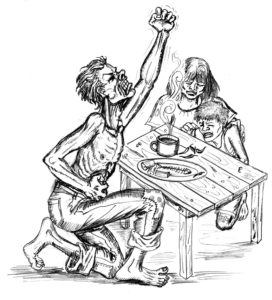
Manong Esto consumes as much as 245 liters of diesel to farm his one-hectare rice field in Cagayan. He uses it for the water pump, tractor, and kuliglig (mechanized hand tractor). Diesel in the province, which was at ₱56.5/liter when he planted in January, shot up to ₱122.31/liter on March 24, when his rice was already blooming, a critical stage for irrigation.
Manong Esto’s conservative estimate for his whole production’s diesel cost will reach ₱27,345.23, far from the projected ₱13,842.5 expenses had prices stayed at January levels. He is certain to pay higher for renting the reaper and hauling costs this April harvest. Fertilizer prices have also nearly doubled. Urea used to cost ₱1,600-₱1,700, but now costs ₱2,400 per 50 kilos, while Triple 14, which used to cost ₱1,600-₱1,700, is now ₱2,100.
Manong Esto spent a total of ₱74,846 in this production cycle. This excludes the free hybrid seed from the Department of Agriculture (DA), which was worth ₱12,000. He will get ₱76,692 if his harvests reach his target of 83 sacks of palay and sells dry palay at ₱28/kilo. He is set to earn only ₱1,845 for the entire four months of farming.
Manong Esto sighed, “This trend of continuous oil price increases and the persistently low price of palay will completely wipe out our livelihood.”
Even the DA admits that the soaring production costs will drop rice production in the country. The DA estimates a “worst-case scenario” of not reaching this entire year’s targetted 19.87 million metric tons (MT) of palay production. The country will fall short by 11,868 MT in the first half of 2026 and 112,522 in the second half.
Parched cornfields
Farmer Tatang Sisko lost ₱54,000 in his one-hectare cornfield in Isabela because of low yield and high production costs. He invested ₱70,000 for it.
He typically uses a water pump for irrigation but found it unsustainable when oil prices shot up. This stunted the corn which is usually as tall as Tatang Sisko. The supposedly large, heavy, and kernel-full ears are now small and sparsely filled.
His previous five to eight ton harvest from one hectare of cornfield yielded only one ton in March. The trader even forced down the price of his corn to ₱12/kilo because of its “low quality.” Tatang Sisko insisted and sold it for ₱16/kilo (₱16,000 in total), still far below the ₱21/kilo he originally bargained for.
In the case of some cornfields, farmers harvested only ten sacks from one hectare. With this, farmers now consider wise to abandon farming and leave the land idle, free from spending and toiling.
Useless regime
According to the Pambansang Katipunan ng mga Magbubukid-Cagayan Valley (PKM-CV), the continued collapse of harvests will worsen the country’s food crisis. This is clear in the current ordeal of farmers in the region that is the second-biggest rice producer and the country’s leading corn producer.
The Marcos regime is heavily accountable for its uselessness in controlling oil prices and for its rotten irrigation facilities and services. It has taken no meaningful action and instead offered only a token ₱2,345 in financial aid to a very limited number of farmers.
“Our ordeal is a concrete picture of the intensifying scourge of imperialism, feudalism, and bureaucrat-capitalism on the peasantry,” according to PKM-CV. In line with this, the group called on farmers to strengthen unity in the region and vigorously advance the people’s democratic revolution.