Balikatan 2026 heightens endangerment of the Filipino people
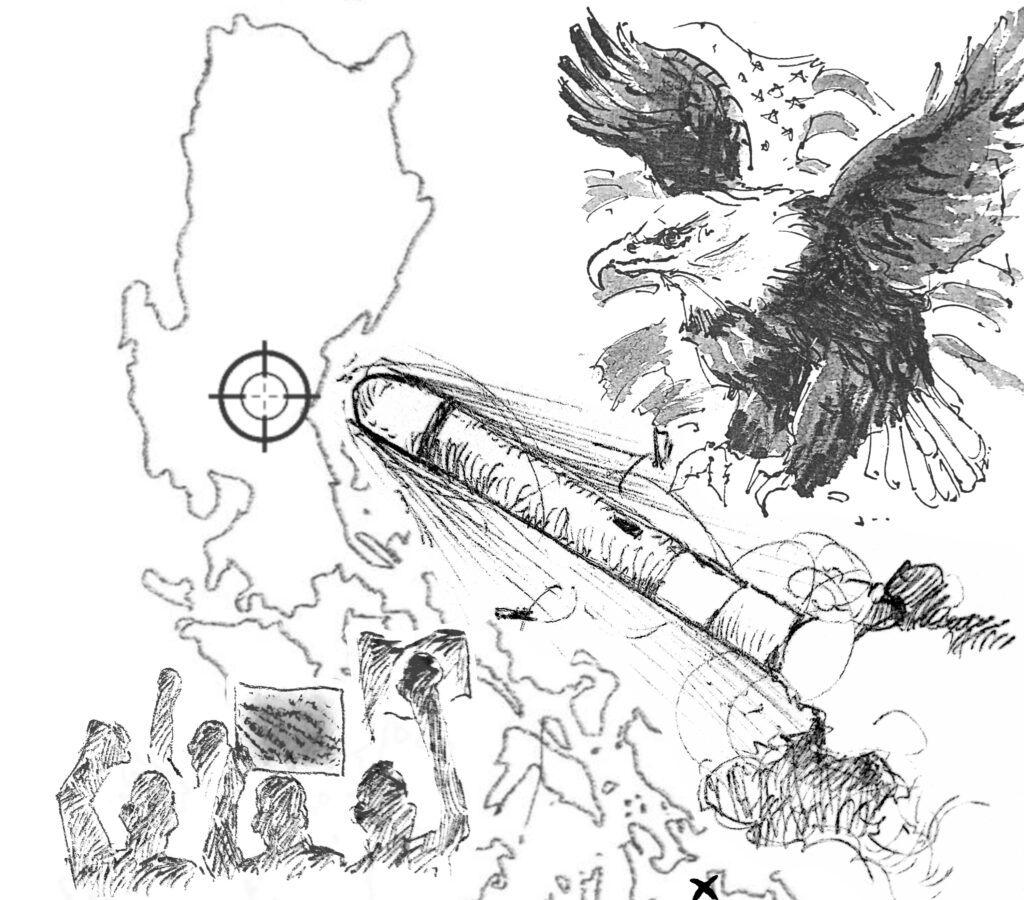
Balikatan becomes more dangerous every year to the Filipino people. On May 5, the US launched a Tomahawk missile from the civilian airport in Tacloban City using the Typhon Mid-Range Capability missile system.
The Tomahawk missile flew for 48 minutes over a distance of 640 kilometers toward its target in Laur, Nueva Ecija. The Tomahawk is called a low-level skimming missile, meaning it “skims over the terrain” or follows the contour of the terrain, or in cities, the space between tall buildings. It passed over densely populated areas in three regions, including Metro Manila, irresponsibly risking the lives of millions of Filipinos.
The US and its puppet Marcos regime did not issue warnings to those along the missile’s path, except for fisherfolk in nearby fishing grounds in Tacloban City who were told to “exercise extreme caution in going out to sea” while the Tomahawk Land Attack Missile operation was conducted from May 5 to 7. The US launching a “live-track” missile without Filipinos’ knowledge, seriously violating the country’s security and sovereignty.
The US claims the Tomahawk missile posed no danger to civilians. However, a similar missile destroyed a school in Minab, Iran on February 28, where more than 170 were killed, mostly young girls, which the US insisted was a “program error.”
The use of the Tacloban City airport aligns with the US military’s testing of civilian facilities for military purposes emphasized in the current Balikatan. Earlier, the US also used civilian ports in Cebu and Cagayan de Oro, as well as commercial ro-ro (roll on-roll off) ships, for the rapid transfer of war matériel from Mindanao to Luzon.
The Typhon missile system used to launch the Tomahawk is among the war matériel the US smuggled into the Philippines in 2024 and secretly stored in “undisclosed locations” nationwide. China, along with Russia, considers this missile system an offensive weapon and a threat to their security, and has warned against its presence in the Philippines. The deployment of an undisclosed number of missile launchers in the Philippines accelerates the pace of the US-instigated imperialist war against China.
Offensive maneuvers
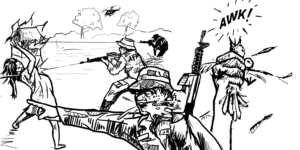
Launching the Tomahawk is one of 500 “combined activities” that the US plans to carry out in the country in 2026. A US spokesperson said most of these activities are “discreet” or concealed from the public to avoid being “provocative.” These are integrated into large war games involving 17,000 troops from the US, Philippines, Japan, France, Canada, Australia, and New Zealand. Contrary to the claims of the US and the AFP, these war games are offensive maneuvers, not “defense” against an “attacking enemy.”
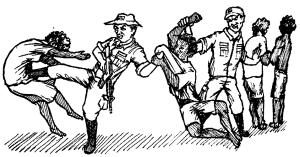
These include the Multilateral Maritime Exercise and Integrated Air and Missile Defense in Subic Bay, Zambales from April 20–29. American and other troops in these operations forcibly boarded an “enemy” ship to seize it. The war simulation banned 6,000 fisherfolk in 21 barangays from going out to sea, effectively depriving them of livelihood for nearly 10 days.
The US conducted “coastal defense” operations in Palawan and Batanes using HIMARS and NMESIS. A one-day mock “counter-landing” operation against an “enemy vehicle” was held in Ilocos Norte using planes, helicopters, drones, missiles, bombs, guns, and other war matériel in the so-called “Distinguished Visitors’ Event.” Balikatan effectively showcased weapons where Japan, the US, France, and Canada displayed their capabilities before 17 invited “observer” countries.
A combined amphibious landing (assault from the sea) was carried out in the Cagayan towns of Abulug, Ballesteros, and Aparri using amphibious vehicles, ships, and aircraft. Fisherfolk in Abulug were also banned from sailing while Americans repurposed their coastline into a playground for amphibious and ship-to-shore operations.