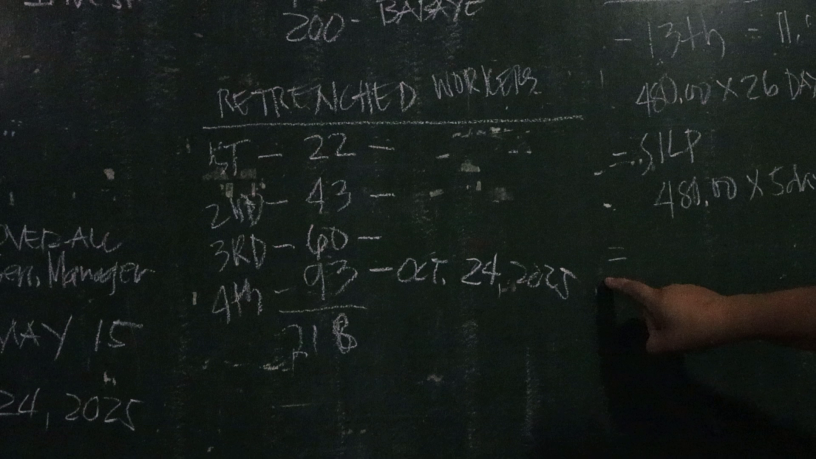
Oil palm plantation illegally dismisses 93 workers in Negros Occidental
For the fourth time, Hacienda Asia Plantations Inc. (HAPI Inc.), a partnership of the Consunji family’s Sirawai Plywood and Lumber Corporation and Alfred Joseph Araneta, carried out mass dismissal on October 24 in Barangay Gatuslao, Candoni, Negros Occidental. The company dismissed 93 workers, following previous layoffs of 22, 43, and 60 workers since the beginning of the year.
HAPI Inc. has dismissed a total of 218 workers this year. The company employs an estimated 600 workers. It has gradually terminated workers as at least 3,000 hectares of its 6,652.32-hectare oil palm plantation have already been planted, and claims currently requiring less labor.
The National Federation of Sugar Workers (NFSW) and Kilusang Mayo Uno (KMU) condemned the layoffs. “This reflects the worsening capitalists’ attacks against workers and the Marcos government’s anti-worker character,” the KMU stated.
In an interview with the alternative Negros-based media Paghimutad, NFSW spokesperson Mario Tapi-on said the dismissals were systematic. The workers had been employed for two to three years and were terminated without due process or clear justification.
HAPI Inc. did not provide compensation or separation pay for many of the dismissed workers. Company supervisors warned them not to file complaints at the Department of Labor and Employment.
Even before the mass layoffs, the company had already stopped remitting benefits and insurance such as SSS and PhilHealth, despite being automatically deducting from workers’ wages. The workers were also denied 13th month pay, service incentive leave, and other legally mandated compensation.
Some workers were arbitrarily declared AWOL (absence without leave). Others were downgraded to casual status despite years of regular employment.
Most HAPI Inc. workers were farmers whose land had been grabbed by the company to establish the oil palm plantation. The company deceived them into surrendering their land in exchange for permanent plantation employment. Years later, they now suffer from hunger and abuse under HAPI Inc. after losing both their land and livelihood.
The NFSW appealed to remaining workers not to sign any documents or papers from HAPI management. The group also urged them to file complaints with DOLE. “They must organize and form a union to protect their rights,” Tapi-on said.
He added that beyond the workers’ demands for unpaid wages and benefits, they must unite to reclaim the land seized by HAPI Inc.
In June, the Environmental Management Bureau (EMB)’s cease-and-desist order temporarily halted HAPI Inc.’s operations after revelations that the company had failed to secure the required Environmental Compliance Certificate (ECC) for its operations.
Since 2023, farmers and indigenous Ati people have continuously mobilized against HAPI Inc., which has been trying to evict them for plantation expansion. The targeted area is classified as forest land, and 4,000 hectares of it constitute Ati ancestral domain.
Colluding with the local government of Candoni, the Department of Environment and Natural Resources (DENR), the National Commission of Indigenous Peoples (NCIP), and Armed Forces of the Philippines units, the Consunji family seized control of the public land. The company was granted permission to use the land for 25 years, with a 25-year extension option.