Social Media Registration Proposal: Surveillance and suppression of right to expression
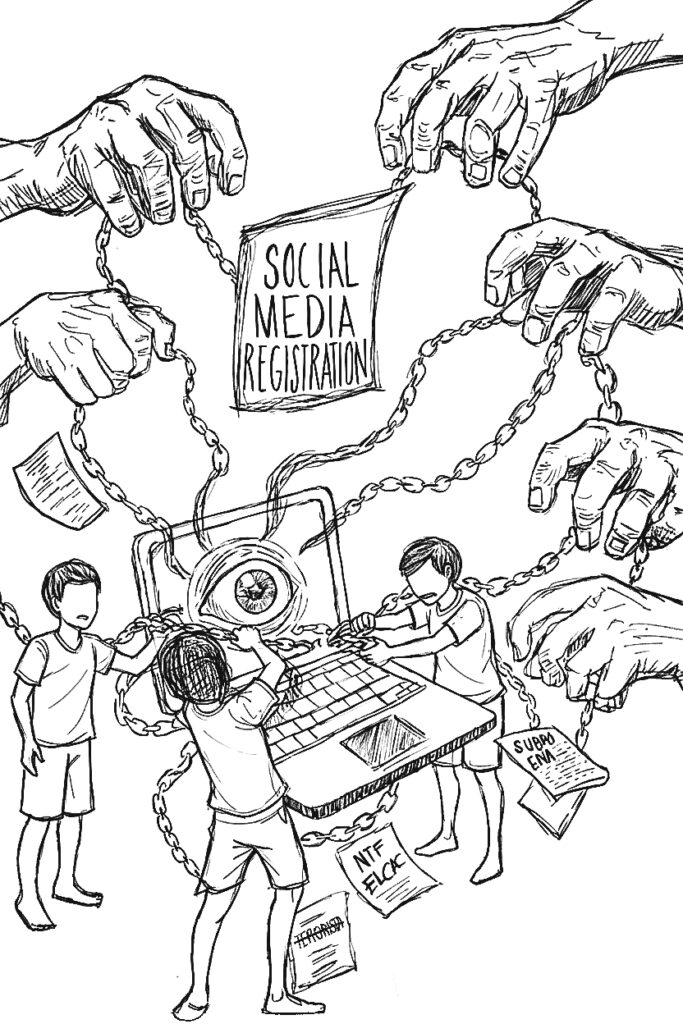
On January 21, the Department of Information and Communication Technology pushed a draft policy requiring Filipinos to register before opening an account on any social media platform. The proposed law would require users to provide their real names and other personal data to enable them to use their own accounts. Parental verification would be mandatory for users aged 18 and below.
Platforms would also be obliged to institute strict identity verification, including facial image capture of users. This allegedly aims to combat online crimes such as scams, identity theft, and child sexual abuse and exploitation. The same policy is already being implemented in the European Union and is being pushed across Southeast Asia. Senator Panfilo Lacson first proposed a similar policy in July 2025.
According to the groups Agham and the Computer Professionals’ Union, the DICT raised legitimate issues but the policy flagrantly violates social media users’ privacy. The agency shifts the burden of addressing online crimes onto ordinary Filipinos instead of holding the corporations that own social media platforms accountable. It normalizes surveillance and the collection of individuals’ private information.
This measure clearly aligns with the US-Marcos regime’s intensifying surveillance, censorship, and suppression of press freedom and the people’s right to expression. It is no different from failed laws such as the SIM Registration Law and the Cybercrime Prevention Act, which handed over people’s sensitive data to repressive state agencies and private corporations. These laws failed to curb online crimes, which have persisted and even worsened.
Weaponizing social media for fascism
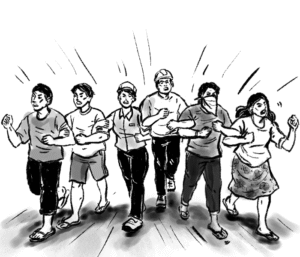
Social media comments expressing the people’s anger against the US-Marcos regime’s corruption and fascism sharply increased in December 2025 and January this year. Outrage and frustration prompted many to declare the justness of the armed struggle led by the Communist Party of the Philippines and the New People’s Army. Comments coincidentally surged with the Party’s anniversary, when statements, photos, and videos of the celebration circulated online. Most comments voiced discontent with the rotten system and a desire for revolution to change the country’s corrupt order.
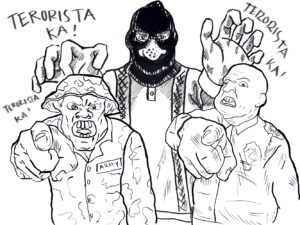
Aiming to suppress this upsurge, the Armed Forces of the Philippines (AFP) threatened those who spoke out accusing them of “inciting anti-government rebellion.” The NTF-Elcac dismissed the grievances as “propaganda” and falsely portrayed them as the Party’s “massive social media campaign.” Fearing the growing public disenchantment toward the Marcos regime, the agency and AFP launched an online “troll offensive” using PR firms and paid trolls. The NTF-Elcac mobilized tens of thousands of AFP soldiers to flood social media with ridicule and mockery against anyone critical of the regime, particularly those condemning military abuses. They also openly flooded reports of human rights violations with fake news, manipulating public opinion through censorship of the media.
Within NAP-UPD framework
The online troll campaign, intensified surveillance, and targeting of state critics are framed under the National Action Plan for Unity, Peace, and Development (NAP-UPD). With its Strategic Communication component, NTF-Elcac seeks to control information channels, block recruitment, and combat revolutionary movement “propaganda” inside and outside the country through disinformation, psychological warfare, and Red-tagging. The agency spreads the notion that all criticism of corruption and repression is the revolutionary movement’s propaganda, while branding anti-corruption youth protests as “terror grooming,” to justify attacks on democratic rights to free expression and organizing.
If approved, forced social media registration will not only increase the state’s gathering of private information and opinions but will further systematize large-scale state surveillance. Like its predecessors, the law will certainly fail to stop online crime. Like the forced SIM card registration, it will take away access of millions of Filipinos to vital communication services and deprive them of a voice. The state will gain greater ease in controlling opinion and news, and targeting its critics.