Marcos’ new general education reform Exposes further the rotten education system
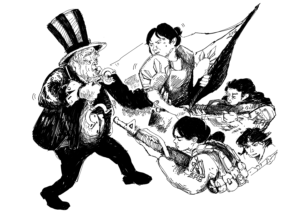
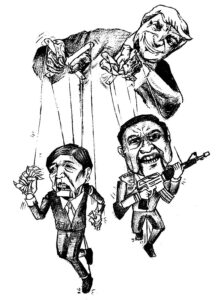
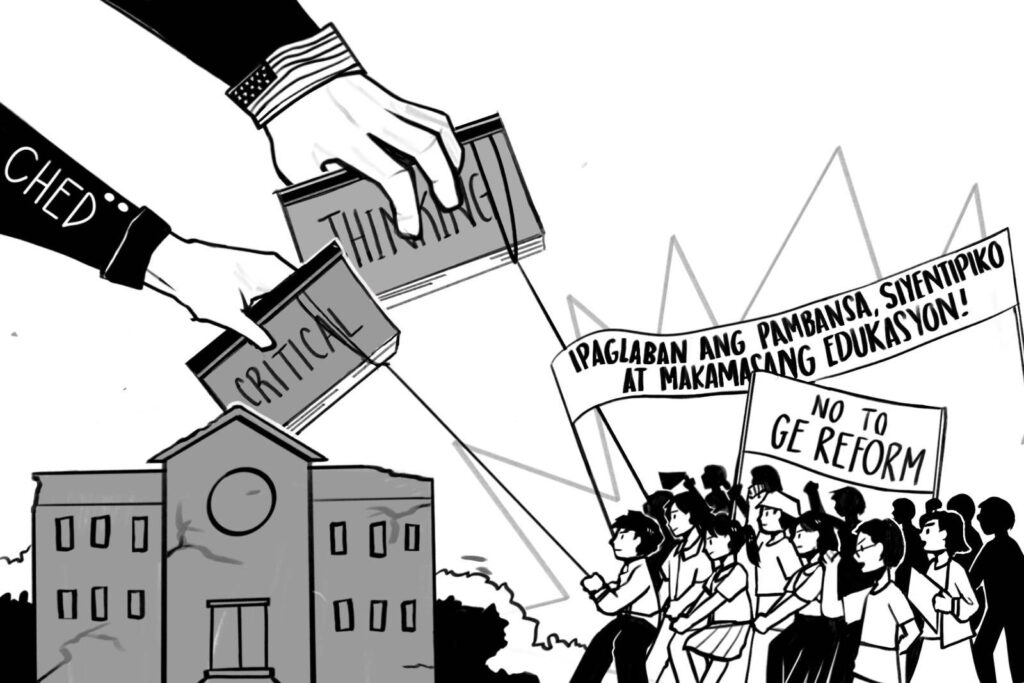
The US-Marcos regime’s new reform in general education (GE) further exposes the Philippine rotten system. The Commission on Higher Education (CHED) is pushing the proposed Reframed General Education Curriculum Component (RGECC). It aims to cut required GE subjects from the current 36 units to only 18. It targets pilot (experimental) implementation in academic year 2026–2027, which will again reduce courses on history, literature, and ethics.
The GE courses provide a basic foundation in college such as Filipino, literature, history, philosophy, and ethics, which are said to help develop critical consciousness. The RGECC follows the 2013 reform (CHED Memorandum Order No. 20) that reduced GE units from 42–64 to 36 in line with “globalization,” K-12, and ASEAN integration, which removed Filipino and Literature as key subjects.
Academics and teachers oppose
A series of forums and protests in May pushed the CHED to announce on May 13 the postponement of the experimental implementation of the RGECC. The sector earlier gathered signatures for a petition against the RGECC. National artists, professors, and legislators signed.
The General Education Movement (GEM) consider the postponement a victory of collective resistance, but it is not enough because the central problem remains: the restructuring of education in line with market forces and neoliberalism. The RGECC aims to make students “job-ready” and mold them into docile and submissive labor for foreign corporations and the big comprador bourgeoisie, while removing the “human” aspect of learning. It also threatens the livelihood of an estimated 60,000–90,000 contractual, part-time, and non-permanent teachers who may be laid off.
GEM pushes for the total scrapping of the RGECC. It also calls for a genuine and national review of the current GE curriculum, the democratic drafting of a new curriculum, and a ban on all forms of job termination that will result from the GE revision.
Orientation of the education system
The revolutionary group Katipunan ng mga Gurong Makabayan (Kaguma) described the reform as the “most aggressive” structural change in education within the framework of neoliberalism. While recognizing the growing protests against the reform, the group stated that the people should not fall into the trap of calling to “reverting” to the core purpose of GE.
GE originated from the Great Books program called Contemporary Civilization of Columbia University. This became the model of GE worldwide as a bourgeois response to the “barbarism” that supposedly resulted in the First World War. GE was used in the hope of creating a “more peaceful, humane, and just society” amid ongoing imperialist conflicts.
At its core, the orientation of GE in the Philippines is fundamentally distorted because of its foundations and history. “The only remedy to this excessive commercialization and corporate stranglehold is a militant and unyielding mass movement that advances an education designed for national industrialization and genuine national liberation,” the group stated.
Kabataang Makabayan (KM) unites with the struggle against the rotten education system. It said the Filipino youth must continue to be mobilized to block the GE reform that will further push the youth into ignorance. “The youth must fight for an education that serves the interests of the nation and the people,” KM stated.
Kaguma, KM, and the entire National Democratic Front of the Philippines advance a patriotic, scientific, and mass-oriented education as an alternative to the country’s colonial, commercialized, and repressive education system. This type of education can only be fully achieved and realized by overthrowing the current rotten semicolonial and semifeudal Philippine society through a people’s democratic revolution.